Lab best practices for safe, effective peptide research

TL;DR:
- Peptide research requires tailored safety practices due to bioactive compounds that can pose unexpected hazards during handling. Implementing risk-based assessments and specific PPE protocols minimizes exposure risks, especially when working with powders or aerosols. Maintaining disciplined storage, accurate labeling, and daily procedural checks ensures research integrity and personnel safety in peptide laboratories.
Peptide research demands more than familiarity with standard biosafety procedures. Even highly trained laboratory personnel can face unexpected hazard scenarios when handling compounds that remain bioactive at trace concentrations, degrade rapidly with minor temperature fluctuations, or generate fine aerosols during reconstitution. Generic lab checklists rarely capture these peptide-specific variables in enough detail, which means researchers relying solely on broad institutional guidelines may be operating with significant blind spots. This guide offers actionable, evidence-based practices tailored specifically to peptide research environments, walking through risk assessment, PPE selection, storage discipline, and daily operational habits that protect both personnel and research integrity.
Table of Contents
- Establishing a hazard-based risk assessment framework
- Personal protective equipment (PPE): best practices for peptide labs
- Storage, handling, and labeling: ensuring peptide integrity
- A side-by-side comparison: peptide-specific practices vs. generic lab protocols
- Checklist: daily practices for maintaining a compliant peptide lab
- Where seasoned labs still stumble: real-world peptide safety pitfalls
- Take your peptide research further with Peppy&Me
- Frequently asked questions
Key Takeaways
| Point | Details |
|---|---|
| Risk assessment is essential | Customize lab safety based on peptide-specific hazards, not blanket guidelines. |
| Upgrade your PPE | Proper PPE selection reduces exposure, especially during aerosol-generating procedures. |
| Prioritize proper storage | Peptide integrity relies on controlled cold storage and strict labeling. |
| Daily habits prevent incidents | Routine cleaning, logging, and checks catch issues before they become compliance failures. |
| Continuous improvement | Regularly update protocols and encourage staff feedback to stay ahead of emerging risks. |
Establishing a hazard-based risk assessment framework
With the importance of tailored practices established, we start with how to structure your lab’s approach at the foundational level: risk assessment.
Most laboratory safety incidents are not caused by unknown hazards. They result from inadequate characterization of known risks. In peptide research, this distinction matters enormously because the hazard profile of each compound varies considerably. A synthetic GLP-1 receptor agonist carries different exposure risks compared to an antimicrobial peptide or a growth hormone-releasing peptide. Treating all compounds identically, under a one-size-fits-all framework, creates both under-protection and over-caution.
Risk-based safety protocols are now the standard recommendation from NIH, CDC, and OSHA, replacing the older model of blanket PPE requirements that applied identical precautions regardless of actual hazard. A risk-based approach compels researchers to evaluate each compound’s specific properties before determining protective measures. This produces smarter, more targeted safety decisions.
How to conduct a peptide-focused lab risk assessment:
Identify the compound’s biological activity. Determine whether the peptide acts on receptors, influences cellular signaling, or exhibits any hormonal, antimicrobial, or cytotoxic properties. Bioactive peptides require stricter inhalation and skin contact controls.
Assess the form of the material. Lyophilized (freeze-dried) powders present higher aerosol and inhalation risks than reconstituted solutions. Reconstituted liquids carry needle-stick and splash risks during handling.
Review available toxicological data. Even when full toxicity profiles are absent (as is common with novel research peptides), gather all available pharmacological and structural data to inform your hazard rating.
Evaluate the quantities involved. Working with milligram quantities differs substantially from microgram-scale research. Higher quantities increase both exposure potential and decontamination demands.
Assess personnel-specific factors. Consider whether any team members have known sensitivities, are pregnant, or are immunocompromised. These factors change the acceptable exposure thresholds.
Document all findings formally. A written risk assessment, reviewed and signed by the principal investigator, establishes accountability and creates a reference point for future audits.
“Risk assessment in a laboratory setting is not a one-time administrative task. It is a living document that must evolve alongside the compounds being studied, the personnel conducting research, and the procedures they follow.”
Once the risk assessment is complete, communicate findings to your entire team. Post compound-specific hazard summaries at workstations, include them in onboarding documentation, and reference them during protocol reviews. Labs that establish secure access for peptides and store compound information in centralized, access-controlled systems reduce the chance of critical safety data being overlooked by team members working across shifts or multiple projects.
Personal protective equipment (PPE): best practices for peptide labs
Having grounded your practice in risk-based assessment, you next need to choose and adapt your protective gear accordingly.
The default protective equipment for most research labs includes a lab coat, nitrile gloves, and chemical splash goggles. For routine peptide handling involving reconstituted solutions in sealed vials, this combination is generally adequate. However, the moment your workflow involves lyophilized powders, high-concentration aerosols, or aerosol-generating procedures, that baseline no longer holds.
Core PPE requirements for peptide labs:
- Lab coat: A full-length, long-sleeved lab coat made from flame-resistant or chemical-resistant material, dependent on the hazard profile. Disposable Tyvek gowns are appropriate when working with compounds that could contaminate reusable fabric.
- Nitrile gloves: Double-gloving is strongly recommended when handling peptide powders or during reconstitution. Inspect gloves for micro-tears before use, and change them immediately after any contact with concentrated material.
- Chemical splash goggles: Vented goggles that conform to the face are preferable over safety glasses, which allow splash entry from the sides.
- Respiratory protection: N95 respirators or half-face respirators with particulate filters should be worn during any powder-handling or reconstitution step that could generate aerosols. This is not universally observed in peptide labs, but the risk justification is clear.
Research on aerosol-generating procedures in high-risk laboratory environments is compelling. A Korean study found that diagnostic sputum testing (DST) technicians had a 21.5-fold higher rate of tuberculosis infection than the general population, directly attributable to aerosol exposure from standard-appearing tasks. While peptide labs do not carry TB transmission risk, the principle is universally applicable: activities that look routine can generate hazardous aerosols, and respiratory protection must match that actual risk level, not the perceived one.
When to upgrade your PPE:
- Full-face shields instead of goggles when handling large-volume reconstitutions or highly irritating compounds
- Powered air-purifying respirators (PAPRs) when working with unknown peptides that lack full toxicological data
- Double-gloving with an outer nitrile and inner latex layer when tactile sensitivity is needed alongside maximum protection
Fume hoods and biosafety cabinets are frequently underused in peptide research because most peptides are not classified as biohazards. However, certain research-grade peptides with biological activity, particularly those affecting immune function or derived from biological sources, warrant handling inside a biological safety cabinet (BSC). For purely synthetic peptides with no known biohazard classification, a chemical fume hood offers adequate protection against aerosol and volatile exposure.
Pro Tip: Contact your peptide vendor for compound-specific handling recommendations before finalizing your PPE selection. Reputable suppliers include safety data sheets and handling notes with their products that often address exposure concerns not covered by standard regulatory guidance.
Storage, handling, and labeling: ensuring peptide integrity
With safety gear in place, everyday habits around handling and storage will dictate the reliability and safety of your results.
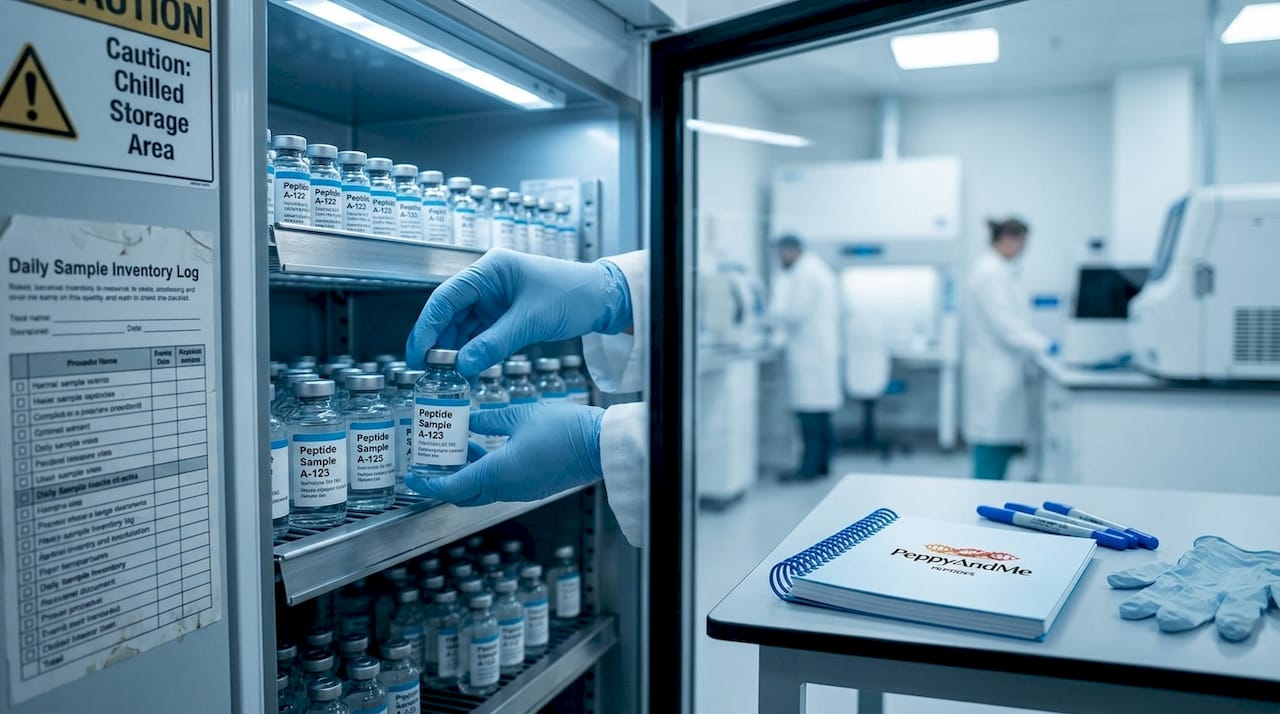
Proper storage is arguably where most avoidable problems in peptide research originate. Unlike small-molecule chemical reagents, peptides are structurally sensitive. Aggregation, oxidation, and hydrolysis can occur under conditions that would leave other compounds unaffected. Preserving both research validity and personnel safety depends on disciplined storage practices applied consistently.
Step-by-step storage protocol:
Assess the storage temperature required per compound. Most lyophilized peptides remain stable at negative 20 degrees Celsius for 12 to 24 months. However, some are susceptible to cold-chain disruption even at freezer temperatures and require negative 80 degrees Celsius storage.
Minimize moisture exposure. Freeze-thaw cycles and desiccation risks are among the most common and least documented causes of peptide degradation. Store lyophilized peptides with desiccant and bring them to room temperature before opening vials, to prevent condensation forming on the cold material.
Segregate peptides by hazard class. Keep peptides with hormonal, cytotoxic, or receptor-active properties in separate, clearly marked storage sections from inert or low-activity compounds.
Implement a first-in, first-out (FIFO) inventory system. Rotate stock so that older vials are used before newer ones, reducing the risk of using expired material without realizing it.
Log all temperature data. Continuous temperature monitoring with a calibrated data logger and documented daily manual checks creates a dual verification system that supports compliance and prevents silent temperature excursions.
Labeling best practices:
- Every vial must be labeled with compound name, concentration, lot number, date received, date of reconstitution (if applicable), and expiration date.
- Use tamper-evident labels that show visible signs of removal or alteration.
- Color-code hazard categories when working with multiple compounds to allow quick visual differentiation at a glance.
- Never store unlabeled vials, even temporarily. Unlabeled containers are a compliance violation and a safety risk.
Spill management:
Spills of reconstituted peptides require immediate, structured response. Contain the spill with absorbent material, avoid generating additional aerosol, and apply appropriate decontamination solution per your risk assessment. Discard all contaminated materials in labeled biohazard or chemical waste bags, depending on compound classification. Document the incident.
Pro Tip: When learning how to source tirzepatide peptides safely or any other research-grade compound, verify that the supplier provides full documentation including lot numbers, purity certificates, and sterility testing results. This documentation is not just useful for quality assurance; it supports your lab’s compliance record in the event of an audit.
A side-by-side comparison: peptide-specific practices vs. generic lab protocols
Now, to clarify exactly where standard operating procedures for peptides differ from generic lab protocols, let us look at a direct, side-by-side comparison.
Standard laboratory safety protocols are designed with broad applicability in mind. They cover the baseline: appropriate PPE, chemical storage principles, waste disposal, and emergency procedures. But peptide-specific nuances extend well beyond these minimums, and researchers working in this space benefit from understanding precisely where the gaps exist.
| Safety practice area | Generic lab protocol | Peptide-specific protocol |
|---|---|---|
| PPE selection | Based on chemical class (flammable, corrosive, toxic) | Based on biological activity, form (powder vs. solution), and aerosol potential |
| Storage conditions | Standard chemical refrigeration or freezer | Compound-specific temperature, moisture control, and desiccant requirements |
| Labeling requirements | Chemical name and hazard class | Name, concentration, lot number, reconstitution date, and expiration |
| Decontamination | Standard chemical neutralization | May require enzymatic degradation or pH adjustment for bioactive residues |
| Waste disposal | Chemical waste streams by class | May require biohazard stream depending on peptide’s biological source or activity |
| Dose documentation | Not typically required | Critical, especially for hormonally or immunologically active peptides |
| Aerosol precautions | Only for classified hazardous chemicals | Required for all powder-form peptides during reconstitution |
| Freeze-thaw tracking | Rarely tracked | Must be logged per vial to preserve potency and detect degradation |
| Vendor documentation | Certificate of analysis for chemicals | Purity, mass accuracy, endotoxin, sterility, and heavy metals testing required |
Using a peptide dose calculator for precise measurement during research is one practical way to reduce dosing errors, which represent both a research validity concern and, depending on the compound, a personnel safety issue. Accurate dosing documentation also supports reproducibility and regulatory traceability.
The table above makes the key differences visible in a structured format, but the underlying principle is consistent: peptide research involves variables that generic protocols were not designed to address. Residual bioactivity is perhaps the most important. A peptide with receptor-binding properties does not simply become inert once a procedure ends. Surfaces, equipment, and waste materials may retain functional peptide residue at concentrations capable of producing biological effects.
Checklist: daily practices for maintaining a compliant peptide lab
Having distinguished between the generic and peptide-specific regimes, use this daily checklist to keep your lab on track.
Consistent daily practices, particularly diligent record-keeping and temperature logging, are what separate labs with strong compliance records from those that accumulate small errors until they become significant problems. This checklist is designed for practical use by bench-level researchers and lab managers alike.
Start-of-day checks:
- Verify that all cold storage units are at correct, logged temperatures before beginning any work
- Confirm PPE supplies are adequately stocked and that no equipment is damaged or expired
- Review the day’s protocols and confirm that compound-specific risk assessments have been consulted
- Check that all vials to be used are correctly labeled and within their stated stability window
During-procedure practices:
- Conduct all powder handling and reconstitutions inside a fume hood or BSC with appropriate respiratory protection in place.
- Change gloves between compounds and after any contact with concentrated material.
- Use a calibrated scale or the lab’s dose calculator for all measurements, and document results immediately.
- Record each freeze-thaw cycle for every vial used, noting the date, time, and person conducting the procedure.
- Dispose of sharps, contaminated materials, and waste immediately into the correct waste stream. Do not allow accumulation.
Peer verification for critical steps:
Certain steps in peptide research carry enough risk of error that a second researcher should independently verify the action before proceeding. These include reconstitution of high-potency compounds, labeling of newly prepared solutions, and calculation of dosing concentrations. This peer-check system does not slow research significantly, but it substantially reduces both error rates and compliance risk.
End-of-day closeout:
- Log final temperature readings for all cold storage units
- Document any near-miss incidents, spills, or unexpected observations in the lab incident log
- Verify that all compounds are properly sealed, labeled, and returned to storage
- Wipe down all work surfaces with appropriate decontamination solution
Pro Tip: Explore the peptide research blog for regularly updated guidance on protocol changes, compound-specific handling notes, and safety recommendations from researchers active in the field.
Near-miss reporting: Most labs have formal incident reporting systems for actual accidents, but near-miss reporting is equally important and frequently underused. A near-miss is any event that could have caused harm but did not. Documenting these events identifies systemic weaknesses before they cause real harm, and creates a culture of transparency that ultimately makes the lab safer for everyone.
Where seasoned labs still stumble: real-world peptide safety pitfalls
After implementing best practices, continual scrutiny and learning from real-world lab experience remain vital.
There is a widespread and understandable assumption that experienced lab personnel are safer than less-trained counterparts. In aggregate, this is true. But the specific failure modes of experienced researchers are different, and in some ways more insidious, than those of newcomers. Novices make errors from ignorance. Experienced researchers make errors from overconfidence.
The most common unsafe behaviors observed in established peptide labs are not violations of obscure regulations. They are shortcuts applied to well-understood procedures that researchers have performed hundreds of times. Skipping double-gloving because reconstitution “only takes a minute.” Omitting respiratory protection for powder handling because “the quantity is small.” Delaying the documentation of a freeze-thaw cycle because the data will be added later, and then forgetting. These are not ignorance failures. They are behavioral failures, and they are far harder to train out of people.
Established protocols are only as effective as their day-to-day application. A safety system that exists on paper but tolerates routine shortcuts is, by definition, not functioning as designed. The fix is not more rules. It is more honest self-assessment and peer accountability.
Risk assessments age. When a lab introduces a new peptide, changes a supplier, brings on a new researcher, or modifies a core procedure, the existing risk assessment needs to be revisited immediately. Not annually. Not at the next scheduled review. At the point of change. This is the standard that major safety authorities recommend, and it is the standard that prevents the most common category of incident: the one that occurs in a familiar setting, with a familiar compound, because something changed and nobody formally accounted for it.
Perhaps the most underused safety intervention in peptide research is post-incident transparency combined with anonymous feedback mechanisms. Most labs conduct post-incident reviews after accidents. Fewer create structured opportunities for researchers to report concerns, near-misses, or procedural observations without fear of repercussion. Anonymous reporting systems, whether digital or physical, consistently surface issues that formal audits miss. They are inexpensive, require no specialized training, and generate safety intelligence that no checklist can replicate.
For labs exploring new compound categories, reviewing a resource like the tesamorelin research guide provides a useful model of how compound-specific documentation, handling instructions, and risk context should be structured. Applying that level of specificity to every compound in your inventory is the standard that high-performing peptide labs maintain.
The uncomfortable truth is that safety culture, not safety equipment, is the most reliable predictor of long-term compliance. Labs that invest in culture, through open communication, non-punitive reporting, and genuine leadership commitment to daily practices, outperform labs with superior equipment but weaker behavioral norms.
Take your peptide research further with Peppy&Me
Ready to strengthen your compliance and research quality? Here’s how Peppy&Me supports modern labs.
Maintaining the standards described in this guide depends on having access to materials you can actually trust. Impure, mislabeled, or poorly documented peptides undermine both safety and scientific validity, regardless of how disciplined your lab protocols are.
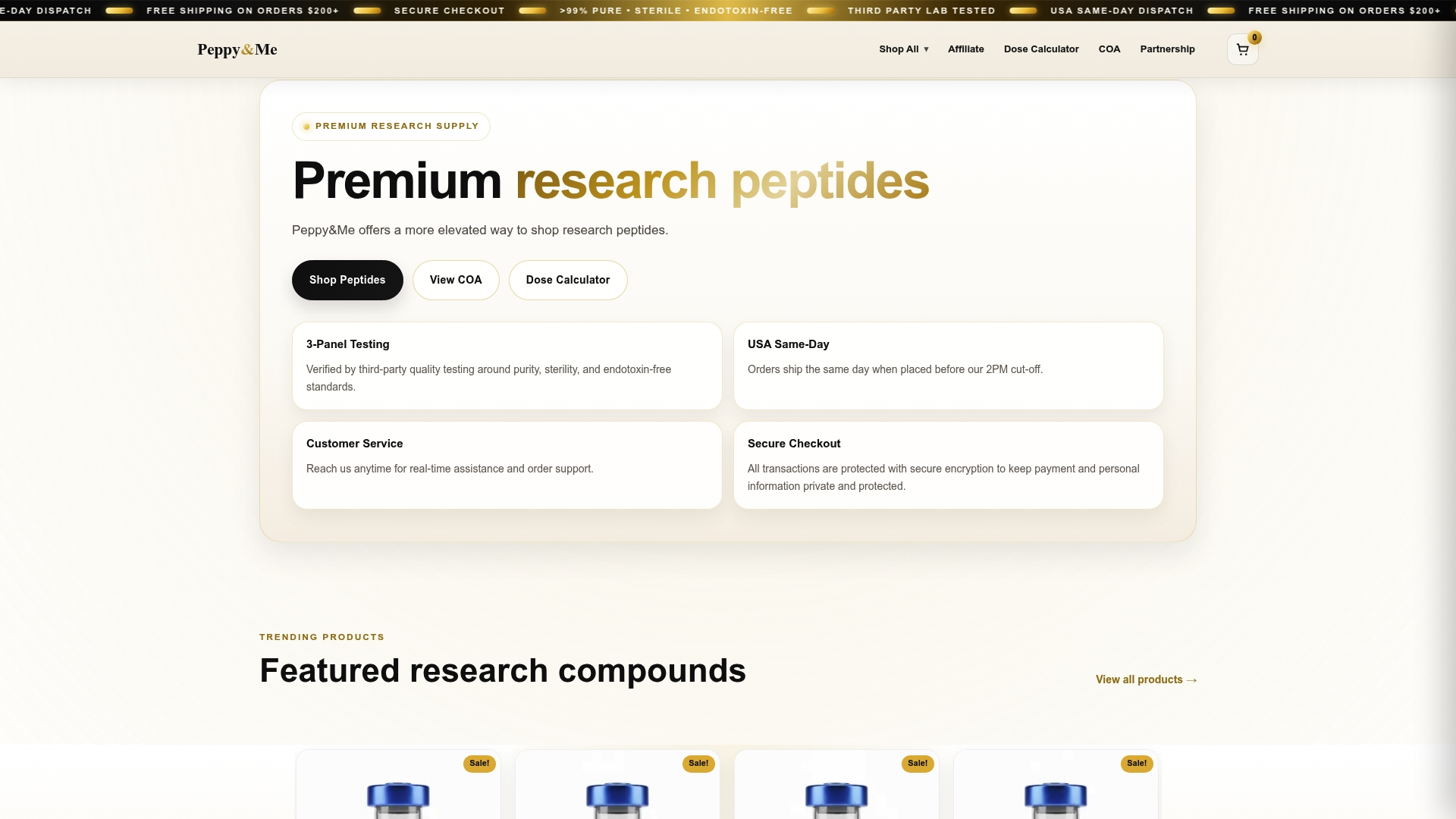
Peppy&Me provides high-quality research peptides that are third-party tested for purity, mass accuracy, endotoxins, sterility, and heavy metals, with traceable lot and batch numbers from manufacturer to warehouse. Every order includes the documentation your lab needs to support compliance records and reproducibility standards. The built-in dose calculator, peptide glossary, and compound-specific guides give your team immediate access to the handling information that generic guidelines do not provide. For researchers who want to build safe peptide sourcing into their standard operating procedures, Peppy&Me offers same-day shipping, real-time support, and secure account management designed for professional laboratory use.
Frequently asked questions
Why are peptide labs considered higher risk than other labs?
Peptide labs require stricter controls because certain peptides can remain bioactive at trace levels, meaning standard decontamination may not fully neutralize biological activity, creating exposure risks that do not exist with conventional chemical reagents.
What PPE is most often overlooked in peptide research?
Respiratory protection such as N95 respirators is the most commonly skipped item, but it is essential during powder handling and reconstitution steps that generate aerosols capable of delivering active peptide material to the airway.
How often should risk assessments be updated in peptide labs?
Risk assessments should be updated with every protocol, personnel, or compound change, and at minimum annually, as recommended by NIH, CDC, and OSHA under their current risk-based safety frameworks.
What’s the most common compliance issue in peptide labs?
Temperature excursions and inconsistent labeling are among the most frequently cited problems in audits, both of which are preventable through daily checks and standardized labeling systems applied consistently across all personnel and shifts.