How to buy tesamorelin: A guide for safe, quality sourcing
TL;DR:
- Pharmaceutical-grade tesamorelin (Egrifta) is FDA-approved with strict manufacturing standards and prescription requirements.
- Research-grade tesamorelin varies in quality; verified suppliers provide batch-specific COAs and third-party testing.
- Thorough supplier evaluation, documentation verification, and proper storage are essential to ensure authenticity and safety.
Sourcing tesamorelin for research or personal optimization is not as simple as placing an order online. The peptide market is populated with suppliers ranging from rigorously tested, GMP-aligned manufacturers to unverified vendors offering little more than a label and a price. For research professionals running clinical trials and biohackers pursuing metabolic optimization, the stakes are real: contaminated or mislabeled peptides can compromise data integrity, introduce safety risks, and create legal exposure. This guide walks through every stage of the sourcing process, from understanding product types to verifying authenticity post-delivery, so you can make decisions grounded in evidence rather than marketing copy.
Table of Contents
- Understand tesamorelin: Pharmaceutical vs. research-grade
- Key sourcing requirements: What to look for in a tesamorelin supplier
- Step-by-step guide: Buying research-grade tesamorelin safely
- Verification and troubleshooting: Ensuring your tesamorelin is authentic and usable
- Why most tesamorelin buyers get quality wrong — and what actually works
- Your next steps: Premium tesamorelin sourcing made easy
- Frequently asked questions
Key Takeaways
| Point | Details |
|---|---|
| Know your tesamorelin source | Pharmaceutical and research-grade tesamorelin serve different needs and standards—review your intended application first. |
| Prioritize verified suppliers | Choose suppliers who provide batch-specific COAs, GMP credentials, and third-party test results to minimize quality risks. |
| Follow stepwise buying protocol | Use a clear checklist—from vetting suppliers to confirming shipment—which ensures safety and data integrity. |
| Never skip verification | After receipt, confirm authenticity and quality through cross-checking documentation and physical inspection. |
Understand tesamorelin: Pharmaceutical vs. research-grade
Before placing a single order, it is essential to understand exactly what tesamorelin is and how the two primary product categories differ in purpose, regulatory standing, and practical use.
Tesamorelin is a synthetic analogue of growth hormone-releasing hormone (GHRH). It binds to GHRH receptors in the pituitary gland, stimulating the pulsatile release of endogenous growth hormone. Unlike direct growth hormone administration, tesamorelin works upstream, preserving the body’s natural regulatory feedback mechanisms. This mechanism makes it a subject of ongoing interest for researchers studying metabolic function, visceral adiposity, and body composition.
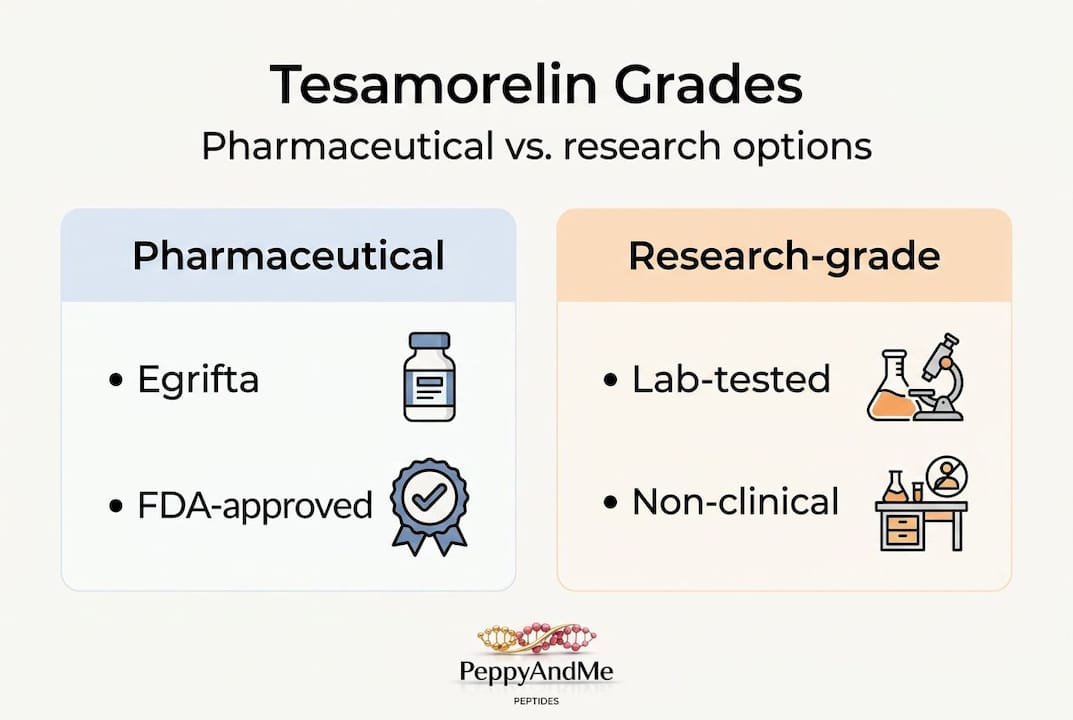
Pharmaceutical-grade tesamorelin (Egrifta)
Egrifta is the only FDA-approved form of tesamorelin. It has been FDA-approved since 2010 specifically for reducing excess abdominal fat in HIV-infected patients with lipodystrophy, with Phase 3 trials demonstrating 15 to 18% visceral fat reduction at 26 weeks. Egrifta is manufactured under strict pharmaceutical GMP standards, subjected to rigorous clinical validation, and dispensed only via prescription. Every vial carries documented purity, sterility, and endotoxin data tied to a regulated manufacturing process.
The cost of Egrifta reflects that regulatory overhead. It is not accessible to most researchers outside of clinical prescription pathways, and its approved indication is narrow. For researchers studying tesamorelin’s broader metabolic effects, or biohackers exploring its applications outside of HIV-associated lipodystrophy, the pharmaceutical route is often impractical.
Research-grade tesamorelin
Research-grade tesamorelin occupies a different regulatory space. These products are explicitly labeled for research use only, meaning laboratory or in-vitro use, and are not approved for human consumption. No prescription is required to purchase them, and many suppliers ship domestically with cold-chain packaging when necessary. The legal framework here is important: purchasing and possessing research peptides for legitimate laboratory research is generally permissible in the United States, but using them for personal consumption or selling them for human use crosses into regulated territory.
Quality across research-grade suppliers varies significantly. Some operate with GMP-aligned processes, third-party testing, and full batch traceability. Others provide minimal documentation and no independent verification. This variance is precisely why understanding the product category is the first step, not an afterthought.
Note: The distinction between research-grade vs. pharmaceutical tesamorelin is not merely regulatory. It reflects real differences in manufacturing oversight, purity assurance, and intended application. Treating them as interchangeable is a sourcing error with serious consequences.
Comparison: Egrifta vs. research-grade tesamorelin
| Feature | Egrifta (pharmaceutical) | Research-grade tesamorelin |
|---|---|---|
| Regulatory status | FDA-approved | Not FDA-approved for human use |
| Prescription required | Yes | No |
| Intended use | HIV-associated lipodystrophy | In-vitro / laboratory research |
| Manufacturing standard | Full pharmaceutical GMP | Varies by supplier |
| Third-party testing | Required by regulation | Depends on supplier |
| Cost per vial | High (insurance/prescription dependent) | $40 to $80 per 10mg vial (typical range) |
| Batch traceability | Full chain of custody | Varies; best suppliers provide full traceability |
Key distinctions to keep in mind:
- Pharmaceutical Egrifta is the only form validated for human efficacy and safety in its approved indication.
- Research-grade products are intended for controlled laboratory environments.
- Off-label personal use of research peptides carries contamination and immunogenicity risks not present with pharma-grade products.
- Supplier quality in the research peptide space ranges from excellent to unreliable, making independent verification non-negotiable.
Key sourcing requirements: What to look for in a tesamorelin supplier
After recognizing where tesamorelin comes from, the next step is selecting a supplier who meets premium quality standards. This is where many researchers and biohackers make critical errors, defaulting to price comparisons or forum recommendations without examining the actual documentation behind a supplier’s claims.

Certificate of Analysis (COA): The baseline requirement
A COA is the primary document confirming a peptide’s identity, purity, and safety profile. Every legitimate research peptide supplier should provide a batch-specific COA, not a generic document that applies to an entire product line. The COA should include:
- Peptide identity confirmation (typically via mass spectrometry or HPLC)
- Purity percentage (research-grade tesamorelin should ideally exceed 98%)
- Endotoxin levels (expressed in EU/mg; lower is better for sensitive applications)
- Sterility testing results
- Heavy metals screening
- Lot and batch number tied to the specific product you receive
The COA verification process matters as much as the document itself. A COA is only meaningful if it comes from an independent third-party laboratory, not the supplier’s in-house testing team. Named labs like Janoshik and TrustPointe are recognized in the research peptide community for their independent validation services.
GMP alignment: What it means in practice
Good Manufacturing Practices (GMP) refer to a set of quality control standards governing how pharmaceutical and research products are manufactured, tested, and distributed. Full pharmaceutical GMP certification is a high bar that most research peptide suppliers do not meet. However, GMP-aligned or GMP-compliant manufacturing, where processes are modeled on those standards without full regulatory certification, is a meaningful indicator of quality commitment.
Quality benchmarks worth prioritizing include batch-specific public COAs from labs like Janoshik or TrustPointe, GMP-aligned USA manufacturing, and documented endotoxin and sterility testing. Avoiding unverified sources minimizes variability in research outcomes and reduces the risk of compromised results.
Supplier evaluation checklist
Use the following criteria when assessing any tesamorelin supplier:
- Publicly available, batch-specific COAs from named third-party labs
- Documented endotoxin testing (results should be below 1 EU/mg for most research applications)
- Sterility testing with clear pass/fail results
- Heavy metals screening included in standard testing
- Traceable lot and batch numbers from manufacturer to warehouse
- Clear labeling: “for research use only, not for human consumption”
- Transparent contact information and responsive customer support
- Domestic shipping with cold-chain options available
- Verifiable reviews from identifiable research communities, not anonymous testimonials
Supplier quality comparison
| Criterion | Minimum acceptable | Premium standard |
|---|---|---|
| COA type | Generic product-level | Batch-specific, third-party |
| Purity | 95%+ | 98%+ |
| Endotoxin testing | Stated but unverified | Named lab, batch-specific |
| Sterility | Claimed | Documented with results |
| Traceability | Lot number only | Full chain from manufacturer |
| Customer support | Email only | Real-time, responsive |
Pro Tip: When contacting a supplier before purchase, ask specifically which third-party laboratory conducted the batch testing for the tesamorelin lot currently in stock. A supplier who cannot name the lab or provide the actual COA on request is not meeting the standard your research demands. Protecting peptide integrity starts with this single verification step.
Step-by-step guide: Buying research-grade tesamorelin safely
You now know what to look for in a supplier; here is how to actually complete your purchase safely and efficiently. Rushing this process is one of the most common mistakes in research peptide procurement.
Step 1: Establish your research purpose and documentation
Before searching for suppliers, document your intended use. If you are conducting institutional research, ensure your protocol is approved and that tesamorelin is appropriate for your study design. If you are an independent researcher or biohacker, understand the legal framework in your jurisdiction. Research peptides are legal to purchase for laboratory use in the United States, but the legal status for personal use is less clear and carries risk.
Retain all documentation related to your research purpose. This includes any institutional review board (IRB) approvals, research protocols, and correspondence with suppliers. In the event of an audit or inquiry, documentation is your primary protection.
Step 2: Identify candidate suppliers
Use multiple sources to build a list of potential suppliers. Reputable research communities, peer-reviewed sourcing forums, and platforms with verifiable review histories are more reliable than anonymous social media recommendations. Look for suppliers who appear consistently across multiple independent sources, not just those with aggressive advertising.
Explore laboratory peptide insights and community resources that evaluate suppliers based on testing documentation rather than marketing claims. Cross-reference supplier names with third-party lab databases where possible.
Step 3: Evaluate each supplier against quality criteria
Apply the checklist from the previous section to every candidate. Request COAs before purchasing. A supplier who refuses to provide batch-specific documentation before you commit to a purchase is signaling a lack of transparency that should disqualify them regardless of price.
Step 4: Assess site trustworthiness
Examine the supplier’s website for clear contact information, a physical address or verifiable business registration, and a transparent returns or quality guarantee policy. Check for SSL encryption on checkout pages. Look for real customer reviews on independent platforms, not just testimonials hosted on the supplier’s own site.
Step 5: Place your order with attention to detail
When ordering, confirm the specific product: tesamorelin, concentration (typically 2mg or 5mg per vial), quantity, and lot number if available. Note the lot number at checkout so you can cross-reference it against the COA upon delivery. Research peptides in the $40 to $80 per 10mg vial range are typical for research-grade tesamorelin, though pricing varies by supplier and quantity ordered.
Step 6: Confirm shipping and cold-chain handling
Tesamorelin is a lyophilized (freeze-dried) peptide that is relatively stable at room temperature for short periods but degrades under sustained heat or improper handling. Confirm that your supplier uses cold-chain packaging for shipping, particularly during warmer months or for longer transit distances. For a comparison of how different peptide products handle shipping requirements, reviewing a Sermorelin sourcing comparison can provide useful context, as both peptides share similar storage sensitivities.
Step 7: Retain all purchase documentation
Pro Tip: Always save order confirmations, invoices, COA copies, and shipping records in a dedicated research file. If your work is ever subject to audit, regulatory inquiry, or internal review, having a complete paper trail from order placement to receipt demonstrates due diligence and professionalism.
A statistic worth noting: research peptide pricing has remained relatively stable in recent years, with reputable suppliers maintaining competitive rates while investing in third-party testing infrastructure. The cost differential between a verified supplier and an unverified one is often less than $20 per vial. That margin is not worth the risk of compromised purity or failed research outcomes.
Verification and troubleshooting: Ensuring your tesamorelin is authentic and usable
Once your tesamorelin arrives, the work is not done. Rigorous verification ensures your research results and safety will not be compromised by undetected quality issues.
Cross-verifying COA and batch details on arrival
When your order arrives, immediately compare the lot or batch number on the vial label against the COA provided by the supplier. These numbers must match exactly. If they do not, contact the supplier immediately and do not use the product until the discrepancy is resolved. Some suppliers publish COAs on their website organized by batch number, making this cross-check straightforward.
Verify that the COA was issued by the named third-party laboratory, not the supplier itself. If the document header shows the supplier’s own branding rather than an independent lab’s, treat it with skepticism and request the original lab report.
Physical inspection of the product
Lyophilized tesamorelin should appear as a white to off-white powder or cake inside the vial. Key physical indicators to check:
- Powder consistency: should be uniform, not clumped or discolored
- Vial seal: crimp cap should be intact with no signs of tampering
- Label quality: professional printing with lot number, expiration date, and storage instructions
- Packaging: should arrive in appropriate cold-chain packaging if ordered during warm months
- Quantity: vial fill should correspond to the labeled amount
Any deviation from expected physical characteristics warrants follow-up with the supplier before proceeding.
Independent lab testing options
For high-stakes research, sending a sample to an independent laboratory for verification is the most reliable quality assurance step available. Services like Janoshik offer peptide identity confirmation, purity analysis, and endotoxin testing for reasonable fees. This is particularly valuable when working with a new supplier for the first time or when using tesamorelin in a study where data integrity is critical.
Peptide quality validation is an investment that pays dividends in research reliability. The cost of independent testing is minor compared to the cost of repeating a study due to compromised reagents.
Common issues and how to address them
- Shipment delays: Extended transit times in warm weather can affect peptide stability. If your order was delayed significantly, request a replacement or conduct independent testing before use.
- Reconstitution errors: Tesamorelin should be reconstituted with bacteriostatic water. Using plain sterile water reduces shelf life of the reconstituted solution. Always follow supplier-provided reconstitution protocols.
- Storage anomalies: Lyophilized tesamorelin should be stored at 2 to 8 degrees Celsius. Reconstituted solution should be refrigerated and used within an appropriate timeframe per supplier guidance.
Warning: Self-administration of research-grade tesamorelin outside of pharmaceutical GMP standards carries significant risks. Unlike GMP-compliant firms such as Bachem or Thermo, which are preferred for premium research needs, niche vendors may not provide the contamination controls necessary to ensure safety in human use scenarios. Research peptides are intended for laboratory and in-vitro use, not personal consumption.
Why most tesamorelin buyers get quality wrong — and what actually works
Stepping back from procedures, it is worth addressing why so many buyers, even experienced ones, make errors that could undermine their work.
The most persistent mistake is treating price and website aesthetics as proxies for quality. A polished storefront and a competitive price point are not evidence of rigorous manufacturing. They are marketing. The actual indicators of quality live in batch-specific COAs, named third-party lab results, and traceable lot numbers. Buyers who skip this documentation review because a supplier “looks legitimate” are taking a risk that no amount of positive forum posts can offset.
There is also a tendency among biohackers to rely heavily on social proof, trusting community recommendations over documentation. Social proof has value, but it is not a substitute for verification. Batch variance is real: a supplier who delivered clean product six months ago may be shipping from a different manufacturing run today. The only way to know is to check the current batch’s COA, not the last buyer’s experience.
For high-stakes research, ultra-premium GMP vendors remain the strongest choice despite higher costs. The additional expense reflects real manufacturing controls that reduce variability and risk. For exploratory work where cost efficiency matters, a rigorous mid-tier supplier with full third-party documentation is a defensible choice. What is never defensible is purchasing from a supplier who cannot provide batch-specific testing data.
The researchers who consistently get tesamorelin sourcing right share one habit: they treat every new order as a new verification event. They do not assume that a supplier’s past performance guarantees current quality. They check the research peptide misconceptions that circulate in the community against actual documentation. That discipline is what separates reliable research from guesswork.
Your next steps: Premium tesamorelin sourcing made easy
If rigorous sourcing and confidence in supply chain matter to you, Peppy&Me is built to support exactly that standard. Every product on the platform is third-party tested for purity, mass accuracy, endotoxins, sterility, and heavy metals, with traceable lot and batch numbers from manufacturer to warehouse. You can explore research peptides across the full catalog, backed by transparent documentation and real-time customer support.
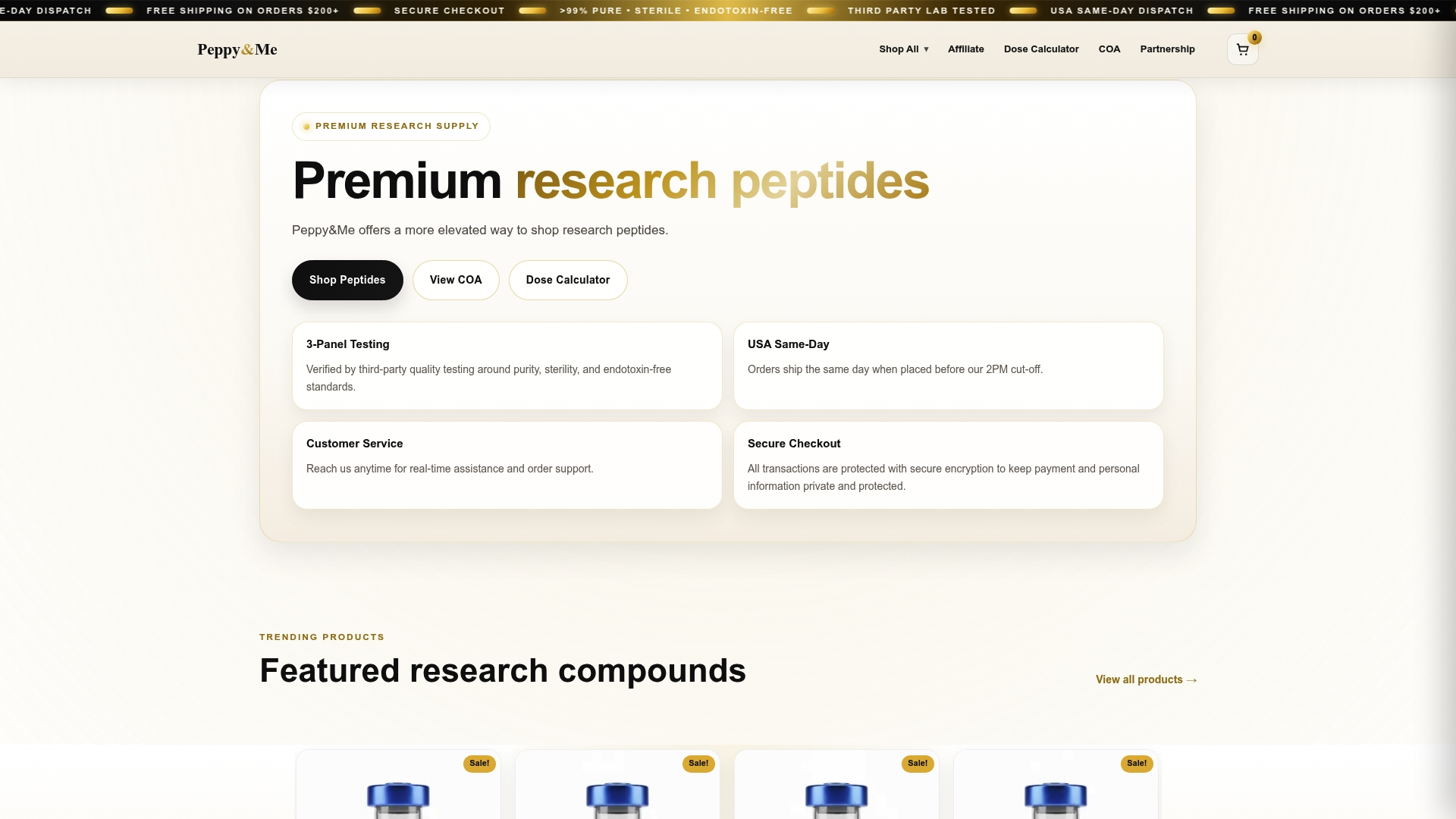
For researchers who want to go deeper on sourcing methodology, the full sourcing guide covers verification workflows applicable across peptide classes. Institutional researchers and entrepreneurs scaling their operations can also explore private label peptides, a program that gives you access to Peppy&Me’s backend fulfillment and quality infrastructure under your own brand. Same-day shipping for orders placed before 2 PM, secure checkout, and no data reselling round out a platform designed for professionals who take sourcing seriously.
Frequently asked questions
Is tesamorelin legal to buy for research purposes in the US?
Tesamorelin can be legally purchased for laboratory and in-vitro research use in the United States, but it is not approved for human consumption outside of prescription Egrifta. Buyers should ensure their intended use aligns with research-only labeling requirements.
How do I verify the quality of a tesamorelin vial I’ve received?
Request the batch-specific Certificate of Analysis and confirm it matches the lot number on your vial, then cross-check results against the named third-party lab. Batch-specific public COAs from labs like Janoshik or TrustPointe are the most reliable verification tools available.
What are the risks of using research-grade tesamorelin for personal use?
Using research peptides for personal purposes carries contamination and immunogenicity risks because they lack full pharmaceutical GMP protections. Off-label human use of research peptides is explicitly outside the intended use category and introduces safety variables not present with regulated pharmaceutical products.
Do research peptides like tesamorelin require refrigeration during shipping?
Many reputable suppliers use cold-chain shipping to protect peptide integrity, particularly for longer distances or warm climates. Confirming cold-chain shipping availability with your supplier before ordering is a standard precaution for temperature-sensitive peptides like tesamorelin.