Melanotan 2 Tanning Peptide: Benefits, Dosage, and Safety

Melanotan 2 (MT-II) is defined as a synthetic cyclic heptapeptide analog of alpha-melanocyte-stimulating hormone (α-MSH) that activates the body’s natural melanin production pathway to support deeper, more even skin pigmentation. Unlike spray tans or bronzing lotions that coat the skin’s surface, this melanotan 2 tanning peptide works from the inside out by binding to melanocortin receptors and triggering melanogenesis, the biological process that produces pigment in skin cells. Researchers and aesthetics-focused individuals have studied MT-II for its potential to accelerate base tan development alongside UV exposure, making it one of the more discussed compounds in the peptide tanning space. Understanding how it works, how it is used responsibly, and what the current regulatory environment looks like is the foundation for any informed decision about this compound.
How does melanotan 2 work as a tanning peptide?
MT-II mimics α-MSH, a naturally occurring hormone that signals melanocytes (pigment-producing skin cells) to synthesize and release melanin. The key receptor involved is MC1R (melanocortin 1 receptor), which sits on the surface of melanocytes and, when activated, triggers the melanogenesis cascade. This is the same pathway your body uses after UV exposure, except MT-II initiates it pharmacologically rather than through sunlight alone.
One critical distinction separates MT-II from its close relative, Melanotan 1 (afamelanotide). MT-II binds to multiple receptors beyond MC1R, including MC3R and MC4R, which are linked to appetite suppression and sexual arousal. Melanotan 1 binds more selectively to MC1R, producing fewer off-target effects but requiring higher doses and carrying a higher cost. This receptor promiscuity is precisely why MT-II produces a broader side effect profile than Melanotan 1.

UV exposure still plays a role when using MT-II. The peptide primes melanocytes to respond more efficiently, but moderate UV stimulation typically amplifies the pigmentation response. Without any UV exposure, results are generally less pronounced.
Key biological steps in MT-II tanning:
- MT-II is administered subcutaneously and enters systemic circulation
- It binds to MC1R on melanocytes, activating adenylyl cyclase and increasing cyclic AMP
- Elevated cAMP triggers tyrosinase activity, the enzyme that converts tyrosine into melanin
- Melanin is transferred to surrounding keratinocytes, producing visible skin darkening
Pro Tip: Start UV sessions at a lower duration than usual when beginning MT-II research protocols. The peptide sensitizes melanocytes, so the same UV dose may produce a stronger pigmentation response than expected.
What are the benefits of melanotan 2 over traditional tanning methods?
The primary appeal of MT-II over conventional tanning methods is the quality and efficiency of the pigmentation it supports. Traditional UV tanning requires repeated, prolonged sun or tanning bed exposure to build a base tan, which accumulates cumulative UV damage over time. Self-tanning products like dihydroxyacetone (DHA)-based lotions create a surface-level color that fades within days and often produces an uneven or orange-toned result.
MT-II, by contrast, stimulates the body’s own melanin production, which means the resulting pigmentation is structurally identical to a natural tan. The color tends to appear more uniform across the skin and lasts longer because it is embedded in the epidermis rather than sitting on top of it.
| Feature | MT-II tanning peptide | UV-only tanning | DHA self-tanner |
|---|---|---|---|
| Pigmentation type | Biologically produced melanin | Biologically produced melanin | Surface chemical reaction |
| Color evenness | Generally even | Depends on exposure pattern | Can streak or patch |
| Duration | Weeks with maintenance | Fades without continued UV | 5 to 7 days |
| UV exposure required | Moderate, reduced | Extensive | None |
| Side effect profile | Systemic (nausea, flushing) | Skin damage, aging | Minimal systemic risk |
“No clinical trials exist on the short- or long-term effects of injected tanning peptides like Melanotan 2, including interactions with other drugs or safety during pregnancy.” — drugs.ie harm-reduction guidance
This absence of clinical trial data is the single most important context for understanding MT-II benefits. The advantages described above are based on the compound’s known mechanism and anecdotal research use, not on controlled human trials. Anyone evaluating MT-II benefits must weigh them against this evidence gap.
How to use melanotan 2 safely: dosage, administration, and storage
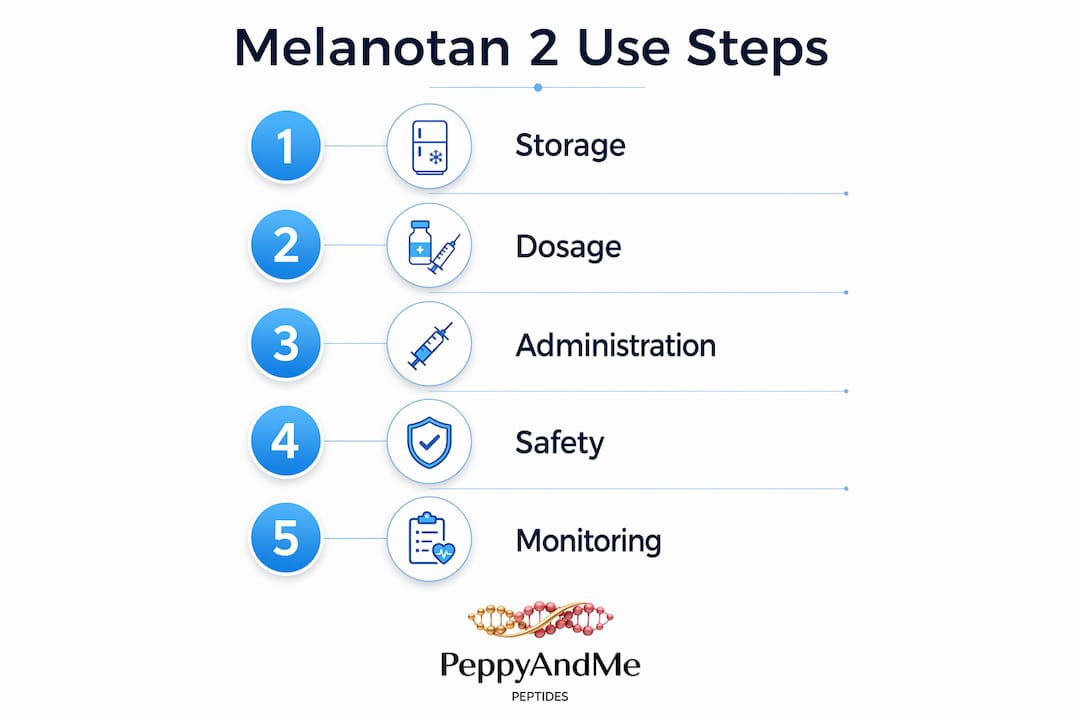
Responsible use of MT-II in a research context follows a structured protocol. The general pattern observed in research settings involves a loading phase followed by a maintenance phase, though no standardized clinical dosing guidelines exist given the lack of approved human trials.
Typical research dosing pattern:
- Loading phase: Daily subcutaneous injections at a low starting dose to assess tolerance and build pigmentation gradually
- Maintenance phase: Reduced injection frequency (every few days) once the desired pigmentation level is reached
- UV integration: Brief, moderate UV sessions during the loading phase to activate the melanin response MT-II has primed
- Cycle breaks: Periodic pauses in administration to observe how pigmentation holds and to assess any cumulative effects
Subcutaneous injection is the standard administration route. Common sites include the abdomen, outer thigh, and lower back, rotating between locations to avoid tissue irritation. Intravenous or intramuscular administration is not appropriate for this compound in research contexts.
Storage is a non-negotiable factor in peptide integrity. Freeze-dried vial formats are preferred because lyophilized peptides are far more stable than reconstituted solutions. Once reconstituted with bacteriostatic water, the solution should be refrigerated and used within a defined window. Heat, moisture, and repeated freeze-thaw cycles degrade the peptide structure and reduce potency. Reviewing lab best practices for peptide handling before beginning any protocol is strongly recommended.
Pro Tip: Use a calibrated peptide calculator before every dose. Concentration varies depending on the volume of bacteriostatic water used during reconstitution, and even a small miscalculation can significantly alter the dose delivered.
Sourcing matters as much as storage. Products from unverified suppliers frequently arrive in unmarked or code-only labeled vials with no confirmed concentration, purity, or sterility data. Dose calculation with such products is guesswork, and the risks that follow are proportional to that uncertainty.
What are the potential side effects and safety concerns of melanotan 2?
MT-II carries a documented side effect profile that users and researchers should understand before any protocol begins. Because the compound binds to multiple melanocortin receptors beyond MC1R, its effects extend beyond skin pigmentation.
Commonly reported side effects include:
- Nausea and facial flushing, particularly in the first hour after injection
- Spontaneous erections in male subjects (a result of MC4R activation)
- Increased appetite suppression
- Darkening of existing moles, freckles, and skin lesions
- Fatigue and yawning shortly after administration
The more serious concern is what happens when MT-II comes from unregulated sources. Severe allergic reactions and hospitalizations have been reported from unregulated peptide use, with documented symptoms including intense itching, heart palpitations, acute pain, insomnia, and blurred vision. The TGA (Australia’s Therapeutic Goods Administration) states these peptides are not evaluated for safety, quality, or effectiveness, meaning the reaction may be to contaminants or mislabeled ingredients rather than MT-II itself.
The long-term safety profile of MT-II is genuinely unknown. No clinical trials cover the short- or long-term effects of injected tanning peptides, including drug interactions or safety in pregnancy. This is not a regulatory technicality. It reflects a real absence of controlled human data. The FDA approval pathway requires extensive clinical trials and commercial investment, and MT-II has not attracted the pharmaceutical backing needed to move through that process.
Clinicians recommend baseline skin assessments before using any pigmentation-altering peptide. Moles and lesions can change unpredictably when melanocyte activity is amplified, and having a documented baseline makes it possible to detect meaningful changes early. Consulting a dermatologist or healthcare professional before beginning any MT-II protocol is the standard of care that responsible researchers follow.
How does regulation affect availability and safety of melanotan 2?
The regulatory status of MT-II is unambiguous in most jurisdictions. It is not approved as a tanning agent by the FDA, the TGA, or equivalent bodies in the EU and UK. In Australia, it is classified as a prescription-only medicine, meaning supply outside a licensed medical framework is illegal.
| Jurisdiction | Regulatory status | Key enforcement action |
|---|---|---|
| United States | Not FDA-approved for tanning | Classified as unapproved drug |
| Australia | Prescription-only, unapproved for tanning | TGA enforcement notices issued |
| European Union | Not approved for cosmetic tanning use | Subject to import restrictions |
| United Kingdom | Unlicensed medicine | Supply without prescription is illegal |
Enforcement is active, not theoretical. In May 2026, the TGA issued infringement notices totaling over $101,000 to a single individual for illegally supplying Melanotan II in Australia. This signals that regulatory bodies are treating MT-II supply as a serious legal matter, not a minor compliance issue.
The TGA also warns that unapproved peptide products frequently arrive in unmarked vials with missing ingredient and dosing information, and are often absent from the Australian Register of Therapeutic Goods (ARTG). The core safety problem is not just unknown side effects. It is unknown ingredients. A vial labeled only with a code number provides no basis for safe dosing. Sourcing from suppliers who provide third-party certificates of analysis, traceable batch numbers, and confirmed purity data is the only way to reduce this specific risk. Reviewing guidance on safe peptide sourcing practices is a practical starting point for anyone navigating this space.
Key takeaways
Melanotan 2 stimulates melanin production through MC1R activation, but its safety profile, regulatory status, and absence of clinical trial data make sourcing quality and informed use non-negotiable.
| Point | Details |
|---|---|
| Mechanism of action | MT-II activates MC1R to trigger melanogenesis, producing biologically identical pigmentation to a natural tan. |
| MT-II vs. Melanotan 1 | MT-II binds multiple receptors, producing more side effects than the more selective Melanotan 1 (afamelanotide). |
| No clinical trial data | No controlled human trials exist on MT-II’s long-term safety, drug interactions, or effects during pregnancy. |
| Regulatory enforcement | The TGA issued over $101,000 in fines in 2026 for illegal MT-II supply, confirming active legal risk. |
| Source quality is critical | Unmarked vials with unknown concentrations make dosing guesswork and significantly increase adverse event risk. |
Peppyandme’s perspective on MT-II research and responsible use
The most common mistake made by people exploring MT-II is treating the absence of widespread reported harm as evidence of safety. It is not. The absence of clinical trials means the absence of systematic data, which is a fundamentally different thing. At Peppyandme, the position is straightforward: the compound’s mechanism is well-understood, its receptor activity is documented, and its anecdotal use is extensive. None of that substitutes for controlled human trial data.
What concerns us more than the peptide itself is the sourcing behavior it tends to attract. When a compound is not commercially approved, the supply chain fragments. Vials arrive with codes instead of labels. Concentrations are unverified. Sterility is assumed rather than confirmed. That is where the real risk lives, not in the peptide’s pharmacology but in the product’s integrity.
There is also a behavioral risk that gets underreported. Users frequently increase UV sessions when using MT-II to maximize results, which paradoxically increases total UV exposure rather than reducing it. The hypothesis that MT-II reduces harmful UV exposure does not hold up in practice for most users. That is a nuance worth sitting with before starting any protocol.
The right approach combines a dermatologist-reviewed skin baseline, a verified peptide source with traceable batch data, a calibrated dose, and conservative UV integration. Anything less is not a research protocol. It is improvisation with biological systems.
— Peppy&Me
Research MT-II with confidence through Peppyandme

Peppyandme provides researchers and informed individuals with access to lab-verified research peptides that meet strict third-party testing standards for purity, sterility, endotoxins, heavy metals, and mass accuracy. Every product carries traceable lot and batch numbers from manufacturer to warehouse, so you are never dosing from an unmarked vial. The built-in peptide dose calculator removes the guesswork from reconstitution math, and the peptide glossary covers handling protocols, storage guidance, and research context for compounds including MT-II. Orders placed before 2 PM ship the same day. For researchers who take sourcing seriously, Peppyandme’s 2026 peptide sourcing guide is a practical resource for evaluating supplier transparency and quality standards before committing to a purchase.
FAQ
What is melanotan 2 and how does it differ from a self-tanner?
Melanotan 2 is a synthetic peptide that activates melanocortin receptors to stimulate the body’s own melanin production, producing biologically natural pigmentation. Self-tanners like DHA-based products create a surface-level color reaction that does not involve melanin and fades within days.
What are the most common melanotan 2 side effects?
The most frequently reported side effects include nausea, facial flushing, appetite suppression, and spontaneous erections in male subjects, all linked to MT-II’s activity at multiple melanocortin receptors. Severe reactions including palpitations, intense itching, and blurred vision have been reported with unregulated products.
Is there a standard melanotan 2 dosage guide for research use?
No standardized clinical dosing protocol exists because MT-II has not completed human clinical trials. Research use typically follows a low-dose loading phase with daily subcutaneous injections, transitioning to a less frequent maintenance schedule once target pigmentation is reached.
Is melanotan 2 legal to buy and use?
MT-II is not approved as a tanning agent by the FDA or TGA and is classified as a prescription-only medicine in Australia. Supply outside a licensed medical framework is illegal in multiple jurisdictions, and the TGA issued over $101,000 in enforcement fines in 2026 for illegal supply.
Does melanotan 2 work without UV exposure?
MT-II primes melanocytes to produce melanin more efficiently, but moderate UV exposure typically amplifies the pigmentation response. Without any UV stimulation, results are generally less pronounced, and some users increase UV sessions to compensate, which can raise overall skin damage risk.