Best Peptide for Inflammation Research: 2026 Guide
The best peptide for inflammation research is one that directly and measurably modulates central inflammatory signaling pathways, specifically NF-κB, Nrf2/ARE, and the NLRP3 inflammasome, with documented preclinical evidence supporting its mechanism. In 2026, the field of anti-inflammatory peptide research has converged on a shortlist of candidates: IDR-1002, WPAW, BPC-157, TB-500, GHK-Cu, KPV, and Thymosin Alpha-1. Each targets inflammation through distinct molecular entry points, making peptide selection a context-dependent decision rather than a universal ranking. Researchers who align their peptide choice with their specific inflammation phenotype and experimental model will extract the most mechanistically valid and translationally relevant data.
How do peptides modulate inflammation at the molecular level?
Peptides regulate inflammation by interfering with transcription factors and signaling cascades that control cytokine production, oxidative stress, and immune cell activation. The three most studied pathways in this context are NF-κB, Nrf2/ARE, and the NLRP3 inflammasome. Understanding which pathway dominates your model determines which peptide delivers the clearest mechanistic signal.
NF-κB is the master regulator of pro-inflammatory gene expression, controlling TNF-α, IL-1β, IL-6, and COX-2. Peptides that inhibit NF-κB nuclear translocation reduce this entire downstream cascade. Nrf2/ARE governs antioxidant enzyme expression, including HO-1, NQO1, and GCLM, and its activation counteracts the oxidative stress that amplifies inflammatory signaling. The NLRP3 inflammasome is a multiprotein complex that drives IL-1β maturation and is particularly relevant in sterile inflammation, gout, and metabolic disease models.

IDR-1002 exemplifies the dual-action concept. This peptide activates Nrf2 and inhibits NF-κB simultaneously, producing dose-dependent increases in antioxidant enzymes while significantly reducing TNF-α expression in stimulated endothelial cells. That dual action is mechanistically valuable because it separates true anti-inflammatory activity from nonspecific cytoprotection. WPAW, a tetrapeptide derived from jellyfish toxin, takes a different route: it suppresses NLRP3 and pP65 proteins, reducing IL-1β, reactive oxygen species (ROS), and nitric oxide in both in vitro and in vivo gout arthritis models.
The table below maps the primary pathway targets for the top peptides in inflammation research, giving researchers a quick reference for mechanistic alignment.
| Peptide | Primary pathway target | Key inflammatory endpoints |
|---|---|---|
| IDR-1002 | Nrf2/ARE + NF-κB | TNF-α, HO-1, NQO1, GCLM |
| WPAW | NLRP3 inflammasome + NF-κB | IL-1β, ROS, nitric oxide |
| BPC-157 | PI3K/Akt, VEGF, NF-κB | TNF-α, pro-inflammatory cytokines |
| TB-500 | Actin polymerization, NF-κB | TNF-α, fibrotic markers |
| GHK-Cu | Gene regulation, antioxidant | TNF-α, IL-6, collagen synthesis |
| KPV | NF-κB + MAPK | Pro-inflammatory cytokines (intracellular) |
| Thymosin Alpha-1 | TLR9, macrophage polarization | TNF-α, IL-1β, IL-6 |
Pro Tip: When designing your assay panel, measure both Nrf2/ARE activation markers and NF-κB-driven cytokines together. Multiparametric readouts that capture both antioxidant and inflammatory endpoints are the most reliable way to confirm a peptide’s true mechanism rather than attributing effects to nonspecific cell stress responses.
Which peptides show the strongest anti-inflammatory effects in preclinical studies?
Preclinical evidence for anti-inflammatory peptides spans cell culture, explant, and animal models, and the quality of that evidence varies considerably across candidates. The peptides with the most mechanistically grounded and reproducible data are the ones worth prioritizing in your research program.
IDR-1002 demonstrates dose-dependent Nrf2 nuclear translocation with concurrent upregulation of HO-1, NQO1, and GCLM, alongside measurable TNF-α suppression in cytokine-stimulated endothelial cells. This makes it one of the few peptides with clearly documented dual-pathway activity in a single model system, which is a significant advantage for mechanistic studies.
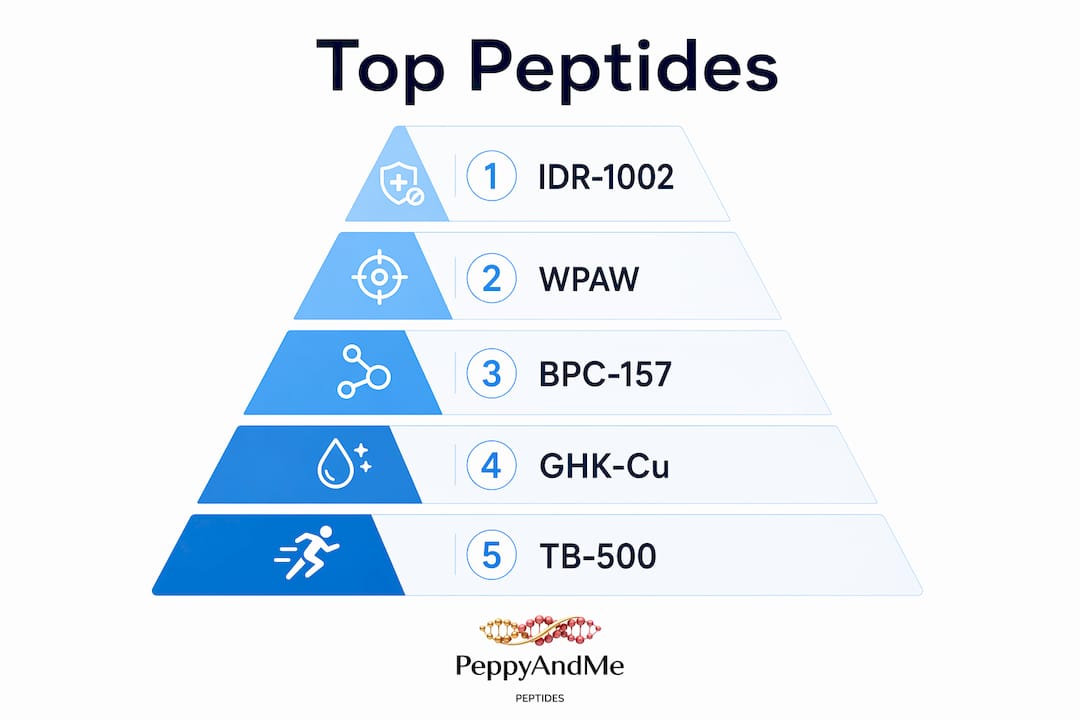
WPAW reduced IL-1β to 53.54 pg/mL, ROS to 0.32 RFI, and nitric oxide to 14.05 μM in macrophage cultures, with NLRP3 and pP65 downregulation confirmed by Western blot. In a gouty arthritis rat model, joint inflammation decreased without cytotoxicity observed up to 125 μM. That cytotoxicity profile matters for dose-ranging studies, as it provides a wider experimental window.
BPC-157 and TB-500 are well-characterized in musculoskeletal injury models. BPC-157 activates PI3K/Akt and VEGF signaling while reducing pro-inflammatory cytokines, supporting both inflammation resolution and tissue repair. TB-500 enhances actin polymerization, reduces TNF-α and NF-κB activation, and shows anti-fibrotic effects in soft tissue models. Both peptides are particularly relevant when the research question involves inflammation at the intersection of tissue injury and repair.
GHK-Cu reduces TNF-α and IL-6 by up to 60% while promoting collagen and elastin synthesis and enhancing fibroblast activity. That combination of anti-inflammatory and matrix-remodeling effects makes GHK-Cu a strong candidate for wound healing and skin inflammation models. KPV, a tripeptide, inhibits NF-κB and MAPK intracellularly by entering inflamed cells via a specific transporter, making it particularly suited to IBD and mucosal inflammation research where targeted intracellular delivery is an advantage. Thymosin Alpha-1 shifts macrophage activation away from the M1 phenotype and reduces TNF-α, IL-1β, and IL-6, with meta-analysis data supporting reduced secondary infections in severe inflammatory conditions.
| Peptide | Model system | Key measured outcome |
|---|---|---|
| IDR-1002 | Endothelial cell culture | TNF-α reduction, Nrf2 nuclear translocation |
| WPAW | Macrophage culture + rat arthritis | IL-1β 53.54 pg/mL, ROS 0.32 RFI |
| BPC-157 | Musculoskeletal injury | PI3K/Akt activation, cytokine reduction |
| GHK-Cu | Wound and fibroblast models | TNF-α/IL-6 up to 60% reduction |
| Thymosin Alpha-1 | Systemic infection/inflammation | M1 macrophage suppression, cytokine reduction |
Pro Tip: For inflammasome-driven models, select peptides validated for NLRP3, caspase-1, and IL-1β modulation and confirm downstream functional markers such as pyroptosis markers or joint histology scores. Mechanistic confirmation at multiple levels significantly strengthens translational claims.
How to select the best peptide for your specific inflammation research model
The best peptide for inflammation research is not a universal answer. It is a context-specific decision based on the dominant inflammation phenotype in your model, the signaling pathway you are interrogating, and the translational endpoint you are working toward. Matching mechanism to model is the single most important selection criterion.
Consider the following framework when making your selection:
- Oxidative stress-driven inflammation: IDR-1002 is the strongest candidate. Its dual Nrf2/NF-κB activity provides a clean mechanistic read in models where ROS and cytokine production are co-elevated, such as endothelial dysfunction, atherosclerosis, or metabolic inflammation.
- Inflammasome-mediated inflammation: WPAW is the most directly validated option for NLRP3-driven models, including gout, crystal-induced arthritis, and sterile inflammation. Confirm NLRP3, caspase-1, and IL-1β as primary endpoints.
- Musculoskeletal and tissue injury inflammation: BPC-157 and TB-500 are the most studied candidates. Their combined effects on angiogenesis, fibroblast activation, and cytokine reduction make them well-suited to orthopaedic, tendon, and ligament models. Combination protocols using both peptides reduce recovery times by 30 to 50% in preclinical observations.
- Mucosal and autoimmune inflammation: KPV’s intracellular delivery mechanism makes it particularly relevant for IBD, colitis, and epithelial barrier models where luminal peptide delivery is feasible.
- Systemic or immune-dysregulated inflammation: Thymosin Alpha-1 is the preferred candidate for models involving macrophage polarization, sepsis, or infection-associated cytokine storms.
- Skin, wound, and matrix remodeling inflammation: GHK-Cu’s broad gene regulation profile, covering collagen, elastin, and antioxidant enzymes, makes it the most versatile option for dermal inflammation and wound healing research.
When designing combination protocols, prioritize mechanistic complementarity. Pairing BPC-157 with TB-500 targets overlapping but distinct repair pathways, while adding GHK-Cu introduces matrix remodeling support. Researchers can explore peptide selection guidance and protocol resources through Peppyandme’s research support tools, including its built-in dose calculator and peptide glossary.
What are the challenges in translating peptide inflammation research to clinical use?
Translating preclinical anti-inflammatory peptide data into clinical application is the field’s most persistent bottleneck. The gap between a well-characterized in vitro mechanism and a validated clinical protocol involves multiple layers of complexity that researchers should account for from the earliest study design stages.
The core challenges include:
- Peptide stability and bioavailability: Most research peptides are susceptible to proteolytic degradation in biological fluids. Delivery route, formulation, and half-life must be characterized before dose-response relationships can be meaningfully extrapolated to in vivo or clinical contexts.
- Dosing protocol gaps: Preclinical dosing rarely translates directly to human equivalents. Most peptides require IND approval and extensive pharmacokinetic validation before clinical use, and the absence of large-scale trial data for many candidates means dosing remains empirical.
- Limited clinical trial data: Despite strong preclinical profiles, most peptides on this list lack Phase II or Phase III trial data. FDA approval requires massive financial investment, commercial backing, and multi-phase clinical trials. Naturally occurring or difficult-to-patent peptides often receive less industry funding despite sustained scientific interest.
- Regulatory compliance: Research use of these peptides must operate within institutional and regulatory frameworks. Peppyandme’s research compliance portal provides guidance on regulatory considerations relevant to peptide studies.
- Assay validity and reproducibility: Single-endpoint readouts are insufficient for establishing mechanism. Multi-parametric assays that capture both pathway activation and downstream functional outcomes are required to build a credible translational case.
To maximize research validity, define your evidence thresholds before beginning. Establish that a peptide must demonstrate both in vitro mechanistic activity and at least one relevant in vivo model confirmation before investing in complex delivery optimization. This prevents premature resource allocation and keeps the research program focused on translationally attractive candidates.
Sourcing quality also matters. Peptide purity, endotoxin levels, and sterility directly affect assay outcomes. Peppyandme’s peptide handling guidelines address storage, reconstitution, and stability factors that affect experimental reproducibility.
Key takeaways
Selecting the right peptide for inflammation research requires matching the peptide’s dominant mechanism to the specific signaling pathway driving inflammation in your model.
| Point | Details |
|---|---|
| Match mechanism to model | IDR-1002 suits oxidative inflammation; WPAW targets NLRP3-driven models; KPV addresses mucosal inflammation. |
| Dual-pathway peptides offer clarity | IDR-1002’s combined Nrf2 activation and NF-κB inhibition separates true anti-inflammatory effects from nonspecific cytoprotection. |
| Combination protocols enhance outcomes | BPC-157 and TB-500 together reduce inflammation and recovery time by 30 to 50% in preclinical musculoskeletal models. |
| Translational gaps require planning | Most peptides lack large-scale clinical trial data; define in vitro plus in vivo evidence thresholds before advancing protocols. |
| Purity directly affects results | Third-party tested peptides with verified endotoxin, sterility, and mass accuracy are required for reproducible assay outcomes. |
Peppyandme’s perspective on advancing inflammation peptide research
The most common mistake in inflammation peptide research is selecting a compound based on general reputation rather than mechanistic fit. IDR-1002 is an excellent peptide, but it is not the right choice for a researcher studying NLRP3-driven crystal arthritis. WPAW is. That distinction sounds obvious, but the literature is full of studies that use broadly popular peptides in models where their dominant mechanism is only tangentially relevant.
What the data consistently shows is that peptides with documented dual-pathway activity, particularly those co-targeting redox and inflammatory signaling, produce the most interpretable results. The reason is straightforward: when you activate Nrf2 and inhibit NF-κB simultaneously, you can distinguish antioxidant-mediated protection from direct cytokine suppression by measuring both arms independently. That mechanistic granularity is what makes a study publishable and translatable.
The translational gap is real, and researchers should treat it as a design constraint rather than a future problem. Building multi-parametric readouts into your initial assay design, and requiring at least one in vivo confirmation before advancing a peptide candidate, will save significant time and resources downstream. The field is moving toward combination protocols for good reason. Single-peptide approaches rarely capture the full complexity of chronic inflammatory conditions, and the preclinical data on BPC-157 plus TB-500 combinations makes a compelling case for multi-target strategies.
Peppyandme works with researchers who take this level of rigor seriously. The platform’s dose calculator, peptide glossary, and compliance resources exist precisely to support the kind of structured, evidence-based research that produces reliable results.
— Peppy&Me
Source your inflammation research peptides from Peppyandme
Peppyandme provides researchers with direct access to lab-verified peptides including IDR-1002, BPC-157, WPAW, GHK-Cu, KPV, TB-500, and Thymosin Alpha-1, all third-party tested for purity, mass accuracy, endotoxins, sterility, and heavy metals. Every product carries traceable lot and batch numbers from manufacturer to warehouse.
Researchers can access Peppyandme’s full research peptide catalog alongside built-in tools including a dose calculator and peptide glossary covering protocols, handling, and mechanism-specific research guidance. Orders placed before 2 PM ship the same day within the U.S. For researchers building out their sourcing strategy, the peptide sourcing guide provides a structured framework for selecting and verifying quality materials. Peppyandme does not sell customer data, and all transactions are processed through a secure checkout system.
FAQ
What is the best peptide for NF-κB inhibition research?
IDR-1002 is the most mechanistically documented peptide for NF-κB inhibition combined with Nrf2 activation, showing dose-dependent TNF-α reduction and antioxidant enzyme upregulation in endothelial cell models.
Which peptide targets the NLRP3 inflammasome most directly?
WPAW, derived from jellyfish toxin, is the most directly validated peptide for NLRP3 inflammasome suppression, reducing IL-1β, ROS, and nitric oxide in both macrophage cultures and a gouty arthritis rat model.
Can BPC-157 and TB-500 be used together in inflammation studies?
Yes. BPC-157 and TB-500 target complementary pathways, with BPC-157 activating PI3K/Akt and VEGF signaling and TB-500 enhancing actin polymerization and reducing NF-κB activation. Combination protocols show 30 to 50% improvements in tissue repair and inflammation resolution in preclinical models.
Why are anti-inflammatory peptides not FDA-approved for clinical use?
FDA approval requires multi-phase clinical trials, large financial investment, and commercial backing. Many naturally occurring or difficult-to-patent peptides receive limited industry funding despite strong preclinical evidence, leaving them in the research phase without formal regulatory approval.
How does peptide purity affect inflammation research outcomes?
Endotoxin contamination in research peptides can independently activate NF-κB and trigger cytokine release, confounding assay results. Third-party tested peptides with verified endotoxin levels, sterility, and mass accuracy are required to attribute observed effects to the peptide rather than contaminants.