Peptide Stacks for Beginners: A Safe-Start Guide
Peptide stacks are defined as combinations of two or more peptides used together to target complementary biological pathways, with the goal of enhancing recovery, body composition, or general wellness. In practice, peptide stacks for beginners represent one of the most misunderstood areas of research peptide use, largely because the community moves faster than the clinical literature. Before combining any peptides, understanding how each compound works individually is not optional. It is the foundation of responsible use. Peppyandme provides lab-verified research peptides with full third-party certificates of analysis, giving researchers a reliable starting point for evidence-informed protocols.
What does the research actually say about peptide stacks?
The science behind peptide stacking is real in some cases and largely theoretical in others. That distinction matters enormously for anyone new to the field.

The strongest evidence exists for GHRH plus GHRP combinations. When a growth hormone-releasing hormone analog (such as CJC-1295) is paired with a growth hormone-releasing peptide (such as Ipamorelin), the result is a supra-additive GH release that exceeds what either peptide produces alone. This happens because the two compounds activate separate intracellular pathways in pituitary cells: the cAMP/PKA pathway and the PLC/IP3/PKC pathway, respectively. Converging signals amplify the output. That is a mechanistically sound and clinically observed synergy, not speculation.
CJC-1295 with Ipamorelin is the most studied GH secretagogue stack, with predictable synergistic effects and a tolerability profile that makes it a reasonable starting point for beginners interested in body composition or recovery support. The clinical data here is more substantive than for most other combinations.
The picture changes significantly when looking at popular recovery stacks. The BPC-157 plus TB-500 combination, sometimes called the “Wolverine Stack,” is widely used based on complementary preclinical mechanisms, but no controlled human studies have examined the combination directly. BPC-157 appears to support localized tissue repair and angiogenesis, while TB-500 (a synthetic version of Thymosin Beta-4) promotes systemic cell migration and inflammation modulation. The rationale for combining them is logical, but safety and efficacy data for the stack itself comes primarily from individual peptide studies and anecdotal reports.
The core limitation of most peptide stack research: Most stacks lack direct clinical evidence confirming safety or efficacy for combined use. Receptor-level synergies are demonstrated for select pairs, but community-designed protocols have not been validated in controlled trials.
This gap between mechanistic plausibility and proven synergy is where beginners most often get into trouble. Community-reported stacking protocols cannot establish safety or optimal dosing because they involve too many confounding variables and no controlled conditions. Treating forum consensus as clinical evidence is a category error that carries real risk.
How to start peptide stacks safely as a beginner
Safe entry into peptide stacking follows a clear sequence. Skipping steps does not accelerate results. It removes the ability to understand what is actually happening in the body.
- Start with one peptide. Single-peptide initiation before adding a second compound is the standard recommendation across research-focused communities. This establishes individual tolerance and makes any adverse effects attributable to a known source.
- Get baseline blood work. Before starting any peptide protocol, obtain a complete blood count (CBC), an IGF-1 level, and a metabolic panel. These values give you a reference point to detect changes, whether positive or negative, once a protocol begins.
- Run the first peptide for at least four weeks. A minimum observation window allows the body to respond and gives enough time to log effects, timing sensitivity, and any side effects before introducing a second compound.
- Add the second peptide only after confirming tolerance. Introduce the second peptide at a conservative dose. Do not increase both compounds simultaneously.
- Keep a detailed log. Record dose, timing, injection site, sleep quality, energy, and any physical changes. This data is what separates informed research from guesswork.
- Never mix peptides in the same syringe. Mixing peptides in one syringe risks chemical interactions that can degrade one or both compounds and alter efficacy. Reconstitute and inject each peptide separately unless specific compatibility has been confirmed.
- Source from verified suppliers. Third-party COAs for purity, sterility, endotoxins, and heavy metals are non-negotiable. Peppyandme provides traceable lot and batch numbers from manufacturer to warehouse, which is the standard that responsible research requires.
- Consult a healthcare provider. A physician or clinician familiar with peptide protocols can interpret blood work changes and advise on cycle length and dosing adjustments.
Pro Tip: Log your IGF-1 levels before and after a GH secretagogue protocol. A measurable increase confirms the peptide is active and gives you a quantitative baseline for any future stack adjustments.
Which beginner peptide combinations are most recommended?
Three entry-level stacks appear consistently in peptide stack research, each with a distinct target and a different evidence profile. Understanding why each combination is structured the way it is helps beginners make more informed decisions.
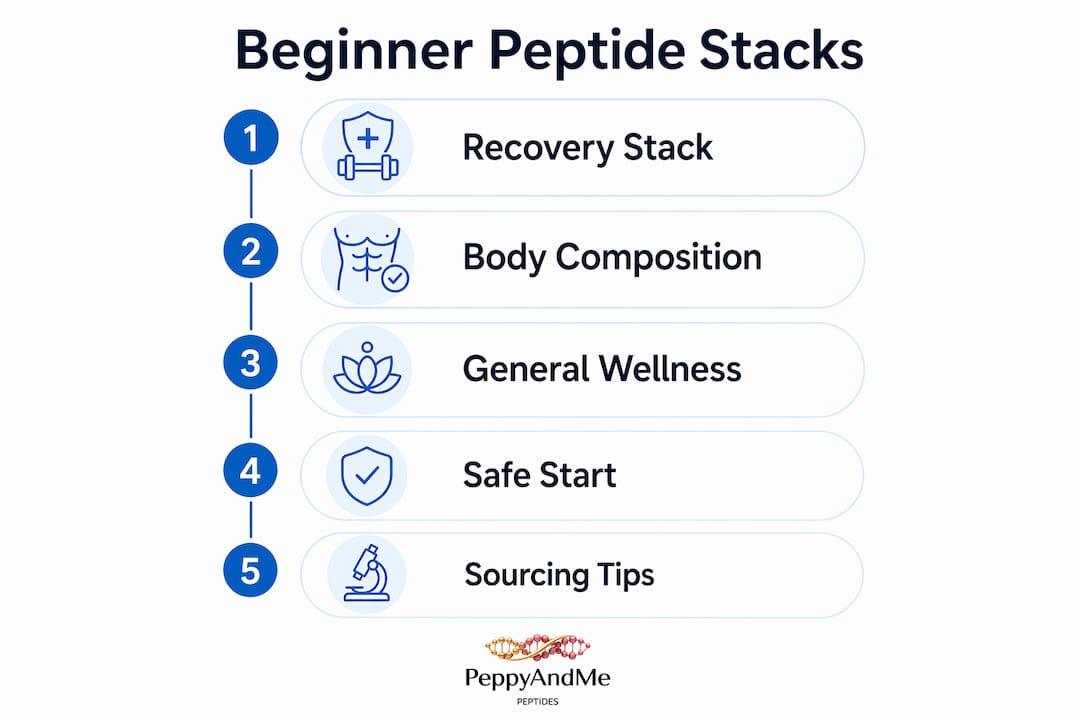
Recovery stack: BPC-157 plus TB-500
This combination targets tissue repair from two angles. BPC-157 works locally, supporting tendon, ligament, and gut tissue repair through growth factor upregulation and angiogenesis. TB-500 operates more systemically, promoting cell migration and reducing inflammation across broader tissue areas. Together, the rationale is that local and systemic healing mechanisms reinforce each other.
Typical research dosing for BPC-157 ranges from 250 to 500 mcg per day, administered subcutaneously or intramuscularly near the site of concern. TB-500 is often used at 2 to 5 mg per week during a loading phase. These are research-context figures, not clinical prescriptions.
Body composition stack: CJC-1295 plus Ipamorelin
This is the most evidence-supported beginner stack for those focused on muscle gain and fat metabolism. CJC-1295 is a GHRH analog that extends the half-life of growth hormone pulses, while Ipamorelin is a selective GHRP that triggers GH release without significantly raising cortisol or prolactin. The combination produces predictable synergistic GH output with a tolerability profile that suits beginners.
Research protocols typically use 100 mcg of Ipamorelin with 100 to 200 mcg of CJC-1295 (without DAC), administered before sleep to align with the body’s natural GH pulse.
General wellness stack: BPC-157 plus CJC-1295 and Ipamorelin
This three-compound protocol combines gut and tissue repair support with GH axis optimization. It is more complex and should only be considered after running each peptide individually. Stacking complexity increases risk in proportion to the number of compounds, and beginners are strongly advised to limit initial stacks to two peptides.
Key sourcing considerations for all stacks:
- Confirm third-party testing for purity (greater than 98% is the accepted research standard), sterility, endotoxins, and heavy metals
- Verify that the supplier provides traceable lot and batch numbers
- Avoid vendors that make therapeutic or disease-treatment claims, as this signals regulatory non-compliance
- Store lyophilized peptides at 2 to 8 degrees Celsius and reconstituted peptides in a refrigerator, away from light
What are the risks and regulatory considerations for beginners?
Peptide stacking carries real risks that beginners frequently underestimate, particularly around regulatory status, product quality, and unknown compound interactions.
The FDA regulates peptides through several overlapping frameworks. Compounded peptides face restrictions, and FDA enforcement in 2026 has clarified that marketing language implying human therapeutic use overrides “research use only” disclaimers. A vendor labeling a product as RUO while simultaneously describing its effects on human health is operating in a legally precarious position. Buyers of such products share that exposure. The reason many research peptides are not FDA-approved is not that they are ineffective. FDA approval requires massive financial investment, large-scale clinical trials, and commercial backing. Naturally occurring or difficult-to-patent compounds often receive less funding despite ongoing scientific interest.
The quality risk is equally serious. Gray-market peptide quality varies widely, and inconsistent vendor claims make it difficult to verify what is actually in a product without independent testing. Contamination with endotoxins, heavy metals, or microbial agents is a documented risk with unverified suppliers.
Practical risk mitigation for beginners includes the following:
- Limit initial stacks to two peptides to keep variables manageable
- Use cycling protocols (for example, five days on, two days off, or eight weeks on, four weeks off) to avoid receptor desensitization
- Never increase dose and add a new peptide in the same week
- Follow laboratory safety practices for reconstitution, storage, and injection technique
- Purchase only from suppliers with publicly available, third-party certificates of analysis
The combination of regulatory uncertainty and variable product quality makes sourcing decisions one of the highest-impact choices a beginner can make.
Key takeaways
Peptide stacks work best when each compound is understood individually first, sourced from verified suppliers, and introduced one at a time with careful monitoring.
| Point | Details |
|---|---|
| Start with one peptide | Establish individual tolerance before adding a second compound to avoid confounding effects. |
| CJC-1295 plus Ipamorelin is the strongest entry stack | This GH secretagogue combination has the most clinical support for synergistic effects and tolerability. |
| BPC-157 plus TB-500 is preclinical only | The recovery stack has strong mechanistic rationale but no direct controlled human trial data. |
| Limit stacks to two peptides | Adding more than two compounds multiplies unknowns and makes adverse effect tracking unreliable. |
| Source quality determines research validity | Third-party COAs for purity, sterility, endotoxins, and heavy metals are required for responsible use. |
Peppyandme’s perspective on starting peptide stacks
The most common mistake seen among beginners is treating mechanistic plausibility as clinical proof. Reading that two peptides activate different receptors and concluding they are therefore safe to combine is a logical shortcut that skips several important steps. The science of receptor synergy is real, but it does not tell you what happens to an individual’s IGF-1 levels, cortisol rhythm, or inflammatory markers over a 12-week protocol. That information only comes from careful, documented personal research.
The community enthusiasm around peptide stacking is understandable. The preclinical data for compounds like BPC-157 and TB-500 is genuinely interesting, and the GH secretagogue literature is among the more substantive bodies of evidence in this space. But enthusiasm is not a substitute for baseline blood work, conservative dosing, and sourcing from suppliers who can prove what is in their products.
At Peppyandme, the position is straightforward: peptides are a research tool, not a shortcut. The value of a well-designed protocol comes from the quality of the compounds, the rigor of the monitoring, and the willingness to adjust based on data rather than expectation. Beginners who approach stacking with that mindset tend to get the most out of it, and they do so without unnecessary risk.
Peptides complement a solid foundation of training, nutrition, and recovery. They do not replace it.
— Peppy&Me
Start your peptide research with Peppyandme
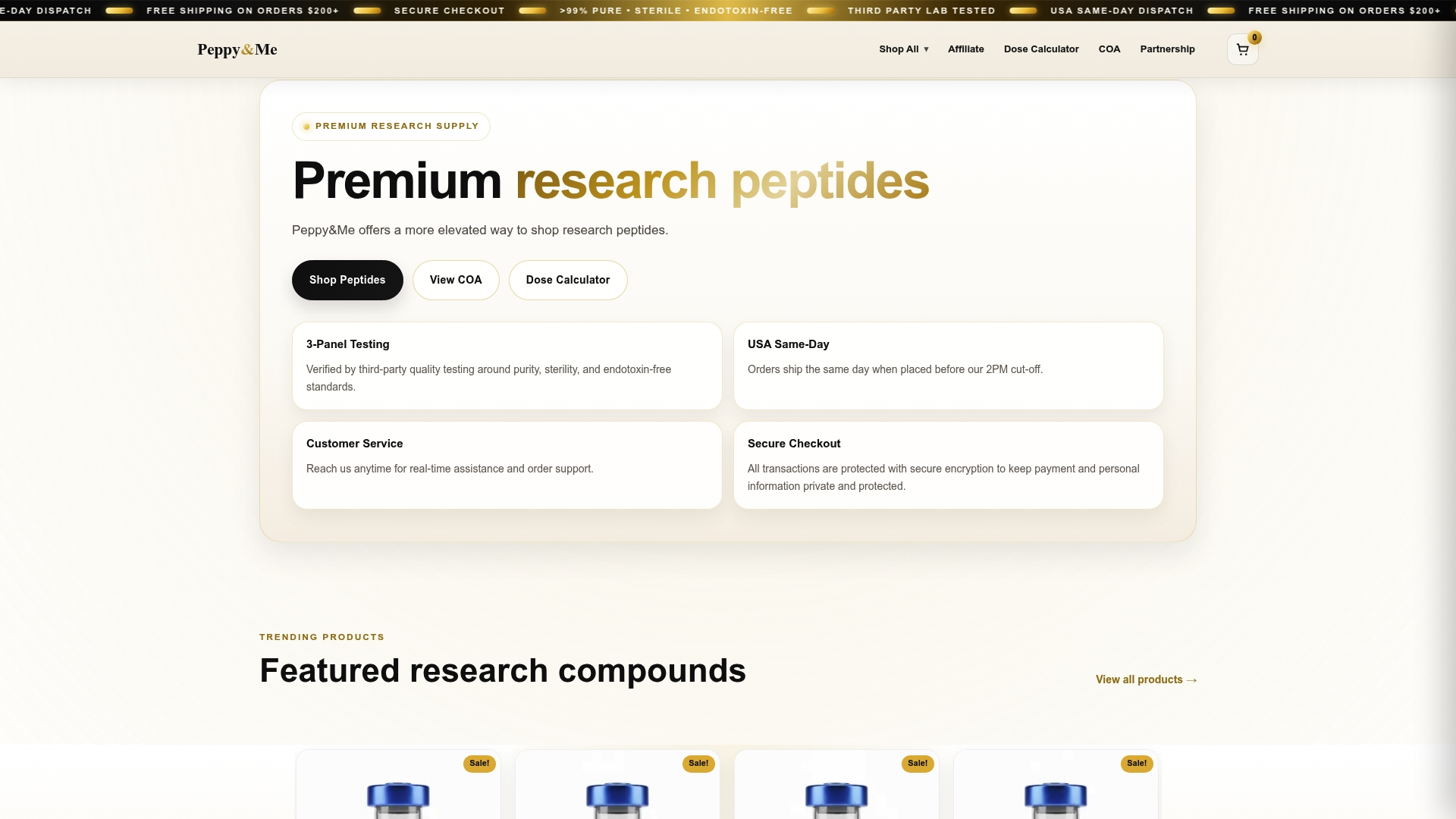
Peppyandme is built for researchers who take quality seriously. Every product in the catalog is third-party tested for purity, sterility, endotoxins, and heavy metals, with traceable lot and batch numbers from manufacturer to warehouse. Orders placed before 2 PM ship the same day. The platform includes a built-in dose calculator and a comprehensive peptide glossary covering protocols, handling, and research-based information for each compound. For beginners building their first protocol, the Peppyandme blog provides evidence-based sourcing guidance and lab best practices to support every stage of research. Access premium research peptides with the transparency and verification your research deserves.
FAQ
What are peptide stacks for beginners?
Peptide stacks are combinations of two or more peptides used together to target complementary biological pathways. Beginners should start with one peptide at a time before combining compounds to establish tolerance and track effects accurately.
Is the BPC-157 and TB-500 stack safe?
BPC-157 and TB-500 have complementary preclinical mechanisms supporting tissue repair, but no controlled human studies have confirmed the safety or efficacy of the combination directly. Individual peptide data and anecdotal reports form the current evidence base.
How many peptides should a beginner stack at once?
Beginners should limit stacks to two peptides. Adding more than three or four compounds at once is discouraged unless under expert supervision, as complexity multiplies unknowns and makes adverse effect tracking unreliable.
Why are research peptides not FDA-approved?
FDA approval requires large-scale clinical trials, substantial financial investment, and commercial backing. Many research peptides are naturally occurring or difficult to patent, which reduces the financial incentive for companies to pursue formal approval despite ongoing scientific interest.
What should I look for when sourcing peptides for a stack?
Prioritize suppliers that provide third-party certificates of analysis confirming purity above 98%, sterility, endotoxin levels, and heavy metal screening. Traceable lot and batch numbers from manufacturer to warehouse are the standard for responsible peptide sourcing.