BPC 157 Benefits Research: What the Evidence Shows

BPC 157 is defined as a synthetic pentadecapeptide derived from a protective protein found in human gastric juice, and bpc 157 benefits research now spans musculoskeletal repair, vascular homeostasis, gastrointestinal protection, and pain modulation. The compound consists of 15 amino acids and is formally designated Body Protection Compound 157. A 2026 MDPI review confirms that its evidence base is dominated by animal studies, with limited but emerging human data pointing toward real therapeutic potential. Researchers and health enthusiasts evaluating this peptide need a clear map of what the science actually supports, where the gaps remain, and what the current clinical trial landscape looks like.
What are the molecular mechanisms behind BPC 157’s healing effects?
BPC 157 operates through multiple biological pathways simultaneously, which is precisely why its effects appear across such a wide range of tissue types. The most significant mechanistic discovery in recent years comes from a 2026 study published in Cell Communication and Signaling, which identified that BPC 157 stabilizes BACH1 by binding to the E3 ubiquitin ligase adaptor FBXO22. This FBXO22–BACH1 signaling axis prevents BACH1 from being tagged for degradation, allowing it to accumulate and drive vascular endothelial cell proliferation. The result is measurable angiogenesis, meaning new blood vessel formation in damaged tissue.
Understanding BPC 157 through the FBXO22–BACH1 lens rather than as a generic healing agent changes how researchers should interpret its effects. BACH1 is a transcription factor whose activity is also influenced by cellular redox state. Under oxidative stress conditions, BACH1 shifts its functional direction, which means BPC 157’s antioxidant properties may work in concert with this pathway to regulate vascular repair. This complexity explains why the peptide’s effects are difficult to reduce to a single mechanism.
BPC 157 also modulates the nitric oxide system. Ex vivo human artery studies demonstrate that BPC 157 induces vasorelaxation that is partially nitric oxide dependent, but additional NO-independent pathways also contribute. This means the peptide does not rely on a single vascular signaling route, which may account for its consistent effects across different tissue environments. Researchers should treat this multi-pathway activity as a feature of the compound’s biology, not a sign of poorly understood pharmacology.
Key molecular pathways currently identified in BPC 157 research include:
- FBXO22–BACH1 axis: Prevents BACH1 ubiquitination, promoting angiogenesis and endothelial repair
- Nitric oxide modulation: Partial NO-dependent vasorelaxation confirmed in human arterial tissue
- Redox state regulation: Antioxidant activity influences BACH1 functional direction under oxidative conditions
- Growth hormone receptor upregulation: Preclinical data links BPC 157 to enhanced GH receptor expression in healing tissue
- Inflammatory cytokine reduction: Animal studies document decreased pro-inflammatory signaling at injury sites
Pro Tip: When reviewing BPC 157 mechanistic studies, distinguish between findings from cell culture, rodent models, and ex vivo human tissue. Each level of evidence carries different translational weight, and conflating them is the most common error in interpreting this literature.
What does preclinical research reveal about BPC 157’s therapeutic benefits?
The preclinical evidence for BPC 157 is extensive and covers a broader range of tissue types than most investigational peptides at a comparable stage of development. Animal studies document enhanced healing across muscle, tendon, ligament, bone, and skin, with measurable improvements in wound closure speed, collagen deposition quality, and angiogenesis density at repair sites. These effects have been reproduced across multiple rodent models and injury types, which strengthens confidence in the biological signal even before human data is available.
Gastrointestinal protection is one of the most consistently documented BPC 157 effects in animal research. The peptide accelerates ulcer healing, protects the gastric mucosa from NSAID-induced damage, and reduces intestinal inflammation in colitis models. This makes biological sense given that BPC 157 is derived from a gastric protein, and it suggests the compound may have evolved a protective role in the GI environment before being investigated as a systemic therapeutic agent.
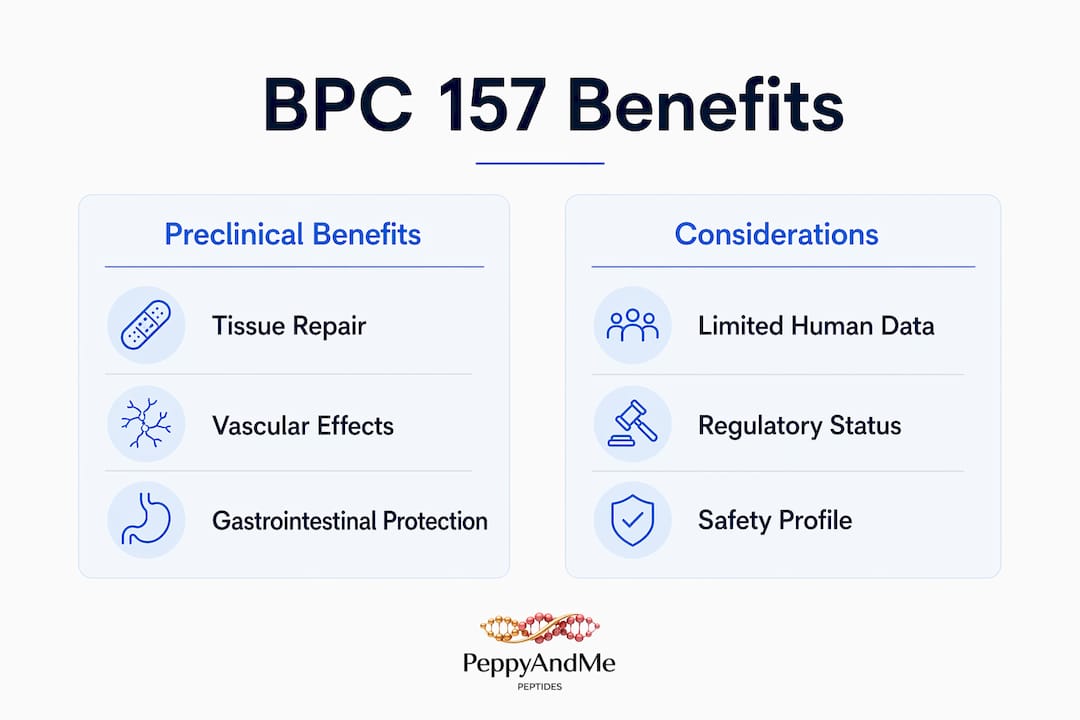
One of the more counterintuitive findings in preclinical BPC 157 research involves its vascular effects. Studies show that BPC 157 simultaneously decreases hemorrhage and thrombosis without directly interfering with coagulation pathways. This cytoprotective profile suggests the peptide stabilizes vascular homeostasis through endothelial protection rather than anticoagulation, which is a meaningfully different mechanism from conventional antithrombotic agents.
| Research area | BPC 157 preclinical finding | Conventional therapy comparison |
|---|---|---|
| Tendon and ligament repair | Accelerated collagen deposition and tensile strength recovery | Standard physical therapy alone shows slower histological recovery |
| Gastric ulcer healing | Mucosal regeneration and cytoprotection against NSAID damage | Proton pump inhibitors reduce acid but do not directly stimulate repair |
| Vascular homeostasis | Simultaneous antihemorrhagic and antithrombotic effects | Anticoagulants reduce clotting but increase bleeding risk |
| Muscle wound healing | Enhanced angiogenesis and reduced inflammatory cytokines | Anti-inflammatories reduce swelling but may impair repair signaling |
The safety profile in animal studies is notably clean. Rodent studies have not identified significant toxicity at therapeutic dose ranges, and no major organ damage has been reported in long-term preclinical models. This does not guarantee human safety, but it does provide a reasonable basis for proceeding to controlled human trials.
Pro Tip: When evaluating preclinical BPC 157 data, prioritize studies that report histological endpoints (collagen fiber alignment, angiogenesis density) over those reporting only functional outcomes. Histological data provides a more direct measure of tissue-level repair.
What is the current state of human clinical research on BPC 157?
Human data on BPC 157 remains limited, and that limitation must be stated clearly before any clinical interpretation. A small pilot pharmacokinetic and safety study administered intravenous BPC 157 at doses up to 20 mg and found no adverse events in either participant, with plasma clearance occurring within 24 hours. The sample size of two subjects makes this finding preliminary at best. It establishes tolerability as a hypothesis worth testing, not a confirmed safety profile.
The most significant development in human BPC 157 research is the ongoing Phase 2 clinical trial registered as NCT07437547. This trial is evaluating BPC 157’s effect on acute grade II hamstring muscle strain using two objective endpoints: MRI-measured injury volume change and return-to-sport timing. The trial pairs subcutaneous BPC 157 dosing with standardized rehabilitation protocols, which reduces confounding variables and increases the validity of any effectiveness data generated. Using MRI volume as an endpoint represents a meaningful shift toward rigorous clinical validation.
The steps that define the current human research trajectory are worth mapping clearly:
- Pilot pharmacokinetics (completed): Small-scale IV dosing confirmed rapid plasma clearance and initial tolerability, providing a pharmacokinetic baseline for dose selection in larger trials.
- Phase 2 trial design (active): NCT07437547 uses subcutaneous administration paired with structured rehabilitation, targeting a sports injury population with measurable, objective outcomes.
- MRI endpoint selection: Injury volume quantification via MRI removes subjective bias from outcome assessment, making the trial’s findings more defensible under regulatory scrutiny.
- Return-to-sport timing: This secondary endpoint captures functional recovery in a clinically meaningful way that resonates with both sports medicine practitioners and athletes.
- Safety monitoring: The trial includes comprehensive adverse event tracking, which will generate the first controlled human safety dataset for BPC 157 at therapeutic doses.
The regulatory context matters here. BPC 157 is not FDA-approved, and the path to approval requires large-scale controlled trials, substantial financial investment, and commercial backing. Naturally derived or difficult-to-patent compounds like BPC 157 often receive less industry funding despite genuine scientific interest, which is why academic and independent research groups are driving the current trial landscape. Researchers should also note that standardized dosing guidelines do not yet exist, and the prevalence of unregulated peptide use in athletic populations creates significant confounding in observational data.
What are the therapeutic applications and safety considerations of BPC 157?
The therapeutic areas where BPC 157 shows the most consistent preclinical support are tissue repair, pain modulation, vascular homeostasis, and gastrointestinal health. For researchers, these four domains represent the most defensible areas of investigation, each supported by multiple independent animal studies and at least partial mechanistic explanation. The complete guide to BPC 157 peptides provides additional context on how these applications are being explored across different research settings.
Safety considerations for BPC 157 research fall into two categories: known findings and knowledge gaps. The known findings are reassuring within their limits. Animal studies show no significant toxicity, and the single human pilot study reported clean tolerability. The knowledge gaps are substantial. There are no long-term human safety data, no established therapeutic dose range validated in controlled trials, and no data on BPC 157 effects in populations with cancer or pre-existing vascular pathology.
The angiogenesis question deserves specific attention. BPC 157 promotes new blood vessel formation, which is beneficial in wound healing and tissue repair contexts. In the context of cancer or uncontrolled vascular proliferation, however, angiogenesis stimulation may raise safety concerns. This is not a reason to dismiss the compound, but it is a reason to apply appropriate inclusion and exclusion criteria in any research protocol.
Key practical considerations for researchers working with BPC 157 include:
- Peptide purity: Research-grade BPC 157 must be verified for purity, sterility, endotoxin levels, and heavy metal content. Impure peptides introduce confounders that invalidate experimental results.
- Dosing variability: Without established human dosing guidelines, researchers should document dose selection rationale carefully and reference the pharmacokinetic pilot data as a starting point.
- Route of administration: Preclinical studies have used subcutaneous, intramuscular, and oral routes with varying bioavailability profiles. Route selection should match the research question.
- Regulatory compliance: BPC 157 is for research use only in most jurisdictions. Researchers must operate within applicable institutional and regulatory frameworks.
- Sourcing transparency: Lot and batch traceability from manufacturer to laboratory is non-negotiable for reproducible research. Reviewing lab best practices for peptide research before beginning any BPC 157 protocol is strongly recommended.
Key takeaways
BPC 157 demonstrates significant preclinical healing potential through multiple molecular pathways, but clinical validation in humans remains in early stages and requires cautious interpretation.
| Point | Details |
|---|---|
| Molecular mechanism clarity | The FBXO22–BACH1 axis is now the best-characterized pathway driving BPC 157’s angiogenic effects. |
| Preclinical breadth | Animal studies confirm healing benefits across muscle, tendon, bone, GI tissue, and vascular systems. |
| Human data limitations | Only a two-subject pilot study and one active Phase 2 trial (NCT07437547) constitute the current human evidence base. |
| Safety profile | No toxicity in animal models and no adverse events in the pilot study, but long-term human safety data are absent. |
| Research priority | Purity-verified, dose-controlled protocols paired with standardized rehabilitation represent the current gold standard for BPC 157 investigation. |
Peppy&Me’s perspective on interpreting BPC 157 research
The most common mistake in evaluating BPC 157 is treating mechanistic findings, preclinical outcomes, and clinical efficacy as interchangeable levels of evidence. They are not. A molecular pathway identified in cell culture tells you something real about biology. A rodent study showing accelerated tendon healing tells you something real about tissue response. Neither one tells you what will happen in a controlled human trial. Keeping these distinctions sharp is the foundation of credible research interpretation.
At Peppy&Me, we see researchers fall into two traps with equal frequency. The first is dismissing BPC 157 entirely because large-scale human trials are absent. The second is treating anecdotal reports and preclinical data as proof of clinical efficacy. Both positions misread the evidence. The honest position is cautious optimism: the mechanistic and preclinical signals are strong enough to justify rigorous human investigation, and NCT07437547 is exactly the kind of trial that will move the field forward.
The areas where further research would be most impactful are clear. Long-term safety data in diverse human populations, dose-response characterization across different routes of administration, and controlled studies in GI and vascular disease populations would each substantially advance the field. Until that data exists, researchers should prioritize protocol rigor, verified peptide sourcing, and conservative interpretation of results.
— Peppy&Me
Source your BPC 157 research compounds from Peppy&Me
Rigorous BPC 157 research begins with a peptide you can trust. Peppy&Me supplies research-grade peptides that are third-party tested for purity, mass accuracy, sterility, endotoxins, and heavy metals, with full lot and batch traceability from manufacturer to warehouse. Every product ships with documentation that supports reproducible, defensible research.
Peppy&Me also provides a built-in dose calculator and a comprehensive peptide glossary to support protocol development. Orders placed before 2 PM ship the same day, and real-time customer support is available for sourcing and order questions. For researchers who need a supplier that matches their standards for transparency and quality, Peppy&Me is built for exactly that purpose. Explore the full peptide research catalog and request documentation before your next study begins.
FAQ
What is BPC 157 and where does it come from?
BPC 157 is a synthetic pentadecapeptide consisting of 15 amino acids, derived from a protective protein found in human gastric juice. It is formally designated Body Protection Compound 157 and is studied for its regenerative and cytoprotective properties.
What does BPC 157 research show about tissue healing?
Preclinical studies document accelerated healing in muscle, tendon, ligament, bone, and gastrointestinal tissue, with effects on collagen deposition, angiogenesis, and inflammatory cytokine reduction. Human clinical data is limited to a small pilot study and one active Phase 2 trial targeting hamstring muscle strain.
How does BPC 157 promote angiogenesis at the molecular level?
BPC 157 stabilizes the transcription factor BACH1 by binding to the E3 ubiquitin ligase adaptor FBXO22, preventing BACH1 degradation and promoting vascular endothelial cell proliferation. This FBXO22–BACH1 axis is the best-characterized molecular mechanism identified in 2026 research.
Is BPC 157 safe for human use based on current research?
A two-subject pilot study found BPC 157 well tolerated with no adverse events at intravenous doses up to 20 mg, with plasma clearance within 24 hours. Long-term human safety data do not yet exist, and the compound is not FDA-approved for therapeutic use.
Why is BPC 157 not FDA-approved despite promising research?
FDA approval requires large-scale controlled clinical trials, substantial financial investment, and commercial backing that naturally derived or difficult-to-patent compounds rarely attract. BPC 157 research continues through academic and independent channels, with Phase 2 trial NCT07437547 representing the current frontier of clinical validation.