Sterile water for peptides: a researcher’s guide
TL;DR:
- Using sterile water for peptides is suitable only for single-use reconstitution, as it lacks preservative protection and presents contamination risks. Bacteriostatic water, containing 0.9% benzyl alcohol, allows safe multi-dose use over 28 days, reducing bacterial growth and maintaining peptide integrity. Proper aseptic technique, precise handling, and protocol adherence are essential to ensure research safety and data validity.
Sterile water for peptides and bacteriostatic water sit side by side in storage, look identical in the vial, and both dissolve lyophilized peptide powder without visible issue. Yet treating them as interchangeable is one of the most consequential errors in peptide preparation. The choice between them determines contamination risk, peptide stability, and whether a reconstituted solution remains safe beyond a single draw. This guide cuts through the confusion, clarifies exactly when sterile water is appropriate, and details the technique and handling protocols that protect both your research and your results.
Table of Contents
- Understanding sterile water and its role in peptide preparation
- Risks and limitations of using sterile water for peptides
- Best practices for reconstituting peptides with sterile water
- When is sterile water the right choice for peptide research?
- Storage and handling tips for sterile water and reconstituted peptides
- Rethinking peptide preparation: why sterility and technique trump shortcuts
- Explore premium research peptide supplies and support at Peppy&Me
- Frequently asked questions
Key Takeaways
| Point | Details |
|---|---|
| Know the difference | Sterile water has no preservatives; bacteriostatic water contains benzyl alcohol to inhibit bacteria growth. |
| Use sterile water singly | Sterile water must be used immediately after opening and discarded; suitable only for single-dose peptide reconstitution. |
| Gentle reconstitution | Add water slowly down vial walls to preserve peptide bonds and maximize potency. |
| Needle gauge matters | Use larger needles for reconstitution to reduce stopper coring and insulin syringes for dosing precision. |
| Storage protects | Reconstituted peptides with bacteriostatic water last weeks refrigerated; sterile water-based solutions degrade quickly. |
Understanding sterile water and its role in peptide preparation
Sterile water for injection (SWFI) is highly purified water that has been sterilized to eliminate microbial contamination. It contains no additives, no preservatives, and no antimicrobial agents. That purity is both its strength and its limitation.
Bacteriostatic water, by contrast, is sterile water with one critical addition: 0.9% benzyl alcohol as a preservative. That single ingredient changes everything about how the water can be used. Benzyl alcohol inhibits bacterial growth, which means a vial of bacteriostatic water can be punctured multiple times over a 28-day period without meaningful contamination risk. Sterile water offers no such protection. Once the septum is punctured, the clock starts immediately.
The distinction matters because the choice of water is not really about the peptide itself. It is about how you intend to use the vial. Single-use reconstitution with immediate administration? Sterile water is appropriate. Multiple draws from the same vial over days or weeks? That requires bacteriostatic water, full stop. Researchers who understand this distinction avoid a category of errors that compromises entire batches of work. For a deeper look at bacteriostatic water protocols, the bacteriostatic water guide at Peppy&Me is a practical reference.
Key differences at a glance:
| Feature | Sterile water (SWFI) | Bacteriostatic water |
|---|---|---|
| Preservative | None | 0.9% benzyl alcohol |
| Use type | Single-use only | Multi-dose (up to 28 days) |
| Shelf life after opening | Discard within 1 hour | Up to 28 days refrigerated |
| Benzyl alcohol sensitivity | Safe | Contraindicated in some cases |
| Cost per vial | Lower | Slightly higher |
| Contamination risk after puncture | High | Low |
- Sterile water is best for immediate, single-dose reconstitution where the entire vial contents will be used at once.
- Bacteriostatic water is the standard choice for peptide research protocols involving repeated dosing from the same vial.
- Neither type substitutes for the other without risk. The selection should be protocol-driven, not convenience-driven.
Risks and limitations of using sterile water for peptides
With the fundamental differences clear, understanding the practical dangers of misuse is critical for research safety.
The absence of preservatives in sterile water is not a minor technical footnote. It is the defining safety constraint. Once a sterile water vial is punctured, any microorganism introduced through the needle, the air, or the stopper surface can multiply in the solution without inhibition. Bacteria do not need much time. At room temperature, contamination can become significant within hours.
The risk compounds when researchers use sterile water in multi-dose scenarios. Do not substitute sterile water for bacteriostatic water in multi-dose peptide reconstitution, as the absence of a preservative increases bacterial contamination risk substantially. This is not a theoretical concern. Contaminated peptide solutions administered subcutaneously can introduce pathogens directly into tissue, and contaminated assay samples produce results that are impossible to trust.
Common risks associated with improper sterile water use:
- Puncturing a sterile water vial and storing the remainder for later use
- Reconstituting a peptide with sterile water and drawing multiple doses over several days
- Assuming that refrigeration alone prevents bacterial growth in a preservative-free solution
- Failing to use proper aseptic technique, which negates the sterility of the water itself
“The integrity of a sterile water solution depends entirely on the technique used to handle it. A perfectly sterile vial becomes a contamination risk the moment aseptic protocol breaks down.”
Proper sterile technique is not optional when working with sterile water. Alcohol swabs, clean work surfaces, and single-use handling are the baseline requirements. Any contamination introduced during reconstitution passes directly into the peptide solution and, from there, into tissue or experimental samples. For a full breakdown of lab best practices for peptides, Peppy&Me’s research resources cover the procedural details that protect both safety and data quality.
Pro Tip: Always label sterile water vials with the date and time of first use. If any solution remains after the initial draw, discard it immediately. There is no safe way to store an opened sterile water vial.
Best practices for reconstituting peptides with sterile water
Now that risks are understood, follow these detailed reconstitution steps to ensure peptide integrity and sterility with sterile water.
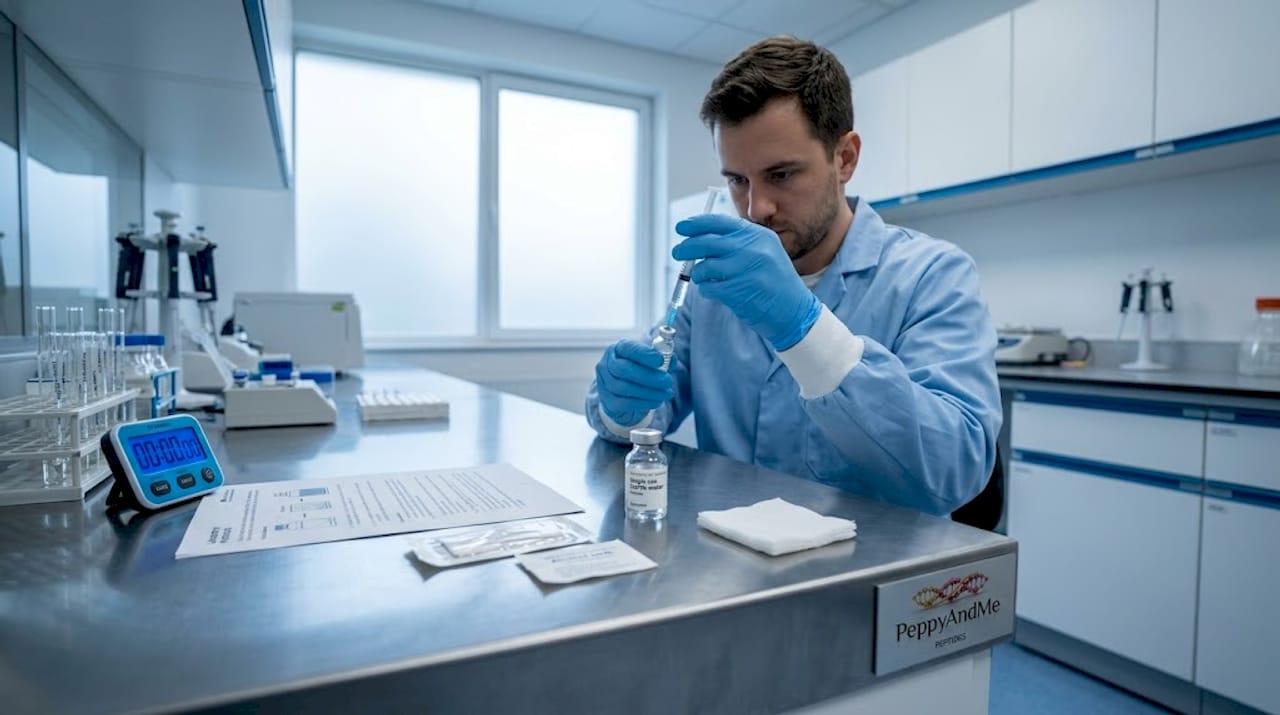
Lyophilized (freeze-dried) peptide powder is fragile. The physical force of water hitting the powder directly can disrupt peptide bonds and reduce potency. The technique used to add water matters as much as the water itself. Direct the stream down the glass wall slowly when adding water to a lyophilized peptide vial, to avoid damage to peptides and reduce potency loss.
Step-by-step reconstitution protocol using sterile water:
- Prepare your workspace. Clean the surface with 70% isopropyl alcohol. Gather your sterile water vial, peptide vial, alcohol swabs, a 20-22G needle for reconstitution, and insulin syringes for dosing.
- Swab both vial stoppers. Use a fresh alcohol swab on each stopper and allow it to dry for 30 seconds before puncturing. Do not touch the swabbed surface.
- Draw the sterile water. Using a 20-22G needle attached to a syringe, draw the precise volume of sterile water required for your target concentration. Use larger gauge needles (20-22G) for reconstitution to minimize rubber stopper coring and reduce particulate contamination.
- Add water slowly down the vial wall. Insert the needle into the peptide vial and angle it so the water runs gently down the inside glass wall. Never squirt directly onto the powder. This preserves peptide structure and avoids foaming.
- Allow passive dissolution. Do not shake the vial. Gentle swirling is acceptable if needed, but most peptides dissolve within a few minutes when left undisturbed. Visual clarity indicates complete dissolution.
- Switch to an insulin syringe for dosing. Once reconstituted, use a 29-31G insulin syringe for all subsequent draws and administration. The finer gauge minimizes tissue trauma and stopper damage.
- Use the entire reconstituted volume immediately. With sterile water, there is no safe storage window. Plan your reconstitution volume to match your immediate need.
Pro Tip: Avoid rubber stopper coring by using a 20-22G needle at a slight angle during insertion. Coring introduces small rubber fragments into the solution, which are difficult to detect visually and can compromise both safety and assay results.
For additional guidance on technique, Peppy&Me’s peptide handling techniques resource covers stability-focused handling across a range of peptide types.
When is sterile water the right choice for peptide research?
With the correct reconstitution method clear, understanding when sterile water is actually preferred brings clarity to selection decisions.
Sterile water is not a fallback option or a substitute for bacteriostatic water when the latter is unavailable. It is the correct choice in specific, well-defined scenarios. Sterile water is acceptable only for single-use peptide preparations or when benzyl alcohol preservative is contraindicated. Knowing those scenarios prevents both under-use and misuse.
Scenarios where sterile water is the appropriate choice:
- Single-use reconstitution: When the entire reconstituted peptide volume will be used in one session, sterile water is appropriate and avoids any preservative exposure.
- Benzyl alcohol sensitivity or contraindication: Benzyl alcohol is toxic to neonates and contraindicated in certain clinical and research contexts. Sterile water is the only safe diluent in these cases.
- Specific assay requirements: Some in vitro assays are sensitive to benzyl alcohol, which can interfere with cell viability or enzyme activity measurements. Sterile water eliminates that variable.
- Short-duration studies: Research protocols that require immediate use of freshly reconstituted peptide, such as acute response studies, align well with sterile water’s single-use profile.
Sterile water vs. bacteriostatic water: practical comparison
| Factor | Sterile water | Bacteriostatic water |
|---|---|---|
| Cost per vial | Lower (~$2-5) | Slightly higher (~$5-10) |
| Shelf life post-opening | Under 1 hour | Up to 28 days |
| Safety for neonates | Yes | No (benzyl alcohol toxicity risk) |
| Multi-dose use | Not safe | Safe |
| Assay compatibility | High (no additives) | Variable (benzyl alcohol may interfere) |
| Recommended for ongoing protocols | No | Yes |
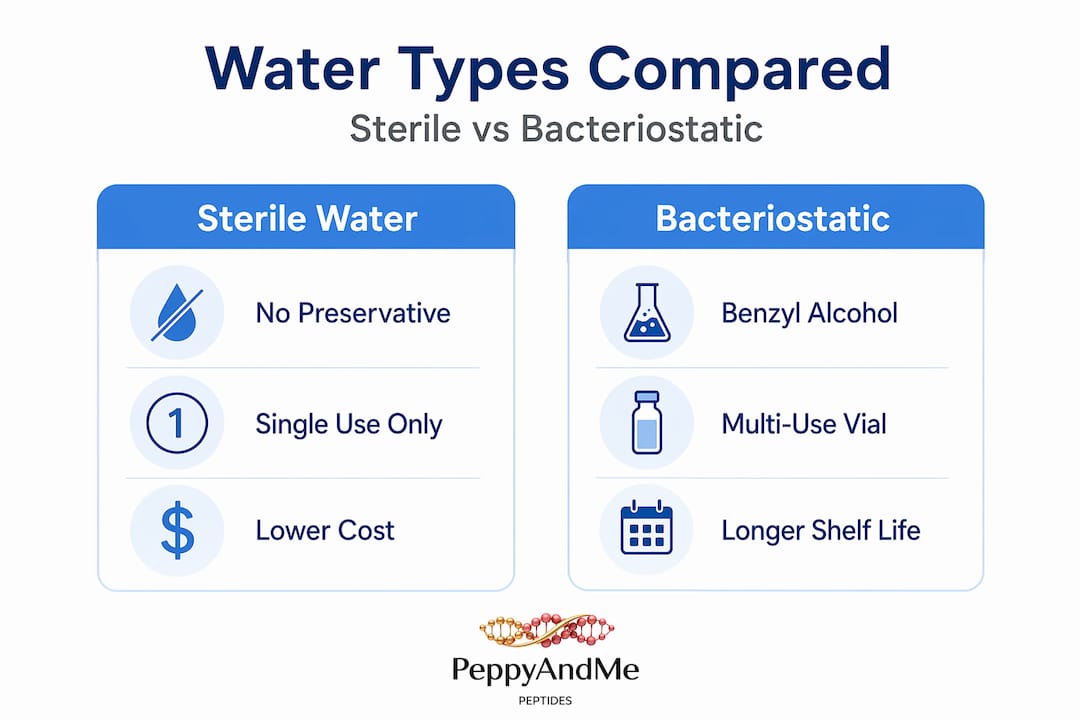
Cost is worth addressing directly. Sterile water vials are cheaper per unit, but the single-use constraint means that any unused portion is discarded. For researchers running multi-dose protocols, bacteriostatic water is more economical in practice because one vial serves multiple draws. The apparent savings from using sterile water in a multi-dose setting are offset by wasted peptide and contamination risk.
For researchers focused on sourcing quality peptides and matching them with the right preparation materials, aligning water type with study design from the outset is the most efficient approach.
Storage and handling tips for sterile water and reconstituted peptides
Having matched your reconstitution method to the peptide, follow these storage guidelines to preserve research integrity and safety.
Storage protocols for sterile water are straightforward but non-negotiable. Sterile water must be used immediately after opening and discarded within one hour to prevent bacterial growth. This is not a conservative recommendation. It reflects the reality that preservative-free water provides no barrier against microbial proliferation at any temperature above freezing.
Reconstituted peptide storage depends entirely on which water was used. Peptides reconstituted with bacteriostatic water remain stable for 3 to 4 weeks refrigerated at 2 to 8°C, while sterile water reconstituted samples degrade faster and must be used quickly. That difference has direct implications for how researchers plan their protocols.
Storage best practices:
- Discard opened sterile water immediately after drawing the required volume. Do not recap and refrigerate.
- Refrigerate reconstituted peptides (bacteriostatic water-based) at 2 to 8°C. Do not store at room temperature.
- Never freeze reconstituted peptide solutions. Freezing disrupts the peptide’s three-dimensional structure and reduces potency. Lyophilized powder can be frozen; reconstituted solutions cannot.
- Label every vial clearly with the peptide name, concentration, reconstitution date, and water type used. Unlabeled vials are a liability in any research setting.
- Keep vials away from direct light. UV exposure degrades many peptides, particularly those with aromatic amino acid residues like tryptophan or tyrosine.
Pro Tip: Protect reconstituted peptides from light by keeping them in their original amber vials or wrapping clear vials in aluminum foil. Even indirect light exposure over several days can measurably reduce peptide potency.
For further guidance on preserving peptide quality through handling and storage, Peppy&Me’s peptide stability tips resource provides protocol-specific recommendations.
Rethinking peptide preparation: why sterility and technique trump shortcuts
There is a persistent tendency in research settings to treat reconstitution as a minor procedural step rather than a critical point of failure. It is not. The quality of a peptide experiment is determined as much by what happens in the preparation phase as by the peptide’s intrinsic properties.
Many researchers underestimate how quickly a small lapse in technique translates into a compromised result. Using the wrong needle gauge introduces rubber particulates. Adding water too forcefully denatures a portion of the peptide. Storing an opened sterile water vial for a second use introduces contamination that is invisible to the naked eye. Each of these errors is individually small. Collectively, they erode the reliability of the data.
“The single greatest practical risk in self-administered peptide therapy is contamination from poor sterile technique” rather than the peptide or the needle itself.
That insight from clinical practice applies equally to research settings. The peptide is rarely the weak link. The process is. And the process is entirely within the researcher’s control.
Cost-driven substitutions deserve particular scrutiny. Replacing bacteriostatic water with sterile water to save a few dollars per vial is a false economy. If the reconstituted peptide is used across multiple draws, the contamination risk invalidates the entire preparation. The cost of a wasted peptide batch, plus the time lost repeating the experiment, far exceeds the cost of using the correct diluent from the start.
The same logic applies to needle selection, workspace preparation, and vial labeling. These are not bureaucratic formalities. They are the technical infrastructure that makes results reproducible. Researchers who treat lab safety practices as foundational rather than optional consistently produce cleaner data and fewer unexplained anomalies.
Pro Tip: Before beginning any reconstitution, write out the full protocol including water type, volume, needle gauge, and storage plan. Reviewing it takes 60 seconds and eliminates the category of errors that come from working from memory under time pressure.
The field of peptide research is advancing rapidly, and the quality of the science depends on the quality of the preparation. Sterility is not a background concern. It is the foundation on which every valid result is built.
Explore premium research peptide supplies and support at Peppy&Me
For researchers who take preparation as seriously as the science itself, sourcing materials from a supplier that matches that standard matters. Peppy&Me provides pharmaceutical-grade sterile and bacteriostatic water alongside a full catalog of research peptides, all third-party tested for purity, sterility, endotoxins, and heavy metals. Every product carries traceable lot and batch numbers from manufacturer to warehouse, so you know exactly what you are working with.
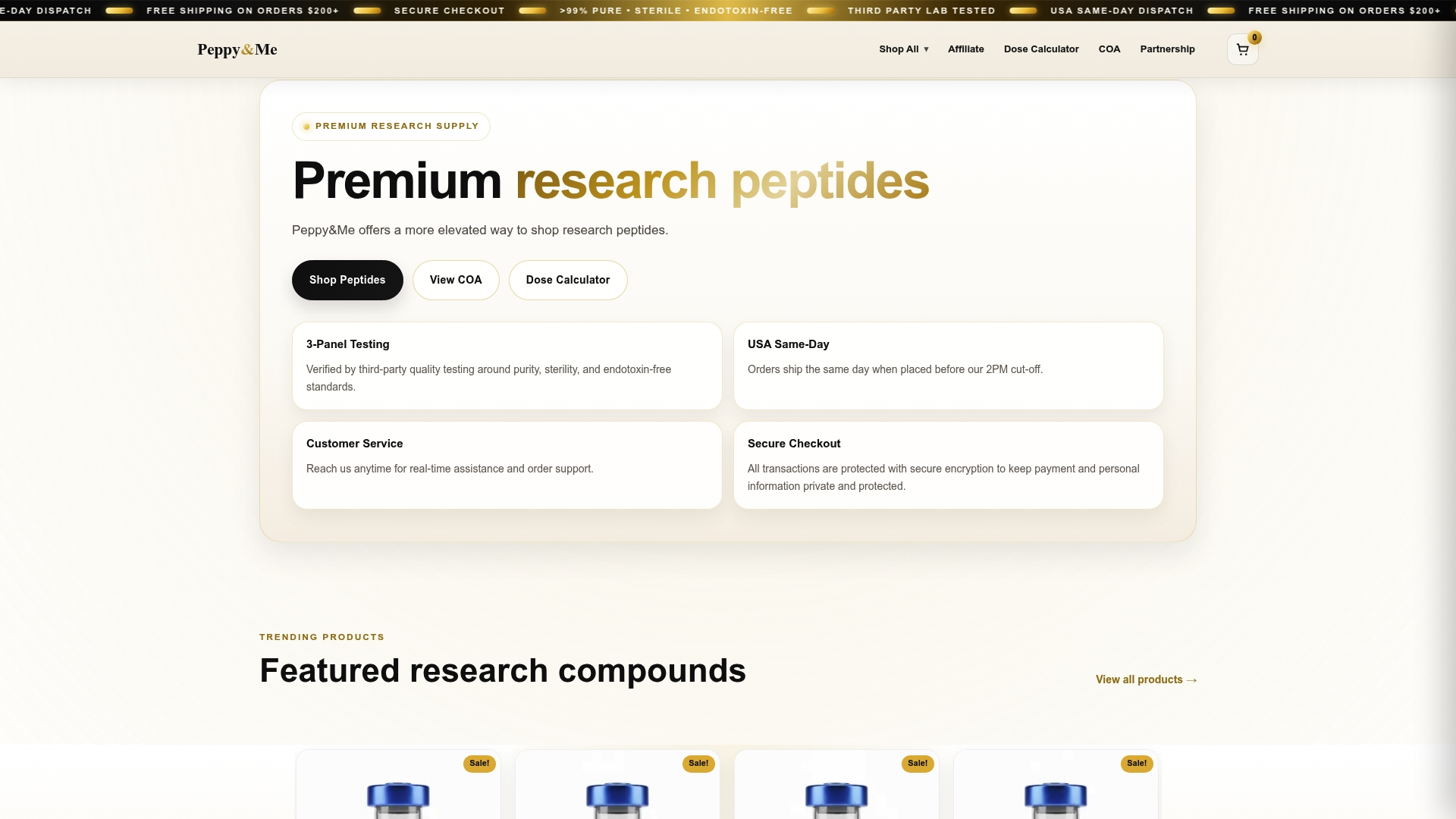
Peppy&Me’s platform is built for researchers who need more than a product listing. The built-in peptide dose calculator supports precise reconstitution planning, and the bacteriostatic water resources help you match diluent to protocol with confidence. Same-day shipping on orders placed before 2 PM, real-time customer support, and a secure checkout with strict data privacy make the sourcing process as reliable as the products themselves.
What you can access through Peppy&Me:
- Pharmaceutical-grade sterile water and bacteriostatic water for peptide preparation
- Third-party tested research peptides with full purity and sterility documentation
- Built-in dose calculator for accurate reconstitution planning
- Educational resources covering protocols, handling, and peptide-specific guidance
- Same-day shipping and responsive customer support
Frequently asked questions
Can sterile water be used for multi-dose peptide vials?
No. Sterile water lacks preservatives, so multi-dose vials reconstituted with it carry a significant bacterial contamination risk and should not be used for repeated draws.
How soon must sterile water be used after opening?
Sterile water must be used immediately after opening, and any unused portion should be discarded within one hour to prevent bacterial growth.
Why is bacteriostatic water usually preferred for peptide preparation?
Because it contains benzyl alcohol that inhibits bacterial growth, allowing safe multiple draws from the same vial for up to 28 days when stored refrigerated.
What is the correct needle gauge usage during peptide reconstitution?
Use a 20-22G needle for adding sterile water to minimize rubber stopper coring, then switch to a 29-31G insulin syringe for all dosing and administration.