How to source quality tirzepatide research peptide safely

TL;DR:
- Proper sourcing of tirzepatide requires GMP certification and verified documentation to ensure research validity.
- Researchers must implement continuous supplier verification and detailed documentation to maintain compliance.
- Building strong supplier relationships and institutional processes minimizes legal risks and improves experimental reproducibility.
Sourcing tirzepatide peptide for legitimate biomedical research is more complicated than most labs anticipate. The market is flooded with vendors making bold purity claims, but without verified documentation, those claims are scientifically worthless. Researchers who rely on gray-market sources risk invalidating their data, jeopardizing institutional approval, and creating serious regulatory exposure. This guide cuts through the noise and gives you a clear, practical framework for identifying GMP-certified tirzepatide suppliers, navigating compliance requirements, and building a procurement process that holds up to scrutiny.
Table of Contents
- Understanding tirzepatide and its research value
- Choosing a trustworthy tirzepatide supplier
- Quality assurance, compliance, and institutional requirements
- Practical steps: Buying, handling, and documenting tirzepatide peptide
- The overlooked risks of research peptide sourcing: What most labs miss
- How Peppy&Me supports compliant tirzepatide research peptide sourcing
- Frequently asked questions
Key Takeaways
| Point | Details |
|---|---|
| Prioritize GMP suppliers | Only source research peptides from GMP-certified suppliers with supporting documentation for quality and compliance. |
| Verify regulatory documents | Request and review CoAs, DMF/CEP filings, and batch traceability to ensure research integrity. |
| Follow institutional protocols | Comply with all legal and ethical guidelines when purchasing, handling, and documenting tirzepatide for research. |
| Avoid gray-market risks | Non-compliant vendors jeopardize your findings, legal standing, and ability to publish. |
Understanding tirzepatide and its research value
Tirzepatide is a synthetic 39-amino acid peptide that functions as a dual agonist of the glucose-dependent insulinotropic polypeptide (GIP) receptor and the glucagon-like peptide-1 (GLP-1) receptor. This dual mechanism sets it apart from earlier GLP-1 receptor agonists like semaglutide, which target only one pathway. By engaging both receptors simultaneously, tirzepatide produces stronger effects on insulin secretion, appetite regulation, and energy metabolism than single-receptor agents.
The clinical data supporting tirzepatide’s research relevance is substantial. The SURMOUNT-1 trial demonstrated up to 22.5% weight loss in participants with obesity, and the SURPASS-2 trial confirmed tirzepatide’s superiority over semaglutide in reducing HbA1c and body weight. These findings have made tirzepatide one of the most actively studied peptides in metabolic disease research today. For researchers exploring obesity, type 2 diabetes, cardiovascular risk reduction, or energy homeostasis, tirzepatide represents a high-priority compound.
Key research applications
- Metabolic disease modeling: Tirzepatide’s dual receptor activity makes it a strong candidate for studying insulin resistance and adipose tissue dynamics.
- Comparative efficacy studies: Its head-to-head advantage over semaglutide creates clear opportunities for mechanistic comparison research.
- Cardiovascular risk research: Emerging data on tirzepatide’s effects on lipid panels and blood pressure opens new investigational avenues.
- Neuroendocrine signaling: GIP receptor activity in the central nervous system is an active area of inquiry, and tirzepatide provides a useful tool compound.
Tirzepatide efficacy snapshot
| Trial | Comparator | Key outcome |
|---|---|---|
| SURMOUNT-1 | Placebo | Up to 22.5% body weight reduction |
| SURPASS-2 | Semaglutide 1mg | Greater HbA1c and weight reduction |
| SURPASS-3 | Insulin degludec | Superior glycemic control |
| SURPASS-CVOT | Standard of care | Cardiovascular outcomes (ongoing) |
The common side effect profile, primarily gastrointestinal, including nausea, vomiting, and diarrhea, is important context for any preclinical or translational study design. Researchers should account for these effects when designing dose-escalation protocols or interpreting behavioral data in animal models.
Why purity matters here: When the peptide you use in a study contains even trace endotoxins, residual solvents, or incorrect mass accuracy, your results become unreliable and potentially unpublishable. A peptide with 95% purity sounds acceptable, but that 5% unknown content can produce off-target biological effects that distort your findings. Explore peptide research insights for a deeper look at how purity standards directly affect experimental validity.
Choosing a trustworthy tirzepatide supplier
With the scientific rationale established, the next challenge is identifying suppliers who can actually deliver research-grade tirzepatide with the documentation your institution requires. This is where many research teams make costly mistakes.

Good Manufacturing Practice (GMP) is the regulatory standard that governs the production of pharmaceutical-grade compounds. It covers everything from raw material sourcing and manufacturing environment controls to quality testing and batch documentation. For research peptides, GMP certification signals that the manufacturer follows rigorous, auditable processes, not just informal quality checks.
What to look for in a tirzepatide supplier
- Certificate of Analysis (CoA): Every legitimate batch should come with a CoA that includes purity percentage, mass accuracy, endotoxin levels, sterility testing results, and residual solvent data. If a vendor cannot produce this document immediately, that is a serious red flag.
- Drug Master File (DMF) or Certificate of Suitability (CEP): These filings with the FDA or European Medicines Agency (EMA) confirm that the supplier’s manufacturing process meets regulatory standards. They are essential for any research intended for publication or regulatory submission.
- Batch traceability: Full traceability means you can trace the compound from the raw starting material through synthesis, purification, testing, and final packaging. This chain of custody is non-negotiable for institutional research.
- Third-party testing: Reputable suppliers send samples to independent laboratories for verification. In-house testing alone is insufficient for research-grade claims.
- Regulatory history: Suppliers with a track record of FDA or EMA inspections and no significant findings carry considerably less risk than newer, unaudited vendors.
Recognized GMP-certified tirzepatide API suppliers
Legitimate GMP-certified suppliers for tirzepatide active pharmaceutical ingredient (API) include Rochem International, ChemWerth, TAPI (Teva API), and MedicaPharma. These organizations maintain the CoA, DMF/CEP filings, and full batch traceability that academic and clinical research environments require.
| Supplier | GMP certified | DMF/CEP available | Traceability | Suitable for academic research |
|---|---|---|---|---|
| Rochem International | Yes | Yes | Full | Yes |
| ChemWerth | Yes | Yes | Full | Yes |
| TAPI (Teva API) | Yes | Yes | Full | Yes |
| MedicaPharma | Yes | Yes | Full | Yes |
| Gray-market online vendor | Unverified | Rarely | Partial or none | No |
“The difference between a GMP-certified supplier and a gray-market vendor is not just paperwork. It is the difference between publishable data and wasted resources.”
Pro Tip: Before placing any order, request the supplier’s most recent CoA for the specific tirzepatide lot you are purchasing, not a generic document. Batch-specific documentation is the only way to confirm what you are actually receiving.
Gray-market vendors often undercut certified suppliers on price, but the hidden costs are significant. Studies conducted with unverified peptides face rejection during peer review when reviewers question compound integrity. Institutional review boards (IRBs) and ethics committees increasingly require documentation of compound sourcing. Explore legitimate research peptide sourcing to understand how partnership-level access can simplify this process.
Quality assurance, compliance, and institutional requirements
Identifying a good supplier is only part of the equation. The procurement and handling processes within your institution must also meet legal and ethical standards. Many researchers underestimate how much documentation their institution actually requires until they face an audit or a grant review.
Documentation checklist for compliant tirzepatide procurement
- Supplier qualification record: A formal assessment of the supplier’s GMP status, regulatory filings, and quality history.
- Purchase order with compound specifications: The PO should specify purity requirements, testing standards, and acceptable lot numbers.
- Received batch CoA: Filed alongside the purchase record for every order.
- Storage condition log: A temperature and humidity record from the moment the compound arrives at your facility.
- Chain-of-custody record: Documents who handled the compound, when, and for what purpose.
- Disposal or use record: Tracks how the compound was consumed or disposed of, as required by institutional biosafety and controlled substance policies.
Researchers sourcing tirzepatide for traceability and ethical sourcing purposes should also be aware that some institutions classify certain peptides under controlled substance-adjacent categories, requiring additional approval layers before procurement can begin.
Legal risks of noncompliant sourcing
Purchasing research peptides from unverified vendors creates exposure on multiple fronts. First, if the compound causes unexpected adverse effects in a study, the absence of proper documentation makes it nearly impossible to defend the research protocol. Second, publications based on unverified compounds face increasing scrutiny, and journals now routinely request compound sourcing documentation during peer review. Third, institutional liability extends to the principal investigator and department if a sourcing violation is discovered during a federal audit.
Prioritizing GMP suppliers like Rochem or TAPI over gray-market online vendors significantly reduces legal risk and ensures your research meets the quality control and regulatory filing standards that institutions and journals expect.
Pro Tip: Build a supplier qualification template that your lab uses for every new compound purchase. Include fields for GMP status, DMF/CEP number, third-party testing confirmation, and institutional approval date. This turns a one-time compliance check into a repeatable, auditable process.
Institutional purchasing approvals often require sign-off from a biosafety officer, a department head, and sometimes a grants compliance officer. Starting this process early, ideally before you need the compound, prevents delays that can derail study timelines.
Practical steps: Buying, handling, and documenting tirzepatide peptide
Once compliance is confirmed and your supplier is vetted, the operational side of procurement and handling requires equal attention. Even the highest-quality tirzepatide peptide can be compromised by poor handling or incomplete documentation at the lab level.
Sequential purchasing workflow for research use
- Initiate institutional approval: Submit your compound request to your IRB or institutional biosafety committee with full supplier documentation attached.
- Request a batch-specific quote: Contact your approved supplier and request a quote tied to a specific, available lot number. Confirm that the CoA for that lot is available before committing.
- Submit a formal purchase order: Use your institution’s procurement system to generate an official PO with compound specifications, quantity, and required documentation listed.
- Confirm shipping conditions: Tirzepatide peptide is sensitive to temperature fluctuations. Confirm that the supplier ships with appropriate cold-chain packaging and that your receiving team is prepared to log arrival conditions immediately.
- Log receipt and inspect documentation: Upon arrival, verify that the received CoA matches the ordered lot number, check the physical condition of the packaging, and enter the compound into your inventory management system.
- File all documents in a centralized research record: Every document related to this purchase should be stored in a single, accessible location that can be produced during an audit or journal review.
GMP-certified suppliers provide the full traceability and documentation necessary for compliant handling, but the responsibility for maintaining that chain of custody once the compound arrives sits entirely with your lab.
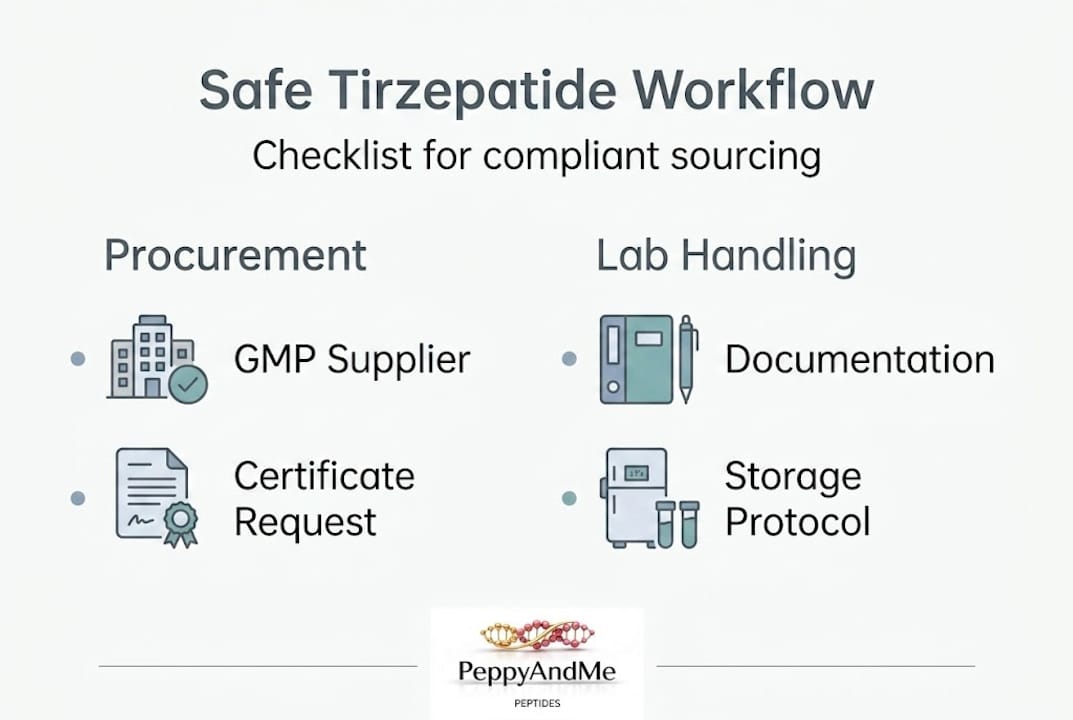
Storage and handling protocols
Tirzepatide peptide should be stored lyophilized (freeze-dried) at minus 20 degrees Celsius or below for long-term stability. Once reconstituted, working solutions should be kept at 4 degrees Celsius and used within 48 to 72 hours to minimize degradation. Avoid repeated freeze-thaw cycles, as these significantly reduce peptide integrity.
Use low-binding tubes and pipette tips to minimize adsorption losses, particularly when working with small volumes. Aliquot your stock solution into single-use volumes immediately after reconstitution to eliminate the need for repeated handling of the same vial.
Pro Tip: Label every vial with the lot number, reconstitution date, concentration, and your initials. This takes 30 seconds and can save hours of confusion during data analysis or an audit review. Explore peptide handling best practices for detailed reconstitution protocols and storage guidance specific to research peptides.
Documenting chain-of-custody
Every time tirzepatide changes hands within your lab, that transfer should be logged. This includes transfers between researchers, movements between storage units, and any use in experimental protocols. A simple paper or digital log with date, time, person responsible, and purpose is sufficient for most institutional requirements. The key is consistency. Gaps in the chain-of-custody record are one of the most common findings in compliance audits and one of the easiest to prevent.
The overlooked risks of research peptide sourcing: What most labs miss
Most sourcing guides stop at supplier selection and documentation checklists. That is useful, but it misses a deeper problem that affects even well-resourced labs: the assumption that a purchase order from an approved vendor is the end of the compliance story. It is not. It is the beginning.
Supply chain verification needs to extend beyond the initial supplier qualification. Manufacturers change contract testing labs, shift raw material sources, or update synthesis routes without notifying customers. A supplier that was fully compliant when you first qualified them may have gaps in their current process. Post-purchase auditing, meaning periodic re-verification of your supplier’s current GMP status and testing practices, is a step most labs skip entirely.
Here is a practical example. A research team publishes a study using tirzepatide from a supplier they qualified two years prior. During peer review, a reviewer requests the current CoA. The team discovers that the supplier switched their third-party testing lab six months ago, and the new lab’s endotoxin testing methodology is not validated to the same standard. The paper is delayed by four months while the team re-verifies the compound. One proactive check per year would have caught this before it became a publication bottleneck.
The myth worth debunking is that institutional purchase orders alone guarantee compliance. A PO proves you followed your institution’s financial process. It does not verify the compound’s quality, the supplier’s current regulatory standing, or the integrity of the batch you received. Compliance is a continuous practice, not a one-time checkbox.
Building compliant peptide supply chains means treating supplier relationships as ongoing partnerships with regular touchpoints, not transactional exchanges. Labs that adopt proactive quality controls produce more reproducible results, face fewer publication delays, and are significantly better positioned when federal funding audits occur.
How Peppy&Me supports compliant tirzepatide research peptide sourcing
For labs looking to streamline the sourcing and documentation process, Peppy&Me offers a research-focused platform built specifically for professionals who need quality, transparency, and efficiency in one place.
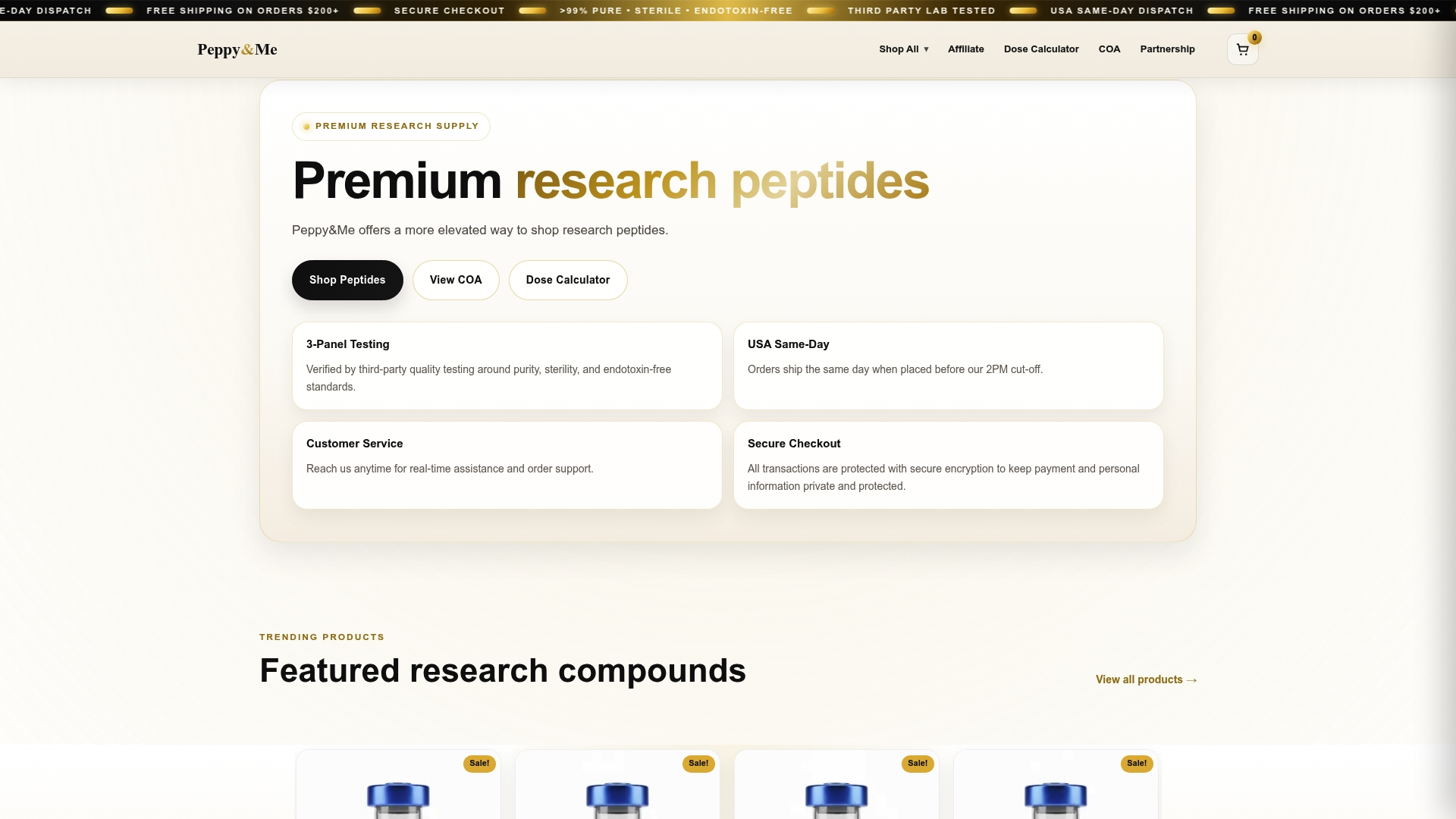
All peptides available through Peppy&Me are third-party tested for purity, mass accuracy, endotoxins, sterility, and heavy metals, with traceable lot and batch numbers from manufacturer to warehouse. The built-in dose calculator for research supports precise measurement planning, and the peptide glossary provides protocol-level guidance for handling and storage. For institutions or entrepreneurs seeking a scalable sourcing solution, the private label partnership program offers backend fulfillment with full operational support. Same-day shipping for orders placed before 2 PM and real-time customer support make the procurement process faster and more reliable.
Frequently asked questions
What regulatory documents should I request from a tirzepatide research peptide supplier?
You should always request a Certificate of Analysis (CoA), traceable batch documentation, and, if available, DMF or CEP filings for institutional use. GMP-certified suppliers provide full traceability and documentation necessary for compliant handling.
Why is GMP certification important for tirzepatide research peptides?
GMP ensures the peptide’s purity and traceability, reducing risk of contamination or regulatory noncompliance in published studies. Researchers should prioritize GMP suppliers like Rochem or TAPI for superior quality control and regulatory documentation.
How does tirzepatide compare to semaglutide in clinical research outcomes?
Recent studies show tirzepatide offers greater A1c reductions and greater weight loss than semaglutide, but with a more pronounced gastrointestinal side effect profile that researchers should account for in study design.
What are common legal pitfalls in buying tirzepatide research peptide?
Purchasing from gray-market suppliers without proper documentation or failing to comply with institutional requirements can result in regulatory action or loss of publication eligibility. Verifying institutional compliance standards before procurement is essential to protecting both the research and the researchers involved.