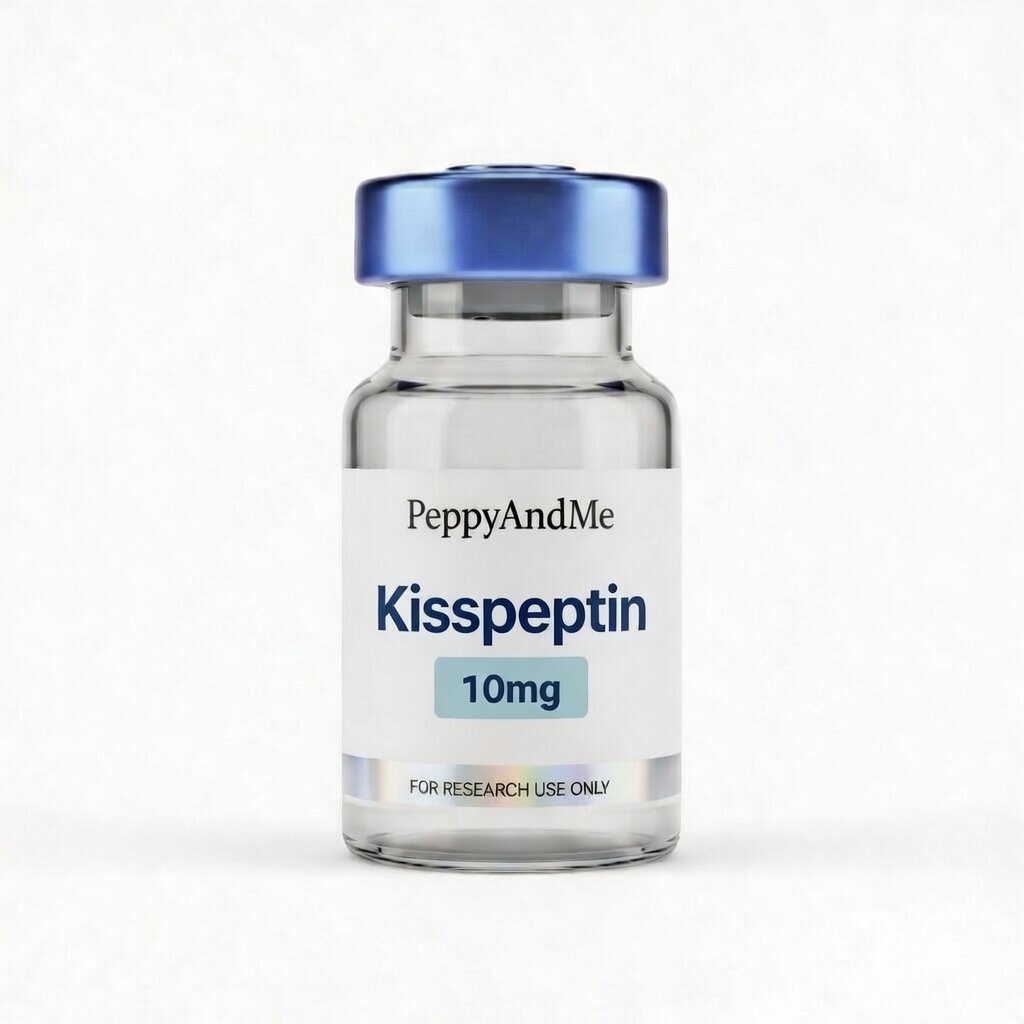
Laboratory Handling Directions
- Store at controlled room temperature (15–25°C / 59–77°F)
- Protect from light and moisture during storage
- Use aseptic technique when handling compound
- Reconstitute with sterile or bacteriostatic water as appropriate
- Once reconstituted, refrigerate at 2–8°C (36–46°F)
- Document all handling procedures per laboratory protocols
Critical Compliance Notice
FOR RESEARCH USE ONLY. This product is sold strictly for in-vitro laboratory research, educational purposes, and scientific investigation. It is NOT intended for human or veterinary use. By purchasing this product, the buyer confirms they are a qualified researcher and assumes full responsibility for ensuring compliance with all applicable regulations.
Mechanism of Action
Kisspeptin (primarily kisspeptin-54 and its shorter forms like kisspeptin-10) is a neuropeptide that binds to the kisspeptin receptor (KISS1R/GPR54), a G protein-coupled receptor predominantly coupled to Gq/11 proteins. This activates phospholipase C, leading to IP3-mediated intracellular calcium release, DAG production, PKC activation, and downstream signaling via MAPK/ERK pathways, PI3K/Akt, and in some cases cAMP elevation through Gs crosstalk. These cascades stimulate GnRH neuron depolarization and pulsatile GnRH secretion from the hypothalamus, thereby driving gonadotropin (LH and FSH) release from the pituitary and regulating the hypothalamic-pituitary-gonadal (HPG) axis. Recent laboratory investigations continue to elucidate its pleiotropic effects, including modulation of sexual behavior circuits, metabolic homeostasis, anti-inflammatory actions, cardiovascular tone regulation, and potential neuroprotective influences, with reassuring evidence highlighting its role in synchronizing neuronal networks (e.g., via glutamate-AMPA in arcuate kisspeptin neurons) and supporting adaptive reproductive and physiological responses in diverse models.
Research Applications
-
HPG axis regulation and pulsatile GnRH/LH/FSH secretion studies
-
Puberty onset and reproductive maturation pathway investigations
-
Hypogonadotropic hypogonadism and infertility mechanism analysis
-
Metabolic-reproductive integration and energy balance research
-
Sexual behavior and motivation modulation in neural circuits Polycystic ovary syndrome (PCOS) and functional hypothalamic amenorrhea models
-
Neuroendocrine responses in aging, stress, or post-viral conditions evaluation
Reviews
There are no reviews yet.