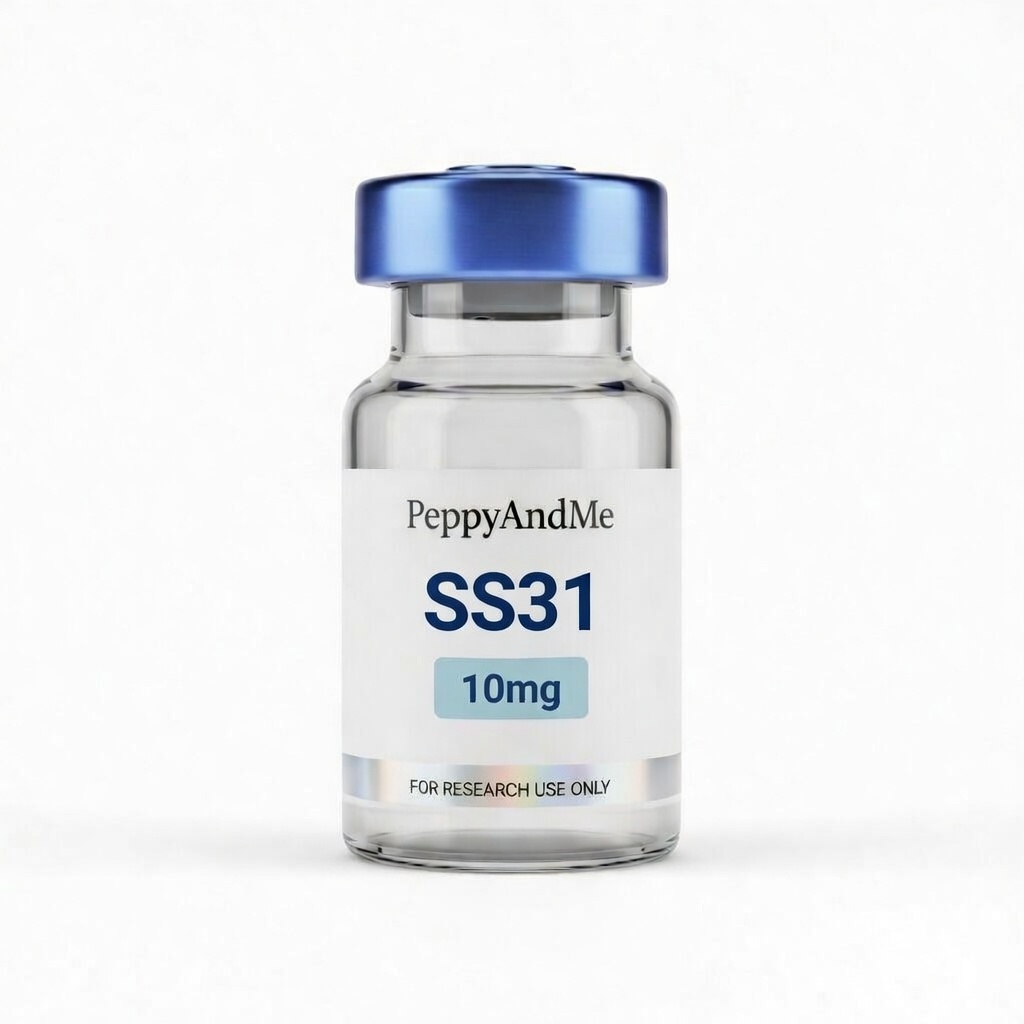
Laboratory Handling Directions
- Store at controlled room temperature (15–25°C / 59–77°F)
- Protect from light and moisture during storage
- Use aseptic technique when handling compound
- Reconstitute with sterile or bacteriostatic water as appropriate
- Once reconstituted, refrigerate at 2–8°C (36–46°F)
- Document all handling procedures per laboratory protocols
Critical Compliance Notice
FOR RESEARCH USE ONLY. This product is sold strictly for in-vitro laboratory research, educational purposes, and scientific investigation. It is NOT intended for human or veterinary use. By purchasing this product, the buyer confirms they are a qualified researcher and assumes full responsibility for ensuring compliance with all applicable regulations.
Mechanism of Action
SS-31 (also known as Elamipretide) is a synthetic mitochondria-targeting tetrapeptide (D-Arg-Dmt-Lys-Phe-NH₂) that selectively accumulates in the inner mitochondrial membrane, where it binds to cardiolipin (CL) through electrostatic and hydrophobic interactions. This binding stabilizes mitochondrial cristae architecture, inhibits cytochrome c peroxidase activity induced by CL, reduces electron leakage from the respiratory chain, suppresses mitochondrial reactive oxygen species (ROS) production, enhances electron transfer efficiency, and promotes ATP synthesis while preventing mitochondrial permeability transition pore opening and calcium overload. Recent laboratory investigations continue to demonstrate its ability to restore bioenergetics, mitigate oxidative stress, modulate membrane electrostatics, protect against protein aggregation (e.g., α-synuclein), and support mitochondrial quality control in dysfunctional states, offering reassuring protective effects on cellular energy homeostasis and resilience.
Research Applications
Mitochondrial dysfunction and oxidative stress pathway studies
Cardiolipin stabilization and inner membrane architecture investigations
ROS scavenging and bioenergetic restoration research
Neurodegenerative models involving α-synuclein aggregation and mitochondrial impairment
Cardiovascular and renal ischemia-reperfusion injury analysis Age-related sarcopenia, cardiac function, and skeletal muscle decline evaluation
Inflammatory and apoptotic pathway modulation in mitochondrial disorders

Reviews
There are no reviews yet.