Peppyandme Peptide Calculator: Precise Dosing Made Easy
The Peppyandme peptide calculator is a dosing tool that converts three inputs — vial peptide mass, reconstitution volume, and target dose — into an exact volume to draw from a syringe. For researchers and individuals working with lyophilized research peptides, this kind of precision is not optional. A miscalculation of even a fraction of a milliliter can shift a dose by hundreds of micrograms, compromising both safety and experimental reproducibility. Peppyandme built this peptide dose calculator directly into its platform so users have a reliable, free resource at the point of need, rather than relying on manual arithmetic or generic spreadsheets that introduce error.
What inputs does the Peppyandme peptide calculator require?
Standard peptide calculators require three core inputs: total peptide mass in milligrams (mg), diluent volume in milliliters (mL), and target dose in micrograms (mcg) or milligrams (mg). The Peppyandme peptide calculator follows this same structure, and understanding each input before you begin is what separates a reliable protocol from a guesswork-driven one.
The three primary inputs
- Total peptide mass (mg): This is the amount printed on the vial label. A vial labeled “5 mg” contains 5 mg of lyophilized peptide before reconstitution.
- Diluent volume (mL): The volume of bacteriostatic water you add to the vial. This number directly determines the final concentration of your solution. Choosing this volume strategically affects how easily you can draw precise amounts on an insulin syringe.
- Target dose (mcg or mg): The dose amount specified by your research protocol. Most peptide doses are expressed in micrograms, so confirm units before entering any value.
A fourth consideration, often overlooked, is net peptide content. Net peptide content is the actual peptide amount after removing impurities and counter-ions, and it is lower than the raw vial weight or HPLC purity figure. For most standard research applications, the labeled vial mass is sufficient. For high-precision work where every microgram matters, net peptide content from the Certificate of Analysis (CoA) gives a more accurate starting figure.
Input reference table

| Input | Unit | Where to find it |
|---|---|---|
| Total peptide mass | mg | Vial label |
| Diluent volume | mL | Your reconstitution plan |
| Target dose | mcg or mg | Research protocol |
| Net peptide content | % or mg | Certificate of Analysis |
| Molecular weight | Da (Daltons) | Certificate of Analysis |
Getting these values right before opening the calculator takes less than two minutes and eliminates the most common source of dosing error: entering the wrong unit or the wrong number.
How the calculator converts inputs into dosing outputs
Once you enter your three inputs, the calculator performs two calculations. First, it divides total peptide mass (converted to mcg) by diluent volume (mL) to produce the solution concentration in mcg/mL. Second, it divides your target dose by that concentration to produce the exact volume to draw in mL, then converts that volume into insulin syringe units.
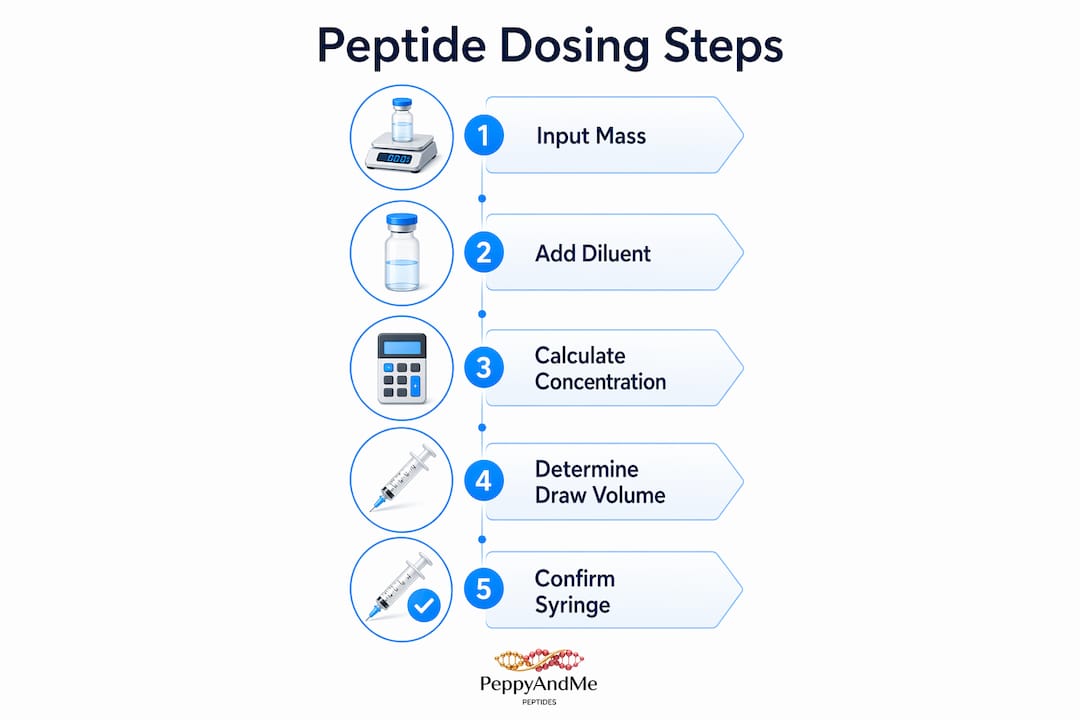
This output is where most confusion arises, and it is worth understanding the syringe unit system clearly. U-100 insulin syringes mark 100 units as equal to 1 mL. Different syringe sizes hold different total volumes: a 30-unit syringe holds 0.3 mL, a 50-unit syringe holds 0.5 mL, and a 100-unit syringe holds 1 mL. Using the wrong syringe type against a calculator output designed for U-100 markings produces a volume error that scales with every dose.
What the outputs tell you
- Concentration (mcg/mL): The potency of your reconstituted solution. A 5 mg vial reconstituted in 2 mL yields 2,500 mcg/mL.
- Volume per dose (mL): The exact liquid volume to draw. For a 250 mcg dose from a 2,500 mcg/mL solution, you draw 0.1 mL.
- Syringe units: The same 0.1 mL expressed as 10 units on a U-100 syringe. This is the number you read directly off the syringe barrel.
Pro Tip: Always confirm your syringe is U-100 before reading the unit output from any peptide dosage calculator. A U-40 syringe marks 40 units per mL, so the same 0.1 mL would read as 4 units, not 10. Mixing these up is one of the most documented sources of dosing error in peptide research.
The Peppyandme dose calculator displays all three outputs simultaneously, so you can cross-reference concentration, volume, and syringe units in one view rather than toggling between steps.
How to use the Peppyandme peptide calculator step by step
Following a consistent process each time you calculate a dose reduces error and creates a record you can replicate across batches. Here is the recommended sequence:
- Gather your vial information. Note the labeled peptide mass (mg) and, if available, the net peptide content from the CoA. Decide on your diluent volume before reconstituting. Refer to Peppyandme’s bacteriostatic water guide if you need guidance on selecting the right diluent.
- Enter values into the calculator. Input total peptide mass, your chosen diluent volume, and your target dose. Double-check that dose units match what the calculator expects (mcg vs. mg).
- Read and record the outputs. Note the concentration (mcg/mL), the draw volume (mL), and the syringe unit equivalent. Write these down or save them in your research log.
- Verify syringe compatibility. Confirm your syringe is U-100 and that its total volume accommodates the draw volume. A 0.3 mL syringe cannot draw 0.35 mL, so syringe selection must match the output.
- Document and repeat for batch preparation. If you are preparing multiple doses from one vial, calculate total draws and confirm the vial volume is sufficient.
“High-precision dosing improves research reproducibility and safety, reducing costly errors.” — Bullit Peptides Peptide Dosage Guide
Common mistakes to avoid
Three errors appear repeatedly among researchers new to peptide dosage calculators. The first is mg vs. mcg confusion. Since 1 mg equals 1,000 mcg, entering a target dose of 250 mg instead of 250 mcg produces a calculated draw volume 1,000 times larger than intended. The second is ignoring net peptide content when the protocol demands high precision. The third is not reading the CoA for molecular weight when a protocol calls for molarity-based dosing rather than mass-based dosing.
Pro Tip: Before drawing any dose, perform a manual sanity check. If your calculated draw volume is greater than 0.5 mL for a typical research peptide dose, revisit your inputs. Most standard doses fall between 5 and 50 units on a U-100 syringe.
What are the most common peptide dosing calculation errors?
Confusing mg and mcg leads to dangerous overdosing, and it is the single most preventable error in peptide dose calculations. The fix is straightforward: always write out the unit next to every number in your protocol, and never assume a value is in one unit without confirming it against the source document.
Beyond unit confusion, several other challenges arise regularly:
- U-40 vs. U-100 syringe errors: A U-40 syringe marks 40 units per mL. If you read a U-100 calculator output on a U-40 syringe, you administer 2.5 times the intended dose. Always verify syringe type before drawing.
- Wrong diluent volume after reconstitution: If you add more or less bacteriostatic water than planned, the concentration changes and your previous draw volume calculation is no longer valid. Recalculate from the actual volume added.
- Multi-vial blends: Standard calculators fail with multi-peptide vials because each component has a different mass and target dose. Researchers using blended vials need per-component calculations, not a single aggregate figure.
“Always verify syringe type markings and understand insulin syringe unit definitions to avoid serious dosing errors.” — Toolita Peptide Calculator
Dose titration is another area where calculation accuracy directly affects safety. A 4-week ramp-up is typical before reaching full maintenance doses for peptides like Semaglutide, and each titration step requires its own accurate calculation. Recalculate at every dose change rather than estimating from a previous draw volume.
Pro Tip: Cross-check every calculator output manually at least once per new vial or protocol. Divide your target dose (mcg) by your concentration (mcg/mL) on a basic calculator. If the result matches the tool’s output, you can proceed with confidence.
How advanced calculator features support research and optimization
Mass-based dosing, which the Peppyandme peptide calculator handles by default, works well for most research applications. Molarity-based dosing goes one step further. Molar calculations require molecular weight from the Certificate of Analysis and express dose in nanomoles or micromoles rather than micrograms. This method allows more accurate comparison of biological activity across peptides with different molecular weights, which matters when evaluating structural analogs or running comparative protocols.
Advanced calculator tools also include visual decay curves and dosing frequency features that show how a peptide’s concentration changes over time between doses. These visualizations help researchers identify optimal dosing intervals and avoid accumulation or troughs that would compromise data consistency.
Advanced feature comparison
| Feature | Standard calculator | Advanced calculator |
|---|---|---|
| Mass-based dosing | Yes | Yes |
| Molarity-based dosing | No | Yes |
| Decay curve visualization | No | Yes |
| Multi-peptide stack dosing | No | Yes |
| Syringe unit conversion | Yes | Yes |
User-friendly calculators that combine visualization with math improve protocol adherence for both biohackers and formal researchers. The practical benefit is fewer mid-protocol corrections and more consistent data across experimental runs.
Pro Tip: When working with peptides that have molecular weights above 3,000 Da, request the molecular weight figure from your supplier’s CoA and use molarity-based dosing for any comparative analysis. Peppyandme provides traceable lot and batch documentation that includes this data.
Key takeaways
Precise peptide dosing requires accurate inputs, correct syringe selection, and a reliable calculator like the one Peppyandme provides to convert vial data into exact draw volumes.
| Point | Details |
|---|---|
| Three inputs drive accuracy | Peptide mass, diluent volume, and target dose must all be correct before any output is meaningful. |
| Syringe type determines unit reading | U-100 and U-40 syringes produce different unit readings for the same volume; always confirm type first. |
| Net peptide content adds precision | For high-stakes protocols, use net peptide content from the CoA rather than the raw vial label. |
| Recalculate at every change | Any change to diluent volume or dose requires a fresh calculation, not an estimate from prior data. |
| Advanced features extend capability | Molarity-based dosing and decay curves improve reproducibility for comparative and multi-peptide research. |
Why dosing accuracy is the foundation of credible peptide research
At Peppyandme, we see the downstream effects of dosing errors more often than most people expect. A researcher contacts us because their results are inconsistent across batches, and when we walk through their protocol, the issue is almost always upstream: a diluent volume that was eyeballed rather than measured, or a syringe type that was assumed rather than confirmed. The data looks fine on paper until you realize the concentration was off by a factor of two.
What we have found is that the calculator is only as good as the inputs fed into it. Researchers who take five minutes to locate their CoA, confirm net peptide content, and verify their syringe type before calculating get consistent, reproducible results. Those who skip those steps often attribute variability to the peptide itself, when the real source is the measurement process.
The other observation worth sharing: dose titration is not just a safety measure. It is a data quality measure. When you ramp up gradually and recalculate at each step, you build a documented record of how the peptide behaves at each concentration. That record becomes the foundation for any meaningful analysis. Skipping titration to reach a target dose faster removes the very data points that make the research interpretable.
Peppyandme’s built-in calculator, combined with lab best practices and third-party verified peptides, gives researchers the infrastructure to do this correctly from the first dose.
— Peppy&Me
Start your research with Peppyandme’s verified peptides and free calculator
Peppyandme provides researchers and optimization-focused individuals with a free, built-in peptide dosage calculator alongside a full library of third-party tested research peptides. Every product is verified for purity, sterility, endotoxin levels, and heavy metal content, with traceable lot and batch numbers from manufacturer to warehouse.
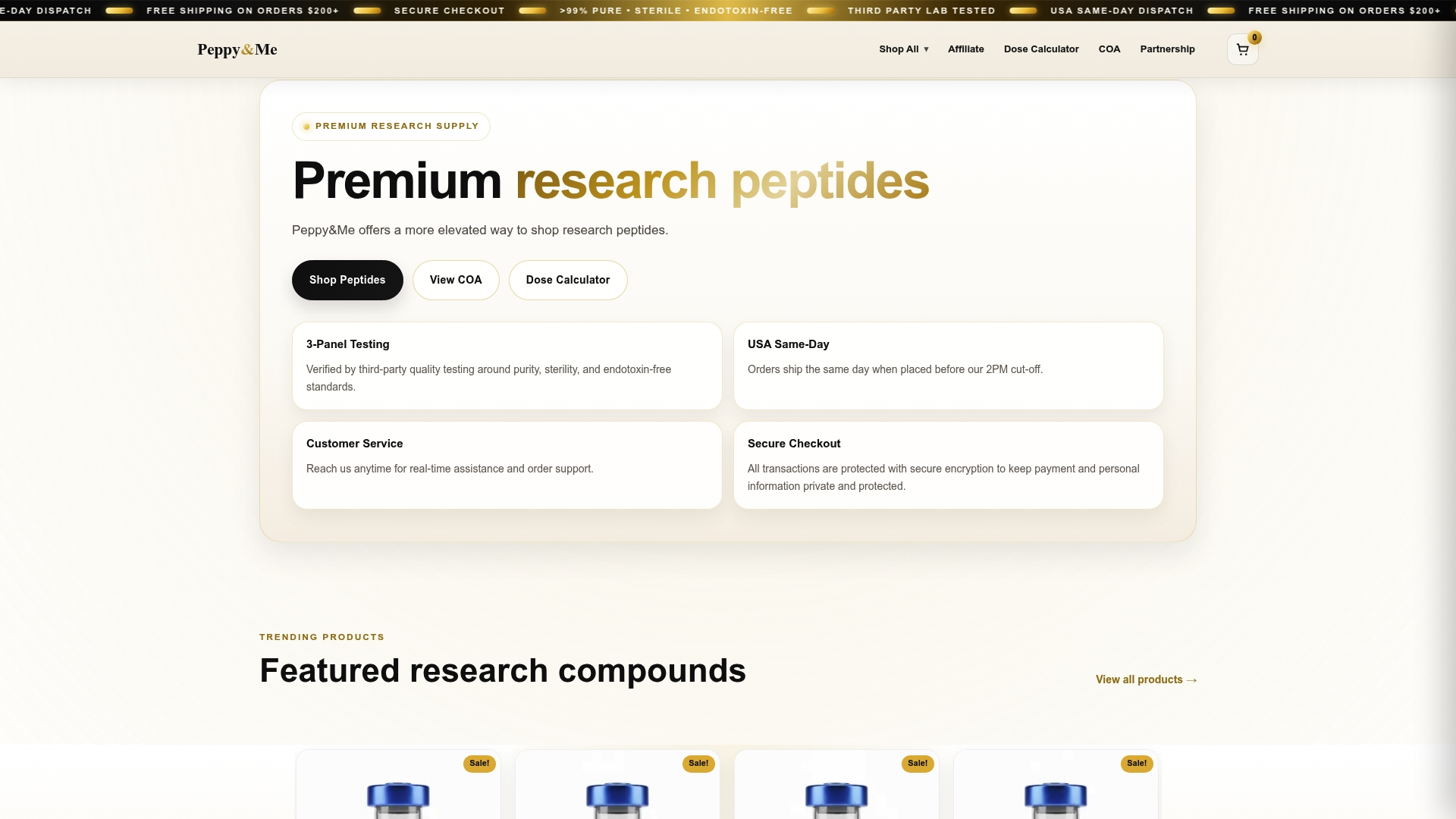
Orders placed before 2 PM ship the same day, and real-time customer support is available for any order or protocol questions. The platform also includes a comprehensive peptide glossary covering reconstitution, handling, and research protocols for each compound. Explore Peppyandme’s full range of research peptides and use the built-in calculator to start your next protocol with confidence.
FAQ
What does the Peppyandme peptide calculator output?
The calculator outputs solution concentration in mcg/mL, the exact draw volume in mL, and the equivalent syringe units for a U-100 insulin syringe. These three values give you everything needed to draw a precise dose.
How do I calculate peptide concentration after reconstitution?
Divide total peptide mass in mcg by the diluent volume in mL. A 5 mg vial (5,000 mcg) reconstituted in 2 mL produces a concentration of 2,500 mcg/mL.
What syringe should I use with a peptide dosage calculator?
Use a U-100 insulin syringe unless your calculator specifies otherwise. U-100 syringes mark 100 units per mL, and most online peptide calculators, including Peppyandme’s, output syringe units based on this standard.
Why does net peptide content matter for dosing?
Net peptide content reflects the actual peptide mass after removing counter-ions and impurities, which is always lower than the raw vial weight. Using the raw weight in high-precision protocols results in a slightly lower actual dose than intended.
Can I use the calculator for multi-peptide blends?
Standard calculators are not designed for multi-peptide vials. For blended formulations, each component requires its own calculation, and the diluent volume must be chosen to accommodate all components simultaneously without making any single draw volume impractically small.