Peptide handling tips to maximize stability and results
TL;DR:
- Peptide research requires precise handling to prevent degradation and ensure reproducibility across experiments. Careful sequence design, solvent selection, and storage conditions tailored to each peptide’s sensitivity are essential for reliable results. Utilizing detailed quality control measures, customized protocols, and supplier data improves success rates and research outcomes.
Peptide research demands precision at every step. A single miscalculation in solvent selection, a lapse in temperature control, or a poorly designed sequence can render an entire batch unusable, wasting both budget and time. Research peptides are structurally sensitive molecules that degrade rapidly when exposed to incorrect conditions, and the consequences extend beyond lost materials to compromised data integrity and failed experimental reproducibility. This article delivers evidence-based, lab-tested guidance across the full peptide workflow, from initial sequence design through dissolution, storage, oxidation prevention, and final quality control, so your research outcomes reflect the quality of your methods, not the gaps in them.
Table of Contents
- Criteria for selecting, handling, and designing peptides
- Solvent selection and dissolution strategies
- Storage solutions: Duration, conditions, and minimizing degradation
- Preventing peptide oxidation and degradation
- Optimized purification and final quality control
- A practical perspective: Avoiding the “one-size-fits-all” trap in peptide research
- Next steps: Take your peptide research further with Peppy&Me
- Frequently asked questions
Key Takeaways
| Point | Details |
|---|---|
| Sequence design matters | Thoughtful sequence choices make peptides more stable and easier to handle in the lab. |
| Solvent selection is critical | Testing solvents in small batches avoids waste and enhances solubility for challenging peptides. |
| Store peptides cold and dark | Most peptides last 1-2 years at -20°C; more sensitive sequences require -80°C freezers and light protection. |
| Prevent oxidation proactively | Purge air and use antioxidants for cysteine, methionine, and tryptophan-rich samples to preserve integrity. |
| Adapt protocols as needed | Combining published methods with COA-specific adaptations maximizes your research peptide success. |
Criteria for selecting, handling, and designing peptides
Having established why peptide workflow optimization matters, let’s start with how to choose and prepare peptide constructs for robust and reproducible results.
Peptide design is not merely an intellectual exercise. The amino acid composition you select directly determines how a peptide behaves in solution, how stable it remains over time, and whether your experimental data will be reproducible across runs. Researchers who treat sequence design as a formality often find themselves troubleshooting solubility problems and aggregation artifacts at later stages, problems that could have been avoided upstream.
The core principle is balancing hydrophobic and hydrophilic residues. A peptide sequence where more than 50% of residues are hydrophobic will likely aggregate in aqueous solution, produce turbid preparations, and bind non-specifically to labware surfaces. These outcomes reduce effective concentration and introduce variability into your assays. According to sequence design guidelines, you should design peptides to keep hydrophobics below 50% of the total sequence and incorporate charged residues to support solubility, while avoiding multiple methionine (Met), cysteine (Cys), and tryptophan (Trp) residues that compromise stability.
Key design criteria for research peptides:
- Keep hydrophobic residues below 50% of the total sequence to reduce aggregation risk
- Incorporate positively or negatively charged residues (Lys, Arg, Asp, Glu) to improve water solubility
- Avoid clustering multiple oxidation-prone residues (Met, Cys, Trp) in a single sequence when possible
- Match sequence length to application: shorter peptides (under 15 residues) dissolve more readily but may lack structural specificity
- Review peptide sequence stability tips before finalizing your construct to cross-reference known behavior patterns
Charge distribution within the sequence matters as much as overall composition. A peptide with charged residues clustered at one terminus can still aggregate when the overall isoelectric point (pI) falls near physiological pH. If your research requires working at or near pH 7.4, confirm that your designed peptide’s pI sits well above or below that value so it carries enough net charge to remain dispersed in solution.
Supplier-provided certificates of analysis (COAs) should be treated as authoritative documents, not merely administrative formalities. The COA specifies purity percentage, molecular weight, lot-specific batch data, and sometimes stability notes that directly inform your handling decisions. Reviewing the COA before writing any dissolution protocol is a fundamental step that many labs skip, often to their detriment. Following lab best practices means integrating COA data into every phase of your workflow, not just the procurement step.
Pro Tip: When in doubt, consult both internal records from previous runs and the supplier’s COA to align your protocol with validated findings. Discrepancies between internal observations and COA data are worth investigating before scaling up.
Solvent selection and dissolution strategies
With your peptide sequences and protocols drafted, the next challenge is dissolving these delicate molecules without loss or denaturation.
Choosing the right solvent is one of the most consequential decisions in peptide preparation. An incorrect solvent causes irreversible aggregation, reduces recovery, and produces inconsistent stock concentrations. The situation is further complicated by the fact that even structurally similar peptides can behave very differently in the same solvent due to subtle sequence differences. There is no single universal approach, but there is a logical decision-making framework that significantly reduces trial-and-error waste.
Step-by-step dissolution protocol:
- Review the COA for any supplier-recommended solvents or observed solubility data before opening the vial
- Start with bacteriostatic water as the primary solvent for most hydrophilic peptides, adding it slowly to the lyophilized pellet without agitation
- Allow equilibration at room temperature for 10 to 15 minutes before visual inspection; do not force dissolution with heat
- If turbidity persists, try a small volume of dilute acetic acid (0.1% to 1%) or DMSO (dimethyl sulfoxide) as a co-solvent, depending on sequence polarity
- Apply brief, gentle sonication (30 to 60 seconds in a water bath sonicator) only if aggregates are clearly visible and equilibration has failed
- If sonication does not resolve aggregation, do not continue forcing the sample. Instead, lyophilize the aliquot again and adjust the solvent choice before a second attempt
- Document every step with the volume used, solvent pH, and visual outcome to build a reliable internal reference for future batches
Solvent selection for peptides depends heavily on the peptide’s physicochemical profile: bacteriostatic water works for most water-soluble peptides, while acetic acid is often needed for GLP-1 analogs or hydrophobic sequences. DMSO is a fallback for extremely insoluble peptides but must be handled carefully given its membrane-penetrating properties and protein-denaturing potential at high concentrations.
“Always begin with the smallest practical aliquot when testing a new solvent or dissolution approach. Losing 0.5 mg of peptide during troubleshooting is far preferable to losing an entire vial of 5 mg or more.”
Understanding why solvent matters goes beyond simple solubility. The choice of solvent determines the pH environment in which the peptide exists, affects its conformation in solution, and can introduce compatibility issues with downstream assay reagents. For example, DMSO above 0.1% v/v in cell-based assays can independently affect cell viability and signaling, confounding your data if you do not account for it.
Pro Tip: Always begin with the smallest practical peptide aliquot to avoid wasting material. Once you confirm a reliable dissolution protocol on a 0.5 mg test portion, you can scale confidently to the full batch.
Storage solutions: Duration, conditions, and minimizing degradation
Once dissolved, peptides’ stability depends heavily on storage. Proper practices greatly reduce risk of loss or contamination.
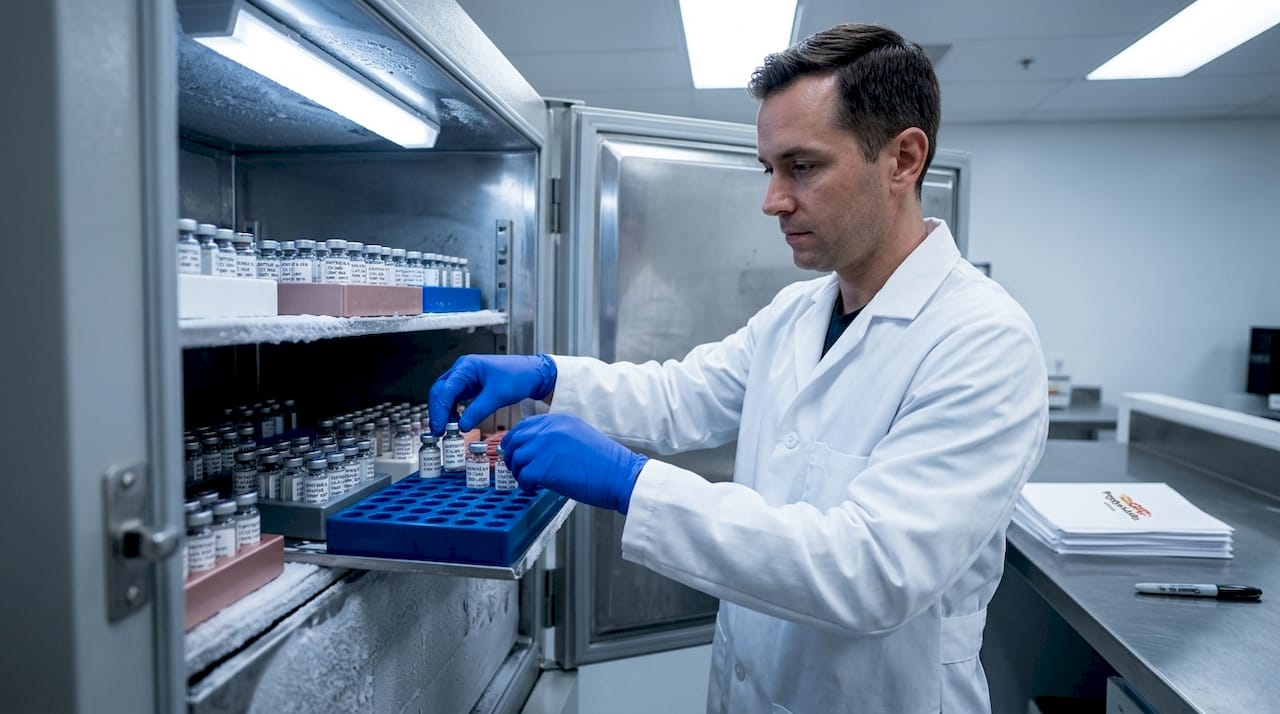
Storage is where many labs inadvertently destroy months of research investment. The lyophilized (freeze-dried) powder form offers the longest shelf life, but even lyophilized peptides degrade when exposed to repeated freeze-thaw cycles, humidity, or inappropriate temperatures. Once reconstituted, the vulnerability of a peptide increases substantially, and the storage conditions must be adapted accordingly.
Storage condition summary by peptide type and duration:
| Peptide Form | Temperature | Duration | Key Considerations |
|---|---|---|---|
| Lyophilized, stable sequences | -20°C | Up to 6 months | Keep desiccated, protect from moisture |
| Lyophilized, oxidation-prone (Cys, Met, Trp) | -80°C | Up to 2 years | Inert gas purge required |
| Reconstituted stock solutions | -20°C | 1 to 4 weeks | Single-use aliquots recommended |
| Working dilutions | 2 to 8°C | 24 to 72 hours | Use within the day if possible |
| Long-term archival | -80°C | 1 to 2+ years | Minimize freeze-thaw cycles |
Lyophilized peptides should be stored at -20°C for short-term use (up to 6 months) or at -80°C for long-term storage to minimize degradation, with stability maintained for 1 to 2 years at -20°C or longer when frozen appropriately.
Practical storage best practices:
- Store lyophilized peptides in sealed vials with desiccant packets at -20°C or -80°C depending on sequence sensitivity
- Pre-aliquot reconstituted stocks into single-use volumes before freezing to prevent repeated freeze-thaw cycles
- Label each aliquot with lot number, concentration, preparation date, and the solvent used
- Purge vials containing Cys, Met, or Trp-rich peptides with nitrogen (N2) or argon gas before sealing to displace oxygen
- Protect all peptide preparations from light, particularly those with Trp residues, which are highly photosensitive
Statistic callout: Stability maintained for 1 to 2 years at -20°C or longer if frozen appropriately. At -80°C with inert gas protection, some sensitive peptides retain measurable biological activity for over 3 years.
Following detailed temperature control advice protects your preparations at every stage, from receipt of lyophilized material through reconstitution and final experimental use. Maintaining a cold chain log for high-value peptides is also advisable, particularly in regulated research environments where data traceability is required.
For sensitive or proprietary peptide libraries, reviewing secure storage protocols ensures that physical and data-level security are handled with equal rigor, protecting both your samples and your research confidentiality.
Preventing peptide oxidation and degradation
Besides storage, the chemical reactivity of certain amino acids requires even further controls to avoid degradation.
Oxidation is among the most common and most underappreciated causes of peptide degradation in active research settings. It occurs silently, without visible change to the sample, and its effects on biological activity can be substantial. A methionine residue oxidized to methionine sulfoxide, or a cysteine residue forming an unintended disulfide bond, produces a chemically distinct molecule. That molecule may have significantly altered binding affinity, reduced potency, or no biological activity at all. When you unknowingly use an oxidized peptide in an assay, your negative result may reflect degradation, not biology.
Oxidation prevention checklist:
- Minimize air exposure time: work quickly and keep vials capped whenever they are not actively in use
- Operate in low-UV conditions or use amber glassware for peptides containing Trp, which absorbs and is damaged by UV light
- Purge vials with nitrogen or argon immediately after dispensing aliquots, before resealing
- Add antioxidants such as dithiothreitol (DTT) or tris(2-carboxyethyl)phosphine (TCEP) to reconstitution buffers for Cys-containing peptides when disulfide formation is not desired
- Avoid co-storing oxidation-prone peptides with reactive reagents or heavy metal-containing solutions
As noted in oxidation handling guidance, peptides containing Cys, Met, and Trp are particularly prone to oxidation. The recommended approach is to purge with N2 or argon, protect preparations from light, and use appropriate antioxidants to extend functional shelf life.
Understanding how to read and act on peptide COA data is essential here. A COA that documents purity at the point of manufacture does not guarantee purity at the point of use if handling has been inadequate. Researchers who treat the COA as a static document rather than a starting baseline for their own handling controls routinely encounter discrepancies between expected and observed activity.
Pro Tip: Label and color-code vials by stability class so you never overlook an at-risk preparation. For example, use red labels for Cys/Met/Trp-containing peptides to trigger additional handling precautions automatically when anyone on the team reaches for that vial.
Optimized purification and final quality control
Even after successful storage and handling, rigorous purification ensures peptides are ready for reproducible and regulatory-compliant research.
Peptide purification is the final gatekeeper between a synthesized or reconstituted batch and a research-ready preparation. No matter how carefully you design, dissolve, and store a peptide, impurities introduced during synthesis or reconstitution can compromise your results. High-performance liquid chromatography using a reverse-phase column remains the gold standard for peptide purification across research and pharmaceutical development settings.
Standard purification workflow:
- Run an analytical-scale HPLC on a small portion (10 to 50 µg) of the batch before committing to preparative scale; this reveals the separation profile and identifies potential contaminant peaks
- Optimize the gradient by adjusting organic solvent (acetonitrile or methanol) ramp rate to achieve baseline resolution between the target peptide and adjacent peaks
- Adjust flow rate and column temperature to improve peak sharpness; higher column temperatures generally reduce retention times and improve resolution for longer peptides
- Scale to preparative HPLC once the analytical method is validated, using a matching column chemistry to maintain separation behavior
- Collect fractions, confirm identity by mass spectrometry, and pool fractions above your purity threshold
Purification by reverse-phase HPLC is the accepted standard, with gradient, flow rate, and temperature requiring optimization during the analytical run before transferring to preparative scale. Shortcuts at this stage frequently produce batches that appear pure by UV absorbance but contain co-eluting impurities that only mass spectrometry or biological assays reveal.
Purification performance comparison by approach:
| Method | Typical Purity | Throughput | Cost | Best For |
|---|---|---|---|---|
| Reverse-phase HPLC (C18) | 95 to 99% | Medium | Moderate | Most research peptides |
| Ion-exchange chromatography | 85 to 95% | Medium | Moderate | Charged peptides |
| Size-exclusion chromatography | 75 to 90% | Low | Low | Aggregation removal |
| Preparative RP-HPLC | 98%+ | High | High | Bulk or high-value batches |
For high-value research peptides, target purities above 90% and yields above 30% as minimum benchmarks. Below these thresholds, experimental variability increases substantially and biological activity assays become difficult to interpret reliably.
Key QC steps after purification:
- Purity analysis by analytical HPLC with UV detection at 214 nm and 280 nm
- Mass confirmation by MALDI-TOF or ESI-MS to verify molecular weight matches the theoretical value
- Biological activity testing (where applicable) using a validated cell-based or binding assay
- Endotoxin testing for peptides intended for cell culture or in vivo work
- Sterility testing for preparations destined for any biological system
Reviewing compliance in peptide purification helps labs align their QC documentation with regulatory expectations, especially important when research outputs may inform clinical development decisions.
A practical perspective: Avoiding the “one-size-fits-all” trap in peptide research
With the workflow complete, consider this advanced insight drawn from real-world research practice.
The peptide research field has no shortage of published protocols. Standard operating procedures, manufacturer guides, and peer-reviewed methods papers are all readily available. The problem is not lack of information. The problem is the assumption that any single protocol, however well-designed, applies equally to every peptide a lab encounters.
Many well-meaning laboratories lose precious samples precisely because they follow a generalized protocol that was not designed for their specific sequence, application, or environmental conditions. A dissolution method optimized for a 10-residue hydrophilic peptide will not translate seamlessly to a 30-residue amphipathic sequence with three proline residues disrupting any ordered structure. A storage protocol validated for a stable, non-oxidizable peptide will fail when applied to a Cys-rich peptide without modification.
The most effective researchers treat published protocols as starting frameworks, not finished procedures. They study the COA from their supplier, note any deviations from typical behavior observed in previous lots, and build a feedback loop into their workflow where each experimental outcome informs the next preparation step. This approach, which might seem slower initially, actually saves substantial time and material in the medium and long term.
Reading and truly understanding a peptide COA is a skill that separates experienced peptide researchers from those still learning. A COA is not merely a certificate of purchase. It documents the specific lot’s purity profile, mass accuracy, and often the storage conditions under which stability was evaluated. When researchers use that information to adjust their own handling steps, their results align more consistently with the manufacturer’s tested performance.
Sequence-specific flexibility, willingness to perform small iterative tests rather than immediately scaling, and honest documentation of failures are the habits that build reproducible workflows over time. The labs that achieve the most consistent results are not necessarily those with the most sophisticated equipment. They are the ones that respect the unique chemistry of each peptide they work with.
Next steps: Take your peptide research further with Peppy&Me
Ready to enhance your research even further? Leverage dedicated resources to streamline your peptide projects and safeguard your results.
Peppy&Me was built specifically to support researchers who understand that peptide quality and research infrastructure are inseparable. Every product on the platform is third-party tested for purity, mass accuracy, endotoxins, sterility, and heavy metals, with traceable lot and batch numbers from manufacturer to warehouse. That traceability connects directly to the workflow principles covered in this article: when you know exactly what is in your vial, you can design handling and storage protocols with confidence.
Beyond sourcing, Peppy&Me provides built-in dose calculators, a comprehensive peptide glossary with protocol-level guidance, and compliance resources designed for professional research environments. Whether you are scaling an existing project or launching a new research direction, the lab best practices resource available through the platform gives your team the operational foundation to work more efficiently and more reliably. Reach out for same-day shipping support, expert guidance, or to explore partnership opportunities tailored to your lab’s specific needs.
Frequently asked questions
What solvent should I start with for most peptides?
Bacteriostatic water is usually the first choice, but hydrophobic peptides or GLP-1 analogs may require dilute acetic acid or DMSO as a primary or co-solvent. Always test a small aliquot before committing to full-batch dissolution.
How long do lyophilized peptides remain stable at -20°C?
Lyophilized peptides typically remain stable for 1 to 2 years at -20°C, and potentially longer at -80°C with inert gas protection, but you should always verify against the supplier’s COA for lot-specific data. Oxidation-prone sequences (Cys, Met, Trp-rich) should always default to -80°C storage regardless of general guidelines.
How can I prevent oxidation of peptides with cysteine or methionine?
Purge vials with nitrogen or argon after each aliquot dispensing, shield preparations from UV light, and consider including antioxidants such as DTT or TCEP in reconstitution buffers when free cysteines must remain reduced. Minimizing air exposure time during every handling step is equally important.
What’s the best way to purify a new peptide batch?
Reverse-phase HPLC is the standard method; begin with an analytical-scale run to define the gradient and separation parameters before transferring to preparative scale. Confirm identity and purity by mass spectrometry on collected fractions before pooling.
Should I always follow standard published protocols for peptide handling?
Use published protocols as a foundational guide, but adapt each step based on your peptide’s specific sequence, the COA data provided by your supplier, and any behavior you observe during analytical or small-scale test runs. The most reproducible outcomes come from protocols that account for the unique chemistry of the peptide you are working with, not generic procedures written for average-case molecules.