Optimize membership approval workflow for research peptide access
TL;DR:
- Inefficient membership approval workflows delay research, risk compliance failures, and threaten controlled peptide access. Creating tailored, auditable processes with proper documentation and automation is essential for regulatory adherence and operational efficiency. Utilizing specialized platforms like Peppy&Me helps streamline approvals, ensure traceability, and maintain ongoing compliance in regulated research environments.
Inefficient membership approval workflows are not just an administrative headache. They directly delay research timelines, expose institutions to compliance failures, and put high-stakes access to research peptides at risk. When multiple regulatory bodies require separate approvals, documentation gaps can create serious audit vulnerabilities that persist long after an approval is granted. This guide provides a practical blueprint for designing secure, auditable, and efficient approval workflows specifically built for research organizations and biotechnology institutions that require controlled access to research-grade peptides.
Table of Contents
- Understanding membership approval in a research context
- Key requirements and preparation steps
- How to design and implement the membership approval workflow
- Compliance, documentation, and safety gates for peptide access
- Verification, updates, and optimizing for ongoing compliance
- What most guides miss about membership approval for research peptide access
- Accelerate secure peptide research with Peppy&Me
- Frequently asked questions
Key Takeaways
| Point | Details |
|---|---|
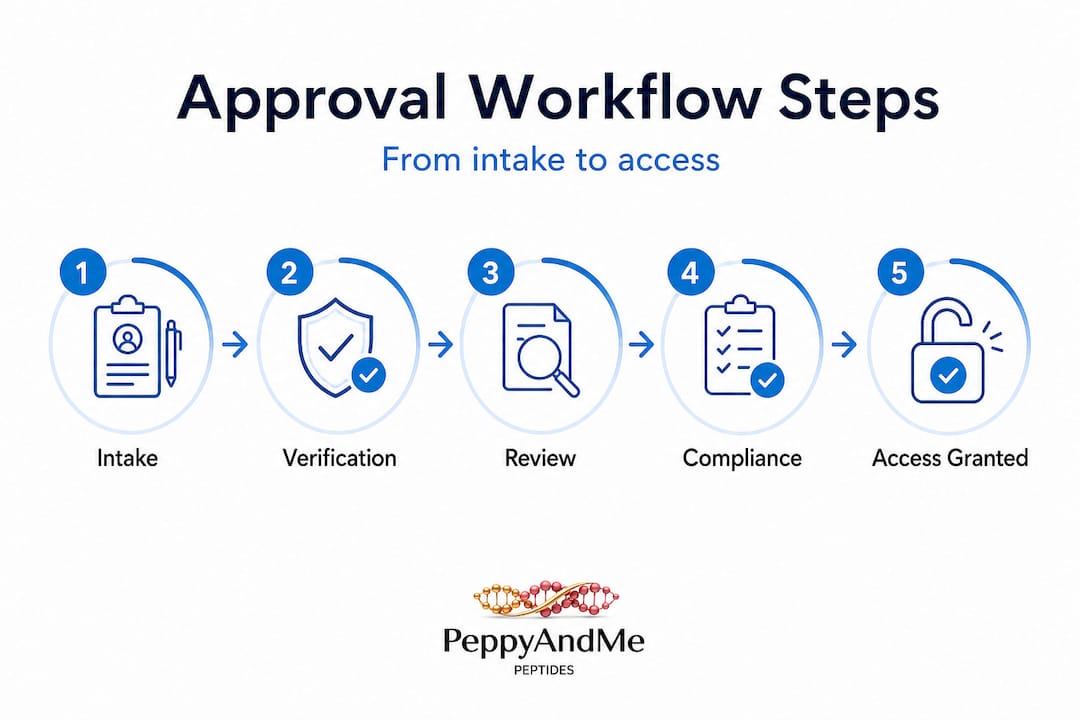
| Clear workflow stages | Breaking approvals into intake, verification, review, and activation ensures both efficiency and compliance. |
| Document everything | Maintaining up-to-date SOPs, training records, and batch documentation is critical for regulated peptide access. |
| Automate and audit | Automated routing, time tracking, and full audit logging minimize bottlenecks and support regulatory traceability. |
| Separate compliance paths | Never assume approvals (like IRB and IBC) overlap; keep documentation and signoffs distinct. |
| Ongoing verification | Periodic updates and continuous governance checks help avoid compliance drift and future disruptions. |
Understanding membership approval in a research context
Now that we’ve set the stakes, let’s clarify exactly what membership approval covers in research peptide access. The phrase “membership approval” carries different meanings depending on institutional context, and using a single-template approach for all of them is a common and costly mistake.
The three most prevalent approval workflows in research settings are:
- Committee membership approval (adding a qualified individual to an Institutional Review Board [IRB], Institutional Biosafety Committee [IBC], or similar body)
- Research portal access approval (granting verified researchers access to restricted systems, databases, or supply channels, such as those that transform peptide access)
- Patient or program enrollment approval (verifying that individuals qualify for a specific clinical or investigational peptide program)
Each of these has a different evidentiary standard, a different approval authority, and a different set of regulatory consequences if handled incorrectly. An IRB membership addition, for example, requires documented expertise review, training verification, and a formal agreement. A portal access request for research peptides might require vendor-validated credentials, institutional affiliation confirmation, and batch-level documentation review. A step-by-step look at peptide program approvals illustrates how each pathway demands its own structured intake and evidence requirements.
Regulatory environments across all three categories demand traceability above all else. If a regulatory auditor cannot reconstruct who approved what, when, and based on which documents, the entire workflow is considered compromised. This makes documentation architecture as important as the decision itself.
Critical note: Do not over-generalize when designing your workflow. “Membership approval” can mean approving committee membership (IRB/IBC), approving access to restricted systems for researchers, or approving patients for peptide programs. Each has different edge cases and documentation requirements. Applying a single process template across all three scenarios will create compliance gaps.
Understanding which category your workflow falls into is the first and most important step before any process design work begins.
Key requirements and preparation steps
Having defined what “membership approval” means, let’s break down what you need for seamless setup. Preparation is not just administrative groundwork. It is the foundation that determines whether your workflow will hold up under regulatory scrutiny.

The most important pre-implementation requirement is a documented standard operating procedure (SOP). IRB member addition workflows are typically governed by a formal SOP that specifies every stage, from CV submission and interviews through training verification, roster updates, and signing the member agreement. Without this, approvals lack legal defensibility and reproducibility.
Prerequisites table
| Prerequisite | Description | Responsible role |
|---|---|---|
| CV or credential submission | Collect current resume and relevant qualifications | Applicant or sponsor |
| Training record verification | Confirm required modules completed and current | Compliance coordinator |
| Reviewer authority definition | Establish who can approve, deny, or escalate | Institutional leadership |
| Portal or IT system setup | Configure access permissions and audit logging | IT/data systems team |
| Documentation template library | Standardize forms, checklists, and agreement text | Compliance or legal team |
| Regulatory separation mapping | Identify if IRB and IBC approvals both apply | Principal investigator |
For institutions managing both IRB and IBC approvals concurrently, regulatory separation is critical. These two bodies operate under different federal frameworks. IRB focuses on human subject protections, while IBC governs biosafety review for biological materials and genetic research. Assuming one committee’s approval covers the other is a significant compliance error that auditors frequently cite.
Documents and checks that a well-prepared workflow should include:
- Institutional affiliation letter or employment verification
- Proof of relevant training (e.g., CITI Program, GLP certifications)
- Conflict of interest disclosure form
- Prior regulatory approval records (if applicable)
- Vendor or supplier credentialing documents (for peptide access specifically)
- Signature pages confirming understanding of research protocols
The secure access setup guide for protecting research peptide data provides additional detail on how portal-level configurations should align with these documentation requirements. Connecting your IT configuration to your compliance checklist from the start prevents rework later.
Pro Tip: Assign one dedicated compliance lead to coordinate all parallel approval pathways. When IRB and IBC approvals run simultaneously, without a single point of coordination, documents fall through the gaps and timelines extend unnecessarily. One person with visibility across both tracks resolves most bottleneck issues before they escalate.
How to design and implement the membership approval workflow
Once you have the right foundation and stakeholders in place, here’s how to structure the workflow. A well-designed approval pipeline is both auditable and efficient. Those two properties are not mutually exclusive when the stages are clearly defined.
Step-by-step workflow structure
Intake and submission. The applicant or sponsoring researcher submits a complete intake package through the designated portal. This includes all required credentials, training records, and institutional documentation. At this stage, the system should auto-confirm receipt and assign a tracking number.
Completeness verification. A staff reviewer (not the committee) checks whether the submission meets minimum completeness standards. Incomplete submissions are returned for correction at this point. This separation of completeness check from substantive review is a best practice for biosafety committee approvals, ensuring that committees evaluate only ready applications.
Document verification and credential validation. The system or a designated reviewer authenticates training records, confirms affiliations, and cross-checks credentials against institutional requirements. Automated verification tools can significantly accelerate this step without reducing accuracy.
Committee or approver review. The verified submission is routed to the relevant approval authority. This may be an IRB chairperson, a biosafety officer, a research director, or a portal administrator. Role-based routing ensures that submissions reach the right reviewer based on pre-set criteria.
Approval or denial decision. The reviewer issues a formal decision with documented rationale. Denials should trigger an explicit notification with reasons and an appeals or correction pathway. Approvals should activate the next step automatically.
Access activation and onboarding. Approved members gain access to the restricted resource, whether that is committee membership, portal access, or peptide ordering privileges. Access parameters (scope, expiration, renewal requirements) should be set at activation, not retroactively.
Audit log closure. Every stage is logged with timestamps, reviewer identity, documents reviewed, and decision rationale. This log should be immutable and accessible for regulatory inspection at any time.
A multi-stage pipeline with automated document verification, role-based routing, human decision points, and full audit logging with escalation on SLA [service level agreement] breach represents the current best practice for secure and efficient member onboarding in regulated environments.
Manual vs. automated workflow comparison
| Stage | Manual approach | Automated approach |
|---|---|---|
| Intake | Paper or email submissions, manual logging | Online portal submission, auto-receipt |
| Completeness check | Staff review, higher error rate | Rule-based checklist, flags missing items |
| Document verification | Time-consuming, prone to human error | API-linked credential checks, faster throughput |
| Routing to approver | Email chains, unclear accountability | Role-based automatic routing, tracked delivery |
| Decision and notification | Manual email, delayed | Automated notification on decision, timestamped |
| Audit log | Spreadsheet or paper files, hard to retrieve | Immutable digital log, audit-ready |
The membership approval portals that perform best in high-compliance environments combine automated intake and routing with human decision points at the review stage. Full automation without human oversight, particularly at the approval or denial stage, introduces risk that undermines both speed and defensibility.
Pro Tip: Build automated escalation triggers into your workflow. If a submission sits in a reviewer’s queue past a defined SLA window, such as 48 or 72 hours, the system should automatically flag and escalate to a backup reviewer or supervisor. This one configuration change reduces average approval time significantly without compromising review quality.
Compliance, documentation, and safety gates for peptide access
With the workflow mapped, pay special attention to compliance steps when peptide access is at stake. Research peptides occupy a unique regulatory space. They are not consumer products, and access to them requires layers of institutional safeguards that go beyond what a standard portal access workflow typically includes.
Research peptides carry risk profiles that demand tighter controls than most other research materials. These include risks related to improper use, chain-of-custody failures, contamination from substandard sourcing, and liability exposure from non-compliant vendor relationships. Regulatory scrutiny of peptide supply chains has increased markedly, and institutions without documented vetting processes are particularly vulnerable.
The documentation gates that institutions must build into their peptide access workflow include:
- Legitimate sourcing verification. Confirm that the supplier operates within applicable regulatory frameworks and does not sell to unverified buyers.
- Batch-specific certificate of analysis (CoA). Each peptide lot should come with a CoA confirming purity percentage, identity testing, endotoxin levels, sterility data, and heavy metal screening.
- Vendor credentialing records. Obtain and retain documentation of the supplier’s third-party testing partnerships, quality assurance protocols, and traceability infrastructure.
- Chain-of-custody documentation. Track the peptide from manufacturer through warehouse to researcher, with lot and batch numbers referenced at each point.
- Post-activation monitoring protocol. Define how ongoing use will be tracked and audited after access is granted.
Vetting the dispensing pharmacy or peptide supplier and requiring batch-level documentation such as certificates of analysis with purity and identity data, alongside an explicit monitoring and follow-up protocol, is the recognized standard for establishing a defensible compliance record.
Institutions that want to source quality research peptides safely should treat vendor vetting as a compliance gate, not an optional quality check. If the supplier cannot provide traceable, batch-specific documentation with third-party verification, that is sufficient grounds for exclusion from the approved vendor list.
Safety warning: Skipping proper supplier vetting in the interest of speed is one of the most common compliance failures in peptide research programs. A single undocumented batch used in a study can invalidate results, trigger regulatory review, and create institutional liability that far exceeds the time saved by bypassing verification steps.
Incident follow-up procedures should also be built into the workflow from the start. If a compliance breach occurs, such as unauthorized access, an out-of-spec batch, or documentation gaps, the process for investigation, remediation, and reporting should already be defined, not improvised in response to an incident.
Verification, updates, and optimizing for ongoing compliance
Even once your workflow is live, sustained compliance and quality demand ongoing updates and monitoring. Many research institutions design a strong initial workflow and then allow it to drift over time as rosters change, regulations are updated, and review cycles are skipped. Compliance drift is gradual and often invisible until an audit surfaces it.
Ongoing governance tasks that should be formally scheduled and tracked include:
Training expiration monitoring. Track when each member’s required training modules expire and trigger renewal requests 30 to 60 days in advance. Lapsed training is one of the most frequently cited compliance deficiencies.
Roster and registration updates. When a committee member’s role changes, their access privileges or authority scope may need to be updated or removed. Formal SOP-governed roster update procedures and continuous governance hygiene ensure that access lists accurately reflect current affiliations.
Documentation refresh cycles. Institutional affiliations, conflict of interest disclosures, and member agreements should be re-confirmed on an annual or biennial basis. Stale documentation creates legal and regulatory exposure.
SLA and process breach monitoring. Regularly review whether approval timelines are meeting SLA targets. Persistent delays in specific stages often indicate systemic issues, such as reviewer bottlenecks or unclear criteria, that need structural correction.
Regulatory change tracking. Federal and institutional regulatory frameworks governing research oversight evolve. Assign responsibility for monitoring relevant regulatory updates from bodies such as the Office for Human Research Protections (OHRP) or the NIH Office of Biosafety, and formalize an amendment process for incorporating changes into the workflow.
Periodic workflow audits. At least annually, conduct a structured review of the entire approval pipeline using actual submissions as test cases. This identifies gaps between the written SOP and what is actually happening in practice.
Staying current with peptide research best practices requires that your compliance infrastructure evolve alongside the regulatory and scientific landscape, not remain static after initial implementation.
Pro Tip: Schedule a formal workflow review every six months for the first two years of operation, then annually thereafter. Use a structured checklist that maps each SOP step against observed practice. Invite a reviewer who was not involved in the original design to conduct the review. External perspective catches assumptions that internal teams normalize over time.
What most guides miss about membership approval for research peptide access
Let’s pause and consider what commonly gets left out of process design conversations. Most workflow guides stop at the implementation blueprint. They tell you what stages to include, which documents to collect, and how to route approvals. What they rarely address is why well-designed workflows still fail in practice.
The most pervasive problem is the belief that a well-documented SOP, once written, handles compliance on its own. Institutions invest significant effort in designing approval pipelines and then treat the written process as a finished product. In reality, an SOP is only as reliable as the human systems and review cycles that keep it honest.
One-size-fits-all approval templates are particularly problematic in regulated research environments. A template built for an IRB committee membership addition cannot be directly adapted for research peptide portal access without substantial modification. The documents are different, the approvers are different, the regulatory stakes are different, and the incident-response requirements are different. Attempting to force a single template across these distinct workflows fragments compliance without anyone realizing it until an auditor points it out.
The hidden cost of siloed or fragmented workflows is also consistently underestimated. When IRB and IBC approvals are managed through separate teams without a coordinating compliance lead, submissions frequently get stuck waiting for one body without the other even being aware of the delay. Researchers experience this as a single approval bottleneck, but the actual cause is two separate processes that have no coordination mechanism.
Over-reliance on automation compounds these risks. Automated workflows are genuinely valuable, but they are prone to a specific failure mode: they process what they are given without judgment. A document that looks complete but contains materially incorrect information will pass automated completeness checks and be routed to a human reviewer, but if that reviewer is also relying on automated flags rather than substantive review, the error propagates. Automation should handle routing, logging, and escalation. Human reviewers should handle judgment.
The research compliance portals that function best over time are those designed with cross-functional input from compliance, IT, research leadership, and legal teams. They also include formal mechanisms for reporting and correcting process failures without fear of institutional repercussions. Psychological safety in compliance reporting is not a soft skill. It is an operational requirement for catching problems early.
Cross-functional teams and periodic reality checks are not optional enhancements to a well-designed workflow. They are what determines whether a theoretically sound process actually performs under real operating conditions. Building them in from the start separates institutions that maintain sustained compliance from those that rely on luck between audits.
Accelerate secure peptide research with Peppy&Me
Ready to put a robust workflow into action? The right platform makes the difference between a compliance framework that looks good on paper and one that performs reliably under operational pressure.
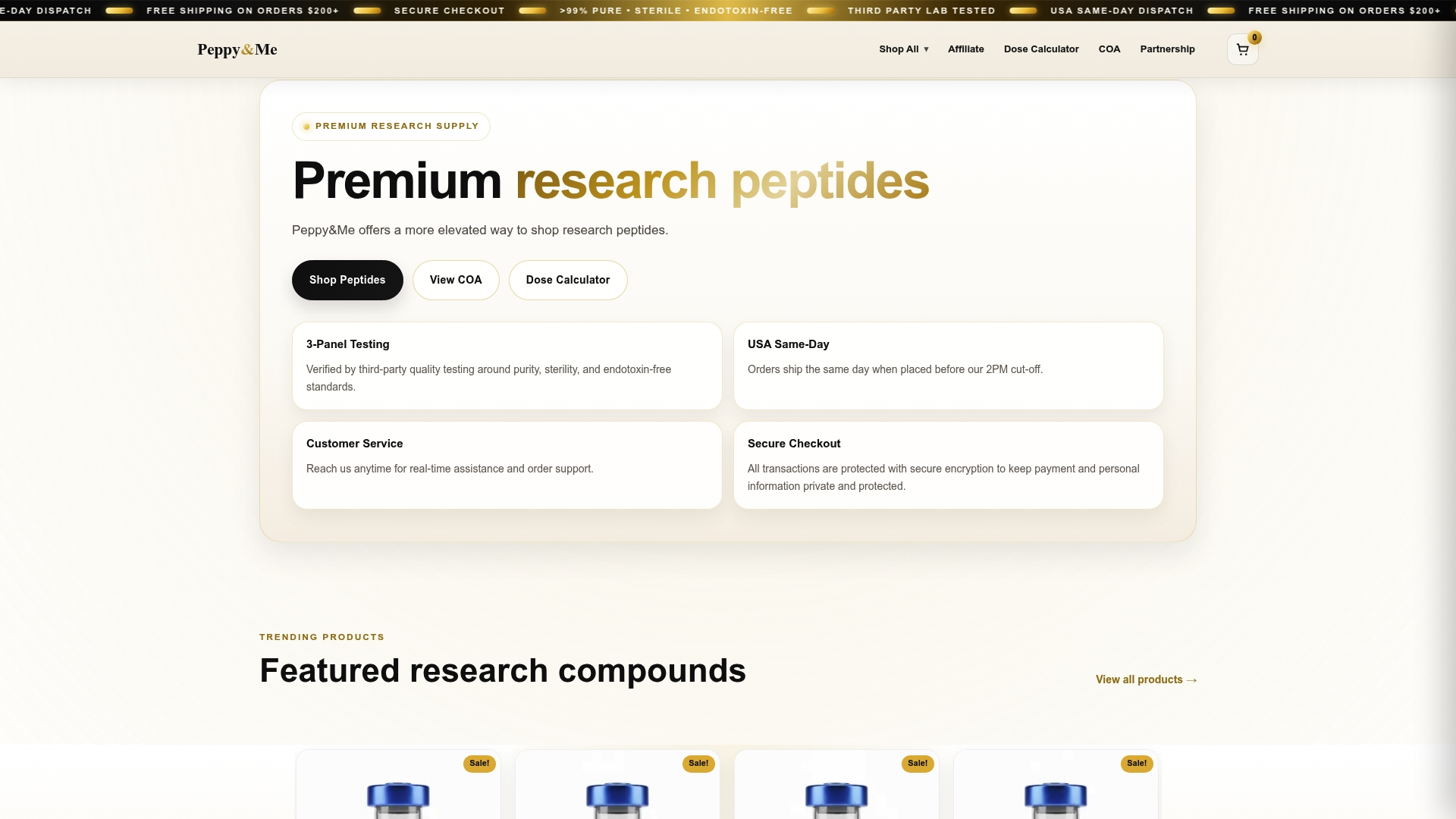
Peppy&Me is built specifically for research professionals who need both stringent documentation and seamless access. The platform’s membership portals are designed to support auditable approval workflows, with integrated CoA documentation, batch-level traceability from manufacturer to warehouse, and full data privacy protections. Through compliance portals, labs can manage vendor-vetted access to third-party tested peptides at competitive pricing. Explore current offerings, including discount research peptides, and experience the operational clarity that a purpose-built research access platform delivers.
Frequently asked questions
What is the difference between IRB and IBC membership approval?
IRB membership approvals focus on human subject protections, while IBC manages biosafety review for genetic and biological material risks. Both operate under separate regulatory frameworks, and IBC review requires coordination with IRB when both apply to a single study, but one approval does not substitute for the other.
What documentation do I need for peptide research membership approval?
You generally need a CV or resume, proof of relevant training, and batch-level documentation such as a certificate of analysis from a vetted supplier. The IRB member addition SOP also requires training verification, institutional agreement signatures, and roster confirmation.
How does automation improve membership approval workflows?
Automation reduces bottlenecks by verifying documents, routing requests to the correct reviewer, escalating delays past SLA windows, and maintaining immutable audit logs. A multi-stage automated pipeline improves both speed and compliance when human judgment is preserved at decision points.
What happens if a submission is incomplete during the approval process?
Incomplete submissions are typically returned for correction before entering substantive committee review. The IBC registration review process follows a staff-driven completeness check before committee deliberation, ensuring reviewers evaluate only fully prepared applications.
Why is vetting peptide suppliers important for research access?
Vetting ensures that peptides are sourced from legitimate, regulated supply channels with validated purity and traceable batch documentation. The telehealth provider guide confirms that empirical compliance mechanics require verifying sourcing legitimacy and restricting access to licensed and vetted supply channels to mitigate research integrity and safety risks.