How membership portals transform peptide access for researchers
TL;DR:
- Traditional peptide sourcing is fragmented, time-consuming, and prone to quality and compliance issues for researchers. Membership portals centralize vendor management, documentation, and inventory, enhancing research efficiency and reproducibility. However, researchers must remain diligent in verifying regulatory status and documentation despite the convenience these portals offer.
Peptide research demands a level of procurement discipline that traditional supply chains rarely support. Researchers working with compounds like BPC-157, CJC-1295, or tirzepatide analogs spend significant time vetting vendors, reconciling inconsistent lot numbers, and navigating a regulatory landscape that continues to evolve. Membership-based portals represent a structural shift in how authorized professionals access research-grade peptides, replacing fragmented, manual sourcing workflows with centralized, compliance-aware systems built specifically for the scientific community.
Table of Contents
- The peptide sourcing dilemma: Challenges and risks
- Membership portals: Transforming peptide access for researchers
- Regulatory compliance and quality assurance: What researchers must know
- Practical benefits: Streamlined operations, savings, and research continuity
- Why the conventional wisdom about peptide portals needs a rethink
- Explore trusted peptide resources and next steps
- Frequently asked questions
Key Takeaways
| Point | Details |
|---|---|
| Centralized sourcing | Membership portals simplify access to regulated, high-quality peptides. |
| Predictable operations | Automated reordering and billing ensure continuous supply for research. |
| Compliance essentials | RUO labeling and FDA regulations remain critical even with portal use. |
| Operational savings | Memberships reduce paperwork and improve lab efficiency. |
| Expert vigilance | Researchers must verify supplier legitimacy and compliance themselves. |
The peptide sourcing dilemma: Challenges and risks
Sourcing peptides for legitimate research has never been a simple task. The market is fragmented across dozens of suppliers, each operating under different quality standards, labeling practices, and fulfillment timelines. For a researcher managing multiple active protocols, that fragmentation creates serious operational risk.
Vendor fragmentation is one of the most persistent problems in the field. When a lab sources different peptides from four or five separate vendors, it introduces complexity at every stage: tracking lot numbers, reconciling certificates of analysis (CoAs), managing separate invoices, and monitoring expiration timelines across disparate product lines. One delayed shipment from a single vendor can stall an entire research timeline.
Quality inconsistency compounds that problem. Peptide research fundamentals require that researchers work with compounds verified for purity, mass accuracy, sterility, and endotoxin levels. Yet not every supplier provides third-party tested products or traceable batch records. When a peptide’s documented purity does not match its actual composition, research results become unreliable and protocols must be repeated from the beginning.
The regulatory environment adds yet another layer of pressure. Researchers must ensure that compounds are labeled appropriately for research use only (RUO), that vendors are not making therapeutic claims, and that supply chains can be audited if needed. Without a centralized system, verifying all of this manually for every vendor and every order is enormously time-consuming.
“Centralized portals like BoomRx simplify regulated sourcing from 503A/503B facilities, reducing vendor fragmentation and operational complexity for high-quality peptide access.”
Traditional vetting processes are largely manual and repetitive. Each new vendor relationship requires background checks, CoA reviews, and compliance assessments that eat into research hours. Researchers who study safe tirzepatide sourcing understand firsthand that even well-known compound classes carry significant supplier risk when procurement is unstructured.
Key sourcing risks researchers face today include:
- Inconsistent purity documentation across vendors with varying third-party testing standards
- Incomplete batch traceability, making it difficult to trace a compound from manufacturer to delivery
- Vendor turnover and stock gaps that interrupt long-term research protocols
- Gray market exposure, particularly for newer or less regulated peptide classes
- Manual compliance burden, including verifying RUO labels and checking for improper therapeutic claims on supplier websites
- Pricing variability that makes budgeting difficult across fiscal quarters
With these sourcing difficulties established, it becomes clear why membership-based portals are attracting significant attention from the research community.
Membership portals: Transforming peptide access for researchers
Membership-based portals do not merely add a login screen to a standard e-commerce catalog. They fundamentally restructure how researchers interact with their peptide supply chain. By centralizing vendor relationships, documentation, ordering workflows, and compliance tracking into a single authenticated environment, these portals reduce the cognitive and administrative load on researchers considerably.
The core value proposition is centralization. Instead of managing five vendor accounts, five separate invoicing systems, and five different CoA formats, a researcher logs into one portal and accesses everything from a unified dashboard. Product listings include batch-specific documentation, third-party test results, and full traceability from synthesis to fulfillment. That transparency directly supports scientific reproducibility, which remains a persistent challenge in peptide-related research.
Membership models in peptide supply reduce administrative friction, improve retention by 15 to 25 percent, and provide predictable cash flow for ongoing research needs. That retention metric matters more than it might initially appear. When researchers stay with a single vetted portal, they build institutional knowledge about supplier reliability, compound behavior across batches, and documentation workflows. That accumulated knowledge reduces errors over time.
Inventory predictability is another underappreciated advantage. Membership portals that offer scheduled ordering or subscription-based delivery allow labs to plan around known supply timelines rather than reacting to stock shortages. A research program studying a peptide’s effects over a 12-week protocol cannot afford a mid-study gap in compound availability. Predictable inventory planning, enabled by membership-based access, protects research continuity in ways that ad hoc ordering never can.

Pro Tip: When evaluating a membership portal, check whether it offers real-time inventory visibility and automated low-stock alerts. These features can prevent mid-protocol supply interruptions that compromise data integrity.
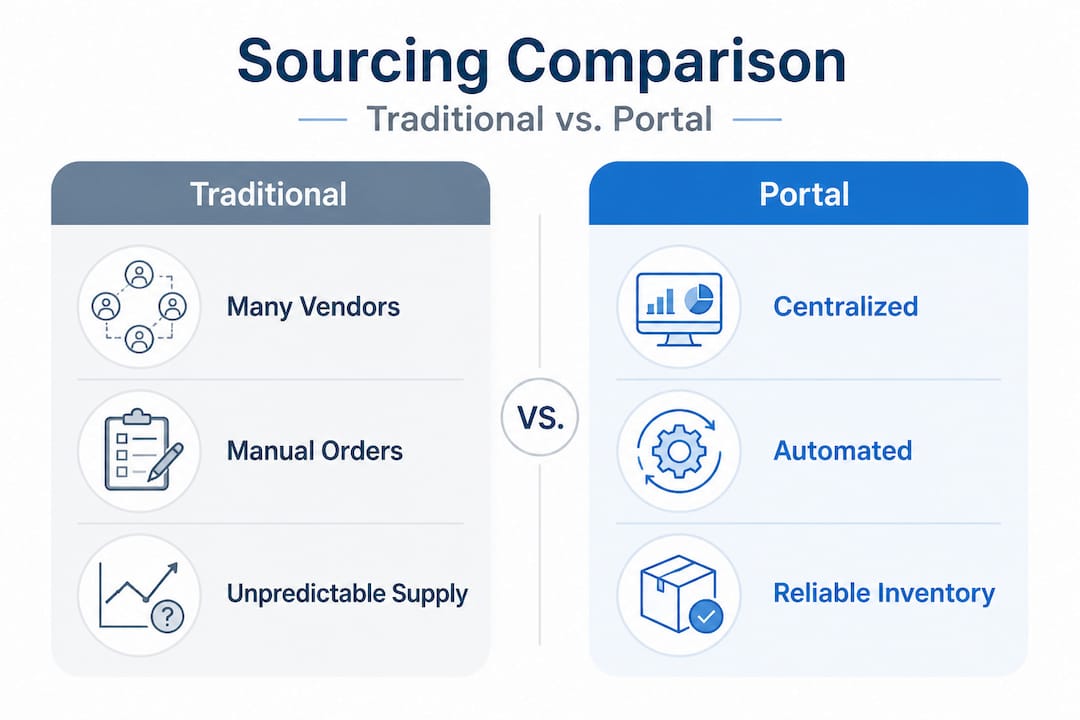
Traditional sourcing vs. membership portal: A direct comparison
| Feature | Traditional sourcing | Membership portal |
|---|---|---|
| Vendor management | Multiple, fragmented | Single, centralized |
| CoA documentation | Inconsistent format | Standardized, batch-specific |
| Compliance tracking | Manual | Automated or integrated |
| Inventory visibility | Limited, reactive | Real-time, predictable |
| Order history | Dispersed across vendors | Unified account history |
| Reorder process | Manual per vendor | Streamlined or automated |
| Data privacy | Variable | Secure, account-protected |
| Customer support | Fragmented response | Dedicated, real-time access |
This comparison is not abstract. For a lab running three simultaneous peptide studies, the difference between fragmented and centralized sourcing translates directly into hours saved per week and errors avoided per quarter. Secure peptide access through authenticated portals also protects sensitive procurement data, which matters when research programs involve proprietary protocols.
Platforms that integrate research peptides overview resources alongside ordering capabilities further amplify value. Researchers can review compound glossaries, handling protocols, and dosing calculators without leaving the platform, reducing the risk of errors from consulting inconsistent third-party sources.
Evidence from peptide therapy benefit studies also supports the growing demand for streamlined, reliable access to these compounds. As the research base for peptides expands, the infrastructure supporting that research must scale accordingly.
Regulatory compliance and quality assurance: What researchers must know
Membership portals provide meaningful compliance support, but they do not exist in a regulatory vacuum. Researchers working with peptides must understand the framework these portals operate within, as well as the boundaries that no platform can cross on their behalf.
The most foundational concept is RUO labeling, or Research Use Only designation. Peptides sold under RUO status are intended exclusively for laboratory research and cannot be marketed, labeled, or sold for human or veterinary therapeutic use. Any supplier that blurs this line, whether through product descriptions, testimonials, or dosing instructions framed around clinical outcomes, is operating outside accepted regulatory norms.
As unregulated peptide markets continue to grow, many compounds remain in a gray area where research interest outpaces regulatory clarity. Membership portals can help researchers navigate this environment by curating their catalogs to exclude gray market or inadequately documented compounds. However, ultimate responsibility for compliance rests with the researcher.
Here are the key compliance steps every researcher should follow, regardless of portal use:
- Verify RUO labeling on every compound before ordering. Check that the label explicitly states “Research Use Only” and includes no therapeutic claims.
- Review the CoA for every lot, confirming purity percentage, mass accuracy, endotoxin levels, and sterility test results from an independent third-party laboratory.
- Confirm batch traceability, ensuring that the manufacturer’s batch number is referenced in all documentation from synthesis through fulfillment.
- Check for heavy metals testing, a less commonly discussed but critical quality marker that reputable portals include in their standard documentation.
- Document your sourcing decisions, including vendor selection rationale and compliance review outcomes, in case of audit or protocol review.
- Avoid portals that make clinical or therapeutic claims anywhere on their platform, as this signals disregard for regulatory norms that extends to their product quality practices.
Synthetic peptide research highlights that while these compounds offer exciting scientific potential, risks are real when sourcing, handling, and documentation are not managed rigorously.
Quality documentation: What portals should provide
| Documentation type | Purpose | Minimum standard |
|---|---|---|
| Certificate of analysis (CoA) | Confirms compound identity and purity | Third-party tested, batch-specific |
| Mass spectrometry report | Verifies molecular weight accuracy | Independent lab verification |
| Endotoxin testing | Confirms absence of bacterial contaminants | LAL or recombinant factor C method |
| Sterility testing | Confirms no microbial contamination | USP 71 or equivalent standard |
| Heavy metals panel | Screens for toxic elemental impurities | ICH Q3D guideline compliant |
| Lot and batch number | Enables full supply chain traceability | Manufacturer to warehouse to order |
Researchers who consult the lab peptide insights available on quality platforms will recognize these standards as non-negotiable for defensible research. For specific compounds, such as those covered in the tesamorelin research guide, understanding how documentation maps to compound-specific properties is equally important.
Once regulatory compliance requirements are clear, the practical operational benefits of portals become even more compelling.
Practical benefits: Streamlined operations, savings, and research continuity
Beyond compliance support, membership portals deliver tangible operational improvements that directly affect a lab’s efficiency, budget, and ability to sustain long-term research programs. These practical advantages are often the deciding factor for research teams evaluating whether to transition from traditional sourcing.
Automated reordering is among the most impactful features. Platforms that integrate scheduled or threshold-triggered reordering eliminate the manual process of monitoring inventory levels, submitting purchase orders, and following up on delivery timelines. For a lab coordinator managing multiple compounds simultaneously, automated reordering can save multiple hours per week and prevent the supply gaps that derail active protocols.
Centralized portals simplify regulated sourcing from 503A/503B-compliant facilities, which means that the compounds arriving through automated orders meet the same documentation and purity standards as manually vetted purchases. That consistency is what makes automation safe to implement in a research context.
Predictable supply supports long-term research in ways that are difficult to quantify but easy to feel. A lab running a 16-week peptide study needs to know that its compound supply will remain consistent in both availability and quality across the full study duration. Membership portals with defined fulfillment schedules and real-time inventory data give research teams the confidence to design longer, more ambitious protocols.
Pro Tip: Before committing to a long-term research protocol, verify that your portal of choice has consistent historical stock levels for the specific compounds your study requires. Check lot turnover frequency as a proxy for demand stability.
Additional practical benefits of membership portals include:
- Integrated invoicing that consolidates billing across all compound orders into a single, auditable record, simplifying budget tracking and grant reporting
- Order history with lot references, enabling researchers to retrospectively link data findings to specific batches and identify any lot-related variability
- Real-time customer support that can resolve order issues, documentation gaps, or shipping concerns quickly without requiring escalation across multiple vendor contacts
- Same-day shipping for orders placed within defined cutoff windows, reducing wait times during time-sensitive experimental phases
- Secure account management with data privacy protections that ensure procurement records and research identities are not exposed to third parties
Professional peptide portals serving active research communities demonstrate that these features are achievable at scale and have become baseline expectations among serious research teams.
For labs or entrepreneurs considering building their own procurement infrastructure, private label peptide partnerships offer an alternative pathway that leverages established fulfillment and quality systems without requiring internal development from scratch.
Why the conventional wisdom about peptide portals needs a rethink
The dominant narrative around membership portals frames them primarily as convenience tools. That framing is understandable but incomplete, and in some cases it is actively misleading for researchers who take it too literally.
Convenience is real. Centralization reduces friction. Automated reordering saves time. These benefits are genuine and worth pursuing. But convenience does not equal compliance, and the distinction matters enormously in a field where regulatory gray areas are common and the consequences of non-compliance can be severe.
A portal that aggregates vendors does not automatically validate those vendors. A membership that provides CoAs does not guarantee those CoAs reflect independent third-party analysis rather than in-house self-reporting. Researchers who assume that portal membership substitutes for their own due diligence are creating the same vulnerability they were trying to avoid with fragmented sourcing, just with fewer obvious warning signs.
The unregulated peptide market continues to present real risks. Peptides that are widely discussed in research communities, available through reputable-looking portals, and supported by extensive online literature may still lack the clinical validation or regulatory clarity required for defensible research documentation. Membership in a portal does not change a compound’s regulatory status. It simply changes how you access it.
What experienced researchers understand is that portal evaluation should be as rigorous as compound evaluation. Ask pointed questions before committing. Does the portal publish third-party test results with identifiable laboratory names? Are lot and batch numbers traceable through documentation, not just listed on a label? Does the platform avoid therapeutic language in all product materials, including marketing content? Does customer support demonstrate genuine regulatory literacy, or do representatives deflect compliance questions?
Portals that pass this scrutiny earn their role as genuine research infrastructure. Those that do not are simply repackaged versions of the fragmented sourcing problem in a more organized interface.
Safe peptide sourcing requires active verification at every stage, regardless of how the procurement system is structured. The researchers who produce the most credible, reproducible results are those who treat their sourcing standards with the same rigor they apply to their experimental protocols. A membership portal is a powerful tool when used correctly. It is not a substitute for scientific judgment.
Explore trusted peptide resources and next steps
Peptide research depends on access to compounds that meet the highest standards of purity, documentation, and traceability. Peppy&Me was built to support exactly that requirement.
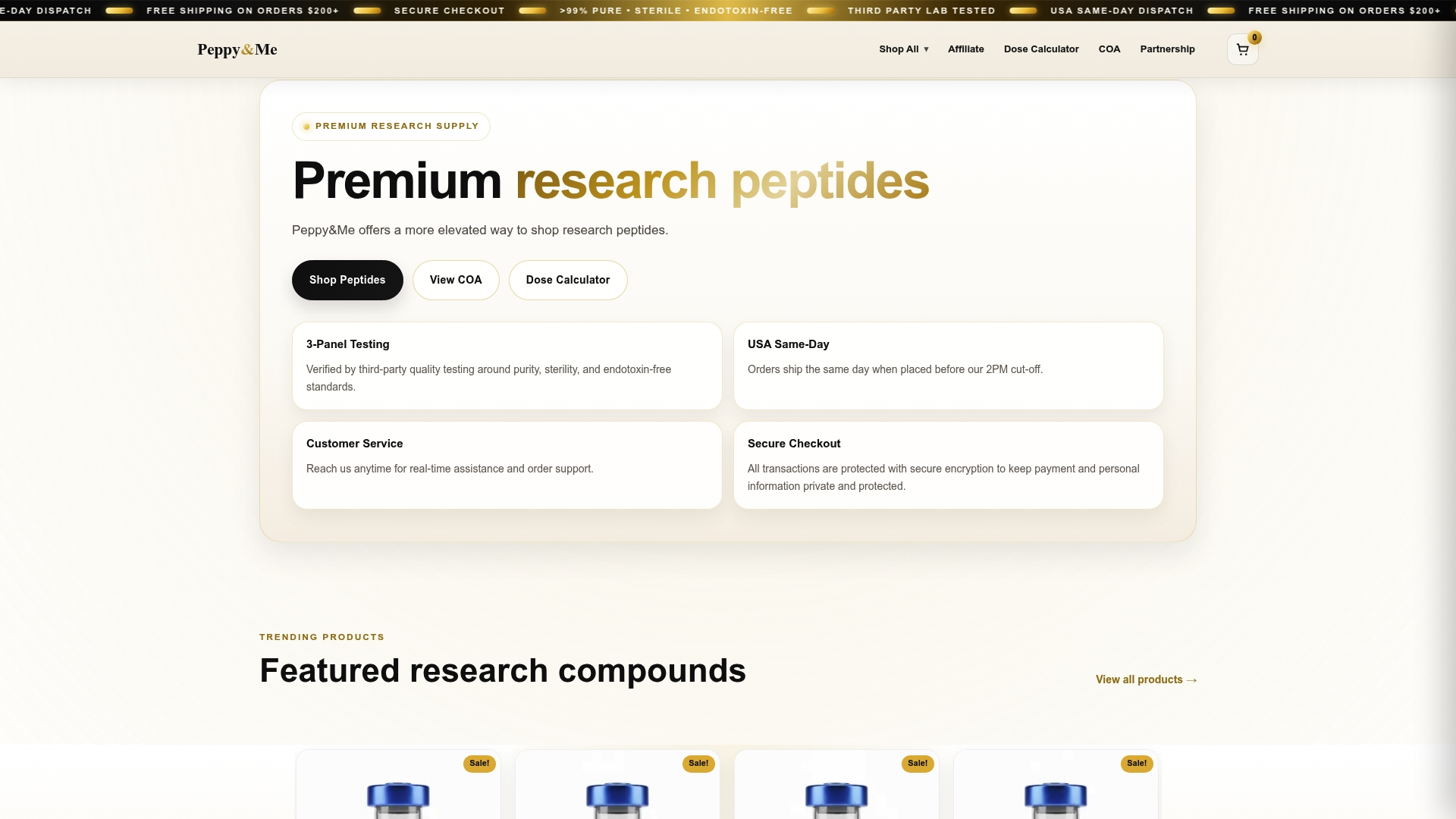
Researchers and professionals can browse research peptides through Peppy&Me’s secure, membership-based platform, where every product is third-party tested and accompanied by full batch documentation. For teams managing budget constraints without compromising quality, discount peptide deals provide access to premium compounds at competitive price points. Entrepreneurs and professionals looking to build their own brand on a reliable operational foundation can explore the peptide brand partnership program, which leverages Peppy&Me’s existing fulfillment, quality assurance, and compliance infrastructure. Same-day shipping, real-time support, and strict data privacy complete the platform’s commitment to researchers who expect more from their supply chain.
Frequently asked questions
Are membership portals the safest way to source peptides for research?
Membership portals provide more reliability and compliance support than fragmented sourcing, but researchers must still verify RUO labeling and supplier credentials on every order. As unregulated market conditions persist, portal membership alone does not guarantee safety or regulatory compliance.
How do membership-based portals help with regulatory compliance?
They streamline sourcing from regulated facilities and automate compliance documentation tasks, reducing paperwork errors and improving auditability. Centralized regulated sourcing through verified portals reduces the vendor fragmentation that makes manual compliance tracking so error-prone.
Do membership models save labs money compared to traditional ordering?
Memberships reduce administrative friction and provide predictable costs, which together produce meaningful operational savings and fewer supply interruptions. Subscription-based models in peptide supply demonstrate 15 to 25 percent higher retention and more stable cash flow compared to ad hoc procurement.
Can portals guarantee all peptides are FDA compliant?
No portal can guarantee universal FDA compliance, and researchers must independently ensure that every compound carries appropriate RUO labeling and avoids gray market status. Unregulated peptide markets mean that even well-structured portals may list compounds that require additional researcher-level scrutiny before use.