Why Secure Research Portals Matter in Biotech and Healthcare
TL;DR:
- Secure research portals safeguard sensitive data within governed environments, enabling compliant analysis without data export. Their layered security features, including role-based access, encryption, and audit logs, greatly reduce breach risks in biotech and healthcare research. However, successful implementation depends on continuous governance, integration, and organizational practices that extend beyond technology.
Healthcare and biotech organizations face a data security crisis that shows no signs of slowing. In 2024, 725 HIPAA breaches exposed sensitive information belonging to 275 million individuals, with each breach costing organizations an average of $9.77 million to remediate. For research institutions handling genomic sequences, electronic health records (EHR), and proprietary compound data, the stakes are even higher. Secure research portals have emerged as a foundational solution, offering controlled environments where scientists and healthcare professionals can access sensitive materials without creating exposure. This article breaks down what these portals are, how they protect data, and how to use them effectively across regulated research settings.
Table of Contents
- What are secure research portals?
- Core security features: How secure portals protect data
- Real-world risks: The impact of data breaches in biotech and healthcare
- Research compliance and data sovereignty: Why one size portal does NOT fit all
- Limitations and integration challenges: What most miss about secure portals
- Our perspective: The uncomfortable truth about secure research portals
- Secure your research: Access compliant peptide portals and expert support
- Frequently asked questions
Key Takeaways
| Point | Details |
|---|---|
| Breach risks are massive | Data breaches in healthcare can impact millions and cost millions per incident, making security non-negotiable. |
| TREs are compliance engines | Trusted research environments enforce international data regulations and safeguard sensitive research peptides and clinical data. |
| Layered security features | Defense-in-depth security with encryption and audit logging is vital for modern research portals. |
| Customization is essential | No single portal fits all; compliance and sovereignty laws require flexible, adaptive solutions. |
| Integration needs patience | Expect integration and usability challenges, but they can be manageable with the right strategies. |
What are secure research portals?
Secure research portals are specialized digital environments designed to give authorized researchers access to sensitive data while keeping that data protected within a governed infrastructure. Rather than downloading files to local machines or sharing data across unsecured networks, researchers interact with the data directly inside the portal. Nothing leaves the controlled environment unless it has been formally reviewed and approved for output.
The most widely recognized model for this approach is the Trusted Research Environment (TRE). TREs are purpose-built platforms that allow researchers to access and analyze sensitive biotech and healthcare data, including genomic sequences and EHR, without ever exporting that data outside a governed boundary. This architecture ensures compliance with major regulatory frameworks including GDPR, HIPAA, and the European Health Data Space (EHDS) by design, not as an afterthought.
Understanding why member portals matter in regulated research is increasingly relevant as institutions expand their data-sharing partnerships across institutions and borders.
Key characteristics of a secure research portal include:
- Centralized data governance with role-based access permissions
- Encrypted data storage and transmission using current cryptographic standards
- Audit logging that records every interaction with sensitive datasets
- Isolated analysis environments that prevent unauthorized data export
- Formal output review processes before any results leave the environment
- Compliance controls aligned to applicable regulatory frameworks
“The value of a TRE is not just what it locks out, but what it enables. Researchers can work with data they would never otherwise be permitted to access, because the environment itself provides the trust guarantees that regulators and data custodians require.”
When applied to biotech research, this model extends beyond genomic and clinical data. Portals designed for compliance in peptide studies must also handle proprietary compound information, batch records, and experimental protocols, all of which carry intellectual property and regulatory significance that demands the same rigor applied to patient data.
The scope of data handled by secure research portals is broad. Genomic sequences, patient-linked EHR data, clinical trial results, and research peptide documentation each carry distinct sensitivity profiles and regulatory obligations. A well-designed portal accounts for all of these data types within a single governed architecture, rather than requiring separate systems for each category.

Core security features: How secure portals protect data
Effective secure research portals do not rely on a single protective mechanism. They operate through defense-in-depth security, a layered approach that stacks multiple independent controls so that a failure in one layer does not expose the entire system. TREs specifically use access controls, encryption, and audit logs alongside the “bring analysis to the data” model to minimize breach risk at every possible point of exposure.
How the core security stack functions in practice:
Identity and access management. Every user is authenticated before entering the portal, typically using multi-factor authentication (MFA). Role-based access controls then determine which datasets a user can view, analyze, or request for output. A junior researcher may see anonymized summary datasets, while a principal investigator with specific approvals can access linked individual-level records.
Data encryption at rest and in transit. All stored data is encrypted using industry-standard algorithms, and any data transmitted between the user’s session and the server is protected through encrypted channels. This prevents interception even if a network is compromised.
Isolated virtual environments. Researchers work inside sandboxed virtual machines or cloud environments. These environments prevent data from being copied, downloaded, or transmitted externally without passing through a formal output review gate.
Comprehensive audit logging. Every query run, file accessed, and action taken within the portal is logged with a timestamp and user identifier. These logs serve both as an internal governance tool and as evidence of compliance for regulatory audits.
Controlled output review. Any results, reports, or derived datasets that a researcher wants to extract from the environment must pass through a disclosure review process. Statistical outputs are checked for re-identification risk before release.
Ongoing monitoring and anomaly detection. Active monitoring systems flag unusual access patterns, such as a user attempting to access data outside their approved scope, for immediate review.
The “bring analysis to the data” model deserves particular attention because it represents a fundamental shift in how research data is used. Instead of sending sensitive data to researchers, the portal sends the researcher’s analytical tools and queries to the data. The underlying records never move. This approach eliminates an entire category of breach risk that exists when data is transferred across systems or stored on individual devices.
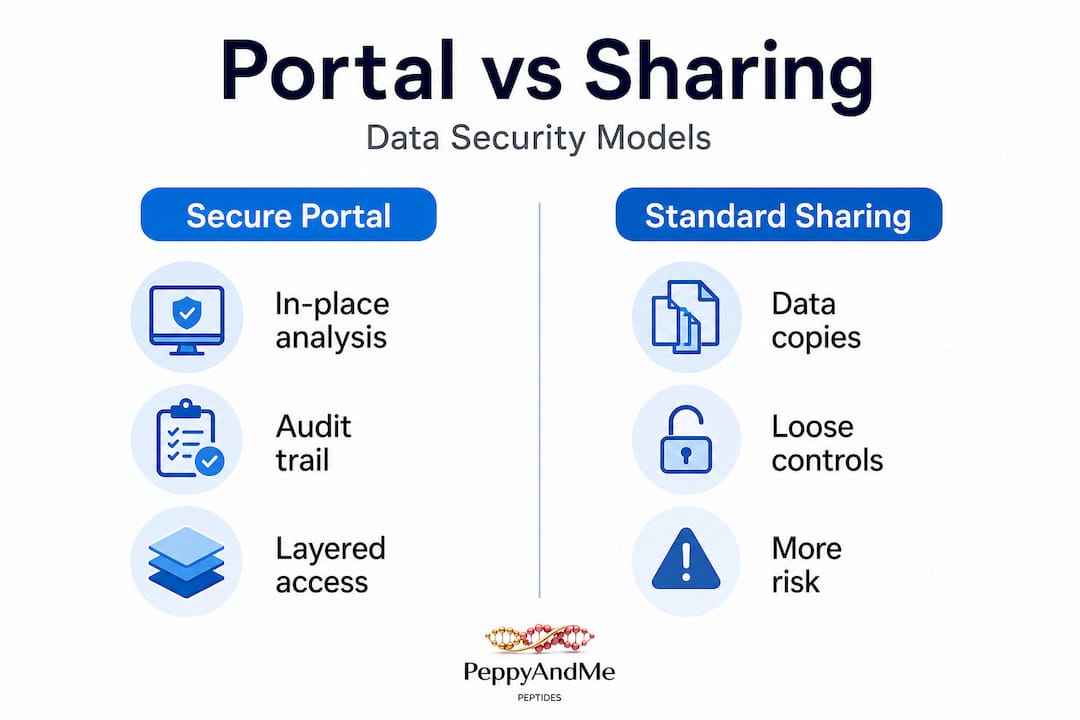
| Feature | Secure Research Portal | Standard Data Sharing |
|---|---|---|
| Data location | Stays within governed environment | Copied to researcher’s system |
| Access control | Role-based, multi-factor | Often credential-only |
| Audit logging | Full, immutable logs | Minimal or absent |
| Output review | Formal disclosure check | No structured review |
| Compliance alignment | Built-in (GDPR, HIPAA, EHDS) | Manual and inconsistent |
| Re-identification risk | Substantially reduced | High for individual-level data |
Setting up the right access controls for your portal requires careful planning, particularly when working with biologically active research compounds. For detailed guidance on structuring those controls, the secure access setup guide provides practical frameworks tailored to peptide research environments.
Pro Tip: When configuring layered access protocols for research peptide data, separate permissions into at least three tiers: read-only access for observers, analysis access for active researchers, and administrative access for data custodians. Never assign administrative permissions by default, even temporarily, as this creates audit gaps that are difficult to retroactively justify to regulators.
Real-world risks: The impact of data breaches in biotech and healthcare
Statistics about data breaches can feel abstract until you consider what each one actually means for the affected institutions and individuals. In healthcare and biotech specifically, a breach does not only compromise personal information. It can expose proprietary genomic sequences, derail years of experimental work, and trigger regulatory consequences that outlast the incident itself.
The scale of recent breaches makes the risk concrete. Healthcare saw 725 HIPAA breaches in 2024, affecting 275 million individuals at an average remediation cost of $9.77 million per event. The following year showed no relief. In Q1 2025 alone, 658 data breaches impacted 32 million people, confirming that the threat environment is both persistent and accelerating.
Key statistic: 725 HIPAA breaches in 2024 affected 275 million individuals. At $9.77 million average cost per breach, the total financial exposure across the sector exceeded $7 billion in a single year.
For biotech organizations, the data lost in a breach typically falls into several high-sensitivity categories:
- Protected health information (PHI) and personally identifiable information (PII): Patient records linked to clinical trials or observational studies, which carry both regulatory and ethical obligations.
- Genomic data: Highly sensitive by nature, genomic sequences cannot be changed like a password. Once exposed, the privacy risk to an individual and their biological relatives is permanent.
- Proprietary research data: Experimental protocols, compound formulations, peptide sequences, and trial results that represent significant intellectual and financial investment.
- Regulatory submission data: Pre-approval drug and compound data shared with regulatory bodies, which may have contractual confidentiality requirements.
The consequences of a breach extend well beyond the immediate remediation cost. Organizations consistently face:
- Regulatory fines under GDPR, HIPAA, or applicable national frameworks, often running into millions of dollars
- Mandatory notification to affected individuals and regulatory bodies, which can trigger reputational damage
- Study suspension or data invalidation if breach investigators determine that data integrity cannot be confirmed
- Loss of institutional access agreements, where data custodians withdraw access following a security failure
- Litigation from affected individuals or partner organizations
Understanding these risks in the context of day-to-day research operations, including the handling of research peptides and associated documentation, reinforces why lab safety best practices must extend to digital infrastructure, not just physical protocols.
Research compliance and data sovereignty: Why one size portal does NOT fit all
Regulatory compliance in biotech and healthcare research is not a single standard. It is a matrix of overlapping, sometimes conflicting requirements that vary by jurisdiction, data type, funding source, and research purpose. A portal that satisfies HIPAA requirements in the United States may not meet GDPR obligations in the European Union, and neither may align with the emerging standards of the European Health Data Space (EHDS).
Data sovereignty laws add another layer of complexity. Many jurisdictions require that data about their residents be stored and processed within their borders, regardless of where the analyzing institution is located. For multinational research collaborations, this creates a practical barrier: how do you allow researchers in three countries to work with datasets they are legally prohibited from transferring?
TREs answer this through federated access. Data sovereignty laws prevent data movement, but TREs allow federated access across institutions without requiring any physical transfer of the underlying data. Each institution maintains its own TRE, and analysis tools are run locally within each environment. Results, rather than raw data, are shared and aggregated. The data never crosses a border.
Approval timelines also change significantly when a TRE is in place. Traditional data access request processes can take six to twelve months. TREs, by centralizing governance and pre-validating security standards, can reduce that timeline to weeks. This efficiency gain has direct research value, particularly for time-sensitive studies.
The Five Safes framework governs how TREs balance access with protection. Each “safe” addresses a different dimension of risk:
- Safe people: Researchers must be trained, credentialed, and vetted before receiving access.
- Safe projects: Research purposes must be clearly defined, ethically approved, and proportionate to the data requested.
- Safe settings: The technical environment must meet defined security standards before access is granted.
- Safe data: Data must be de-identified or pseudonymized to the extent the research purpose allows.
- Safe outputs: Results leaving the environment must be reviewed for re-identification risk before release.
This framework applies directly to membership portals for peptide access, where verifying the credentials and research purposes of each user before granting access to compound records and protocols is both a compliance requirement and an ethical obligation.
Pro Tip: Before deploying a research portal, map every dataset you plan to handle against the regulatory frameworks that govern it. Build a compliance matrix that identifies jurisdiction, applicable regulation, data classification, and required controls for each dataset type. This mapping should be reviewed whenever your research expands to a new geography or data category.
Limitations and integration challenges: What most miss about secure portals
Secure research portals solve many problems, but they introduce their own set of operational challenges that institutions need to anticipate rather than discover after deployment. The most significant risk is not a security failure. It is the fragmentation of tools and workflows that can occur when a TRE or secure portal becomes an isolated environment that does not integrate well with the broader research infrastructure.
TREs can fragment tools when over-relied upon, and some biotech firms encounter genuine integration challenges when connecting secure portals to legacy laboratory information management systems (LIMS), electronic lab notebooks (ELNs), and data repositories built on older architectures. These systems were not designed with TRE-compatible APIs or data standards in mind, and retrofitting them can require significant technical investment.
Common integration and operational challenges include:
- Legacy system incompatibility: Older LIMS and ELN platforms may use proprietary data formats that do not map cleanly to TRE-compatible schemas.
- Tool availability gaps: Researchers accustomed to specific analysis software may find that only a subset of their tools are available within the secure environment.
- Workflow disruption: Moving from unrestricted local analysis to a governed portal environment changes how researchers work, often requiring new habits and training investments.
- Output review delays: The formal output review process, while necessary, can slow the pace of research iteration if not resourced appropriately.
- User adoption resistance: Researchers who prioritize speed may view portal controls as obstacles rather than protections, creating pressure to find workarounds.
Organizations that successfully navigate these challenges share several approaches. They select portals with demonstrated API flexibility and active vendor support for integrations. They invest in user training not as a one-time onboarding event but as an ongoing practice that evolves alongside the platform. They also communicate clearly to researchers why each security control exists, converting compliance requirements into understood obligations rather than unexplained restrictions.
“The organizations that get the most from secure research portals are not the ones with the most sophisticated technical setups. They are the ones where researchers genuinely understand why the controls are there and feel supported in using them correctly.”
For those evaluating platforms for specialized compound research, understanding how to safely source and manage research peptides through compliant channels is directly relevant to the portal integration discussion. The security of the portal only extends as far as the integrity of the supply chain and data it governs.
Our perspective: The uncomfortable truth about secure research portals
There is a tempting narrative in the biotech and healthcare sector that adopting a secure research portal resolves the data protection challenge. Deploy the TRE, check the compliance box, move on. That assumption is one of the most persistent and consequential mistakes organizations make in this space.
The reality is that technology provides the architecture for security, not security itself. The most technically sophisticated portal in the world can be undermined by a researcher who shares their credentials, a governance team that never reviews audit logs, or an institution that has not updated its access permission lists in eighteen months. These failures are human and organizational, not technical. Yet most institutions spend the majority of their security budgets on tools and almost none of it on the culture and governance practices that determine whether those tools actually work.
Effective portal security requires treating access governance as a continuous practice. Permissions need to be reviewed and adjusted as research projects evolve, personnel change, and regulatory requirements are updated. Audit logs need to be analyzed, not just stored. Training needs to be reinforced regularly, not delivered once at onboarding and forgotten. These practices are not glamorous, but they are what separates institutions that actually protect their data from those that simply appear to.
There is also an uncomfortable tension between security and research velocity. As research programs move faster and datasets grow larger, portals that were adequately configured twelve months ago may become operational bottlenecks today. Institutions need to build in regular evaluation cycles, asking whether the current portal architecture still serves the research mission efficiently. A portal that has become too slow, too restrictive, or too isolated from other tools creates pressure for workarounds that can undermine the security it was designed to provide.
The strongest organizations in this space treat secure portals as living systems that require investment, attention, and honest evaluation over time. Understanding why secure member portals matter in a sustained, practical sense, rather than as a one-time implementation decision, is the perspective shift that actually translates into durable data protection.
Secure your research: Access compliant peptide portals and expert support
Peppy&Me is built precisely for researchers and professionals who understand that secure, compliant access is not optional. For those ready to put the principles outlined in this article into practice, the platform offers purpose-built tools and a membership-based portal environment designed with biotech and healthcare professionals in mind.
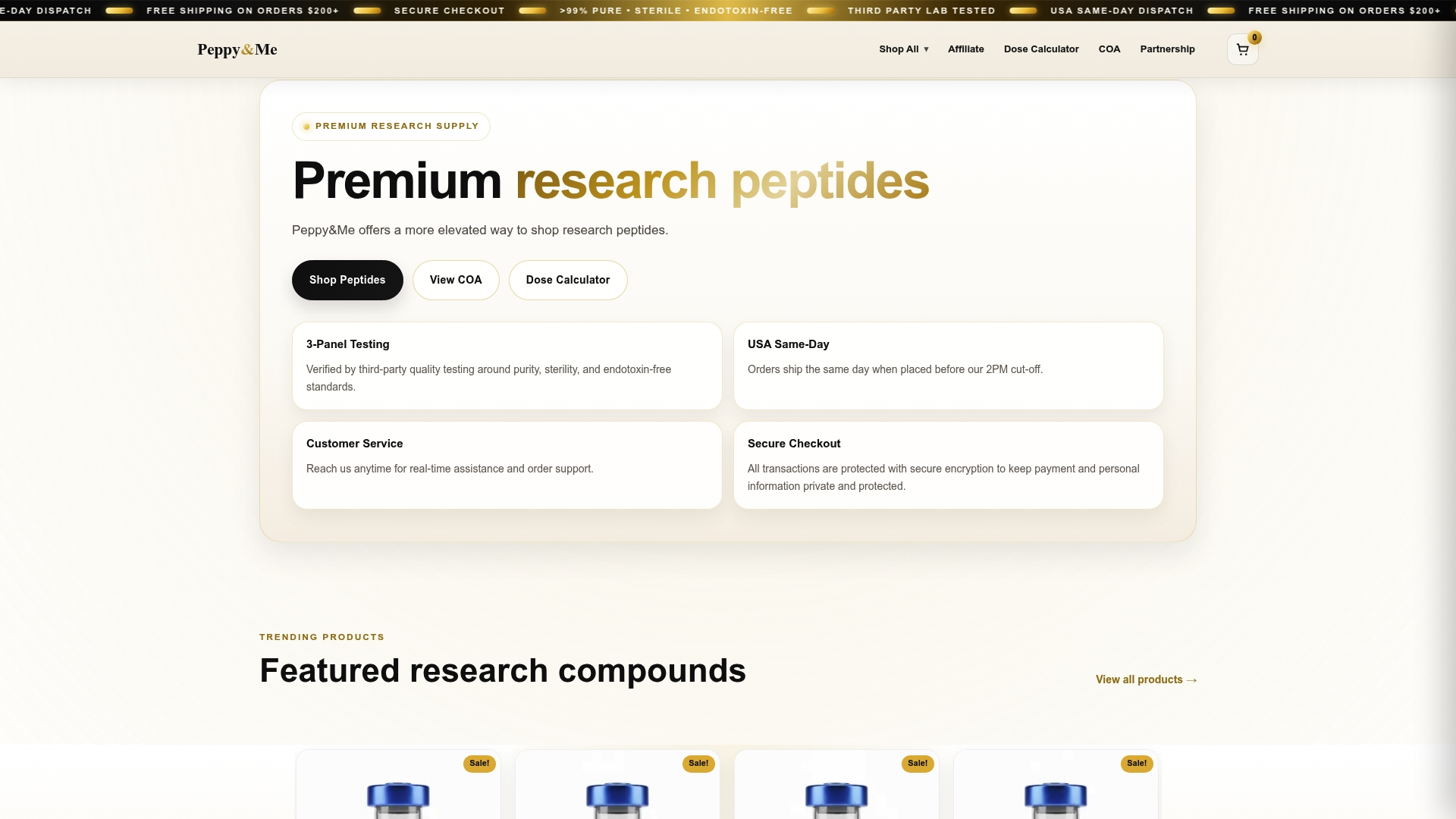
Explore research compliance portals designed for peptide studies, or get started with secure membership portals that provide compliant access to verified, third-party tested research compounds with full traceability from manufacturer to warehouse. For precise dosing in your research protocols, the peptide dose calculator provides accurate measurement guidance within a secure, professional environment. Peppy&Me combines platform security with educational support to give you the infrastructure your research deserves.
Frequently asked questions
What makes a research portal “secure”?
A secure portal uses strong access controls, encryption, audit trails, and keeps data within a governed environment to protect sensitive information. TREs specifically layer access controls, encryption, audit logs, and a “bring analysis to data” model to prevent breaches at multiple points simultaneously.
How do secure research portals help with compliance?
Secure portals help institutions meet regulatory requirements by preventing unauthorized data movement and logging all access events for audit purposes. TREs enable researchers to work with genomic and EHR data while remaining compliant with GDPR, HIPAA, and EHDS, because the data never leaves the governed environment.
Can secure portals prevent every type of data breach?
No solution eliminates all risk, but secure portals substantially reduce exposure by centralizing and controlling every point of data access. The ongoing breach frequency, with 658 incidents in Q1 2025 alone, confirms that organizations without governed environments remain disproportionately vulnerable.
What are the integration challenges with secure research portals?
Integrating with legacy laboratory systems and maintaining a coherent toolset across the research environment are the most common practical obstacles organizations face. TREs can fragment workflows when biotech firms have existing infrastructure that does not align with TRE-compatible data formats or APIs, requiring deliberate technical and organizational investment to bridge the gap.